Students planning several lecture-day lunches
If you use tuna in sandwiches, wraps or salads, drained weight and the number of tins help you judge how much tuna is available across your planned lunches.


For a regular lecture lunch, compare drained weight and choose a tin size you can finish or store according to its label. Spring-water, brine and oil-packed tuna have different ingredients and nutrition profiles; a no-drain format can make lunch away from a kitchen simpler, while a multipack is useful when you have several lunches planned.
If you use tuna in sandwiches, wraps or salads, drained weight and the number of tins help you judge how much tuna is available across your planned lunches.
A no-drain tin avoids a draining step when there is no convenient sink. A chunks-and-flakes format is another option when making a sandwich filling.
Spring water, brine and sunflower oil give you different ingredient and nutrition labels to consider. Choose the exact tin for the lunch you intend to make rather than treating every tuna product alike.
Start with the usable amount of tuna and your lunch plans, then check the packing medium and what happens to any leftovers.
| Priority | What to check | Your needs |
|---|---|---|
| Usable amount | Check drained weight as well as net tin weight. For multipacks, check the size and number of individual tins. | One tin needs to cover my lunch, or I can use separate tins across several lecture days. |
| Packing medium | Read the ingredients and nutrition panel for the exact variant. Princes lists 99 kcal for its spring-water chunks and 180 kcal and 9.5g fat for its sunflower-oil chunks per 100g; check each label’s measurement basis when comparing products. | If I am adding my own dressing, spring water may suit the recipe. If I want tuna packed in oil, I will account for that ingredient and its labelled nutrition values. |
| Preparation and texture | Check whether the tin is labelled no-drain and whether it contains chunks, steaks or a chunks-and-flakes mix. Do not assume a spring-water multipack is no-drain. | With no convenient place to drain a tin between lectures, I would prefer a labelled no-drain format; for a sandwich, texture also matters. |
| Leftovers and labels | Read the fish allergen declaration and the exact pack’s instructions after opening. The Tesco brine tin and M&S spring-water chunks instruct you to transfer leftovers to a suitable container, refrigerate them and use them within two days. | I can finish a tin at lunch, or I have a way to refrigerate the remainder as its label directs. |
Net weight includes the packing liquid. Tesco lists 102g drained weight for its 145g Tuna Chunks in Brine tin, so those figures answer different questions.
Use drained weight when deciding how much tuna a tin provides for lunch.
Princes lists 99 kcal per 100g for its spring-water chunks and 180 kcal and 9.5g fat per 100g for its sunflower-oil chunks. The packing medium changes the labelled nutrition profile.
Choose the medium for your recipe, then compare the exact products’ nutrition panels on the same basis.
An opened tin is not a cupboard item. Tesco and M&S instruct shoppers to transfer leftovers, refrigerate them and consume them within two days for the cited products.
Choose a tin you expect to finish at lunch unless you can follow its leftover-storage instructions.
The NHS states that fresh and canned tuna do not count as oily fish.
If you are using the NHS fish guidance to plan meals, keep that distinction in mind rather than counting a tuna lunch as the oily-fish portion.
These ranges illustrate different formats and label details; a brand name alone does not settle which tin fits a particular lunch.
Tesco lists own-label tuna in individual tins, larger tins and multipacks, including brine and spring-water chunks.
Princes offers chunks in different packing media and pack sizes, alongside sandwich tuna for a different filling texture.
John West’s No Drain Tuna Chunks in Sunflower Oil 3 x 100g offers a format without a liquid-draining step.
M&S describes its Tuna Chunks in Spring Water 160g as pole-and-line caught under its Forever Fish policy.
These options cover a no-drain sunflower-oil multipack, spring-water chunks in single tins or a multipack, and brine and sunflower-oil chunks for lunches planned across several days.
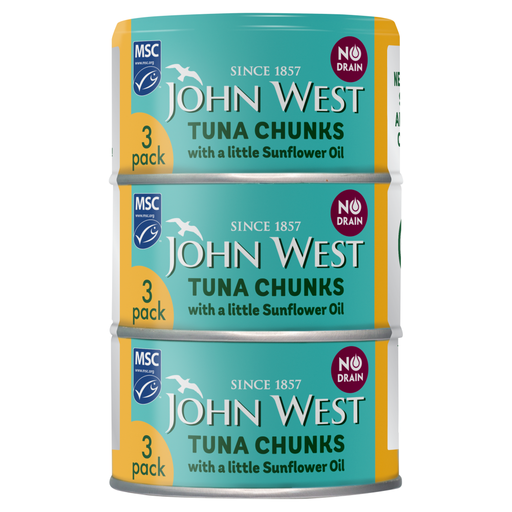 No image available
The no-drain format removes a preparation step when eating away from a kitchen. These are three 100g tins packed in sunflower oil; check the pack’s nutrition basis if comparing it with drained-weight figures.
 No image available
A single tin offers spring-water chunks for one planned sandwich or salad lunch. Check its drained weight to judge the usable amount.
 No image available
Four separate 125g tins suit lunches planned across different days. Check the individual tin’s drained weight and whether its label calls for draining; do not assume this spring-water pack is no-drain.
 No image available
This four-tin brine pack is an option when you are planning more than one tuna lunch. Check each tin’s drained weight and salt label when comparing it with other packing media.
 No image available
Choose this four-tin pack when sunflower-oil chunks suit the lunches you have planned. Check the exact pack’s nutrition measurement basis before comparing it with drained-weight figures for water-packed tuna.
Drained weight tells you how much tuna remains after the packing liquid is removed. Tesco, for example, lists 102g drained weight for its 145g Tuna Chunks in Brine tin; use the drained figure when planning how much tuna a lunch will contain.
No single packing medium fits every recipe. Princes’ spring-water chunks list tuna and water as ingredients, while its sunflower-oil chunks contain oil and have different labelled energy and fat values. Choose the ingredients and texture you want, and compare nutrition panels on the same measurement basis.
Follow the instructions on the exact tin. Tesco’s cited brine tin and the cited M&S spring-water chunks direct you to transfer unused tuna to a suitable container, refrigerate it and consume it within two days; an opened tin is not a cupboard item.
No. The NHS states that fresh and canned tuna do not count as oily fish, so a tinned-tuna lunch does not fulfil the oily-fish part of its fish guidance.
Tuna contains fish, so anyone with a fish allergy needs to check the allergen label and avoid a product containing it. For people who are pregnant or trying for a baby, the Food Standards Agency cites NHS guidance of no more than four cans of tuna a week or two tuna steaks a week; that limit applies to those groups, not every shopper.