Students eating between lectures
If lunch has to fit into a short break, no-drain chunks or an already-drained steak can go straight into a sandwich, wrap or salad without finding somewhere to pour away liquid.


For a short break between lectures, a no-drain or already-drained tin makes lunch easier to assemble when you have nowhere to dispose of liquid. If the fat content matters more to you, compare the nutrition labels of spring-water and oil-packed options per 100g rather than relying on a premium label. Check the exact pack for its opening method, storage instructions and any sourcing claim.
If lunch has to fit into a short break, no-drain chunks or an already-drained steak can go straight into a sandwich, wrap or salad without finding somewhere to pour away liquid.
Spring-water tuna offers a way to compare protein, fat and salt per 100g across packs. Check whether the figures refer to drained contents, and plan what to do with any leftovers.
Look for information on the particular pack, such as an MSC-certified fishery or a stated catch method. A brand-wide statement does not establish that every tin carries the same claim.
Start with how you will open and use the tin between lectures, then compare the label details that matter to your lunch.
| Priority | What to check | Your needs |
|---|---|---|
| Quick preparation | Check whether the exact pack says no-drain or already drained, and whether you need an opener. A spring-water label alone does not establish either point. | I have little time between lectures and nowhere convenient to dispose of packing liquid. |
| Nutrition | Compare protein, fat and salt per 100g on the same basis, including whether values are for drained tuna. Check the tin size against the portion you intend to use. | For this lunch, I care about what is in my portion, not just a claim on the front of the pack. |
| Sourcing | Look for an MSC mark, named fishery, catch-method statement or traceability details on the exact product. Do not transfer a claim from another tin in the range. | If sourcing influences my choice, I want a claim I can check on the pack I am buying. |
| Storage and allergens | Read the fish allergen declaration and the instructions for opened contents. If you will not finish a tin, check its refrigeration and use-by directions before packing lunch. | A single tin may suit my lunch better if I cannot refrigerate opened leftovers promptly. |
The packing medium changes what you are comparing. The Joybuy listing for John West No Drain chunks in sunflower oil gives 6.9g fat per 100g; the cited M&S spring-water steak lists 0.6g per 100g. These are different products, not a rule for every oil or spring-water tin.
Choose the format that works for lunch, then compare nutrition per 100g on the exact labels.
Sainsbury's describes its cited spring-water steak as coming from an MSC-certified fishery and being pole-and-line caught. A general sourcing statement from another brand does not establish those details for each of its products.
Check the certification mark or catch-method wording on the particular pack if it affects your decision.
Storage directions differ between the cited products: the Sainsbury's example says to use refrigerated leftovers within one day, while several other cited packs say within two days.
For an individual lunch, check the tin size and follow its own instructions for transferring and refrigerating anything left over.
An opened portion also needs a suitable container and access to refrigeration if it is being kept for another meal.
The NHS advises people who are pregnant or trying for a baby to have no more than four cans of tuna or two tuna steaks a week because tuna contains more mercury than other fish.
If that guidance applies to you, account for tuna eaten in other meals as well as lecture lunches.
These examples show different pack formats and label details; a brand reference does not mean every product in its range has the same features.
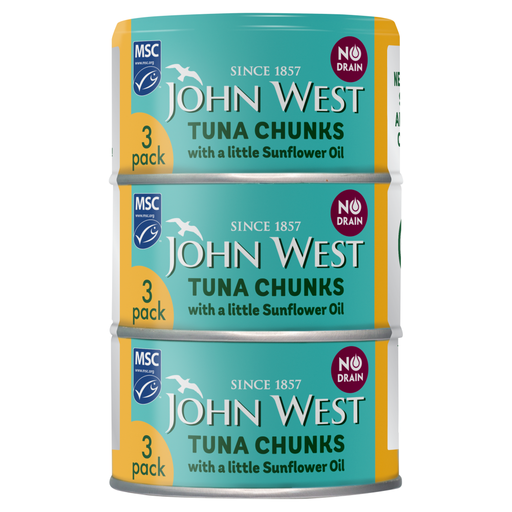
Its No Drain chunks offer a format for adding tuna to lunch without pouring away packing liquid.
Its cited steak with a little spring water is described on the Sainsbury's listing as already drained and ready to use.
Its cited 3 x 120g spring-water tuna steak carries product-specific sourcing information.
Its spring-water steak is another format to consider when comparing label details and portion sizes.
Its cited 3 x 110g tuna steak is packed with spring water.
Its cited 3 x 110g drained spring-water steak is a format to compare with tins that need draining.
These tins cover no-drain chunks and spring-water chunks for a lecture lunch. Compare each exact pack's opening method and portion size before choosing.
 No image available
The no-drain, easy-open format suits a lunch assembled during a short break. The Joybuy listing gives 27g protein and 6.9g fat per 100g and describes the tuna as coming from an MSC-certified fishery; check the mark on the exact pack if that claim determines your choice.
 No image available
This combines a no-drain format with springwater in three 100g tins. If the opening method or a particular sourcing claim matters, check the details on the exact pack.
 No image available
The six-tin pack gives you separate tins for future lunches. Check how this exact pack opens and whether its contents need draining if you will prepare lunch away from a kitchen.
 No image available
Four 125g tins offer separate portions for several lunches. If avoiding liquid is essential during a short break, confirm whether this particular variant needs draining.
 No image available
The single 145g tin avoids opening a larger pack for one lunch. Check whether it needs draining, and follow its label directions if you keep any opened contents.
Choose by features you will use: whether it needs draining, how it opens, the tin size, its packing medium and its nutrition per 100g. If sourcing matters to you, check the claim on that exact pack rather than relying on a premium description.
Start with the label of each product rather than assuming its packing medium settles the choice. The cited John West no-drain sunflower-oil chunks list 6.9g fat per 100g, while the cited M&S spring-water steak lists 0.6g per 100g; compare salt and serving size too. Check a brine-packed tin's own figures before comparing it with either example.
Follow the storage instructions on your exact pack and refrigerate opened contents promptly. The cited Sainsbury's tuna says to transfer leftovers to a non-metallic container and use them within one day; several other cited products specify use within two days. Do not leave opened tuna at room temperature overnight.
The NHS advises people who are pregnant or trying for a baby to have no more than four cans of tuna or two tuna steaks a week because tuna contains more mercury than other fish. Count tuna from other meals as well as lunches.
Yes. Tuna is fish, and the cited UK product labels declare fish as an allergen. Check the current label of the tin you intend to buy.