Fat-label comparers
If an ordinary low-fat diet is your aim, you want to check total fat per 100g rather than rely on the packing liquid or a general claim on the front of the tin. A prescribed minimal-fat diet needs its own, more specific check.


For an everyday low-fat choice, compare total fat per 100g on the tuna label, then consider salt, drained weight and preparation. NHS food-label guidance defines low fat for solid foods as 3g of fat or less per 100g. If you follow a clinician-prescribed minimal-fat diet, use the guidance given for that diet rather than treating the general label threshold as sufficient.
If an ordinary low-fat diet is your aim, you want to check total fat per 100g rather than rely on the packing liquid or a general claim on the front of the tin. A prescribed minimal-fat diet needs its own, more specific check.
If you buy tuna for sandwiches, salads or pasta, the stated tin weight does not tell you how much tuna remains after draining. Compare drained weights when deciding which pack format works for your meals.
If you also watch salt or want fewer preparation steps, compare the salt figures on the same per-100g basis and check whether a tin needs draining. Those details can differ even among spring-water products.
Start with the nutrition panel for the diet you follow. Then decide whether salt, the amount of drained tuna or a particular sourcing or preparation feature matters most to you.
| Concern | What to check | Who this matters to |
|---|---|---|
| Total fat | Read total fat per 100g, comparing drained values where the labels provide them. A prescribed diet may require a different limit. | If I need tuna to fit an ordinary low-fat diet, the individual fat figure matters more than the type of packing liquid. About 29% of consumers would put that label check first. |
| Salt | Compare salt per 100g on the same drained basis where available; use traffic-light labelling as a prompt to read the nutrition panel. | For frequent tuna lunches, I want to see how much salt comes with a tin that otherwise meets my fat criterion. Salt would be the primary concern for about 24% of consumers. |
| Drained amount | Check the drained weight, tin size and number of tins in the pack. | When stocking a cupboard for several meals, I need to know how much tuna the pack contains after liquid is removed. Roughly 29% of consumers would prioritise that comparison. |
| Sourcing and format | Check sourcing statements on the particular pack and whether its opening or no-drain format suits you. | If a stated sourcing method or a simpler preparation format shapes my choice, I still need the individual tin to meet my fat requirements. Those features would come first for about 18% of consumers. |
A standard tin can contain packing liquid, so two tins with similar stated weights need not yield the same amount after draining.
Compare drained weights and pack counts. For a no-drain product, check how its stated contents are described before comparing it with standard tins.
Retailer nutrition listings show differences between spring-water products: Sainsbury's lists 0.12g salt per 100g drained for its 145g own-brand tin, while Tesco lists 0.90g for its checked 145g tin.
Read salt alongside total fat, using the same per-100g basis where possible.
The NHS low-fat labelling threshold for solid foods is not a clearance for a clinician-prescribed minimal-fat diet. Oxford University Hospitals NHS Foundation Trust gives different criteria in its guidance for people advised to restrict fat more strictly.
Use the target and product checks supplied by your clinical team if you follow such a diet.
A product page does not establish that a tin is in stock for your chosen shop or delivery location.
Check availability for the exact pack before planning a meal around it.
These examples show why the exact product label matters more than a brand name alone. Nutrition figures apply to the stated products and serving bases, not to every tuna product from each brand.
Tesco's own-brand 145g tuna chunks in spring water provide a standard-tin example for comparing drained nutrition.
Its checked 145g spring-water tin is relevant when both fat and salt figures matter.
The checked Princes 145g spring-water tin is a branded standard-tin option, distinct from the brine multipack shown below.
John West has both a standard spring-water multipack and a No Drain format relevant to preparation choices.
M&S spring-water tuna is an option for shoppers interested in the sourcing method stated for that product.
These tins cover spring-water standard and No Drain formats alongside a brine multipack. Use each product's label and drained contents to decide whether its format suits your low-fat shopping needs.
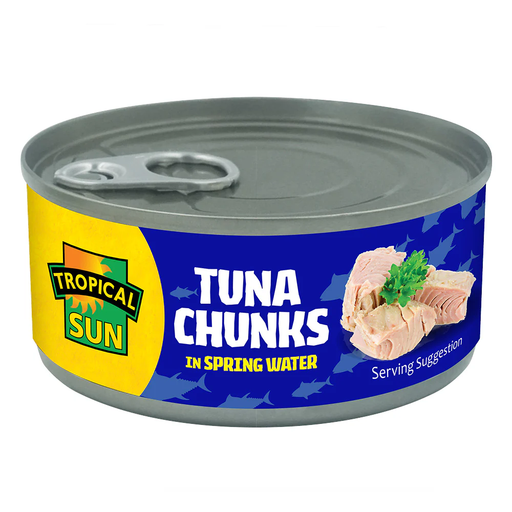 No image available
A single spring-water tin for meals where you plan to drain the tuna before use. Check its current per-100g nutrition panel and drained weight for your comparison.
 No image available
The No Drain format suits a lunch where avoiding a draining step matters. Tesco Groceries lists 0.9g fat and 0.80g salt per 100g for this 3 × 100g product; check the current pack before relying on those figures.
 No image available
Four tins suit shoppers who want several spring-water cans in one pack. Sainsbury's lists 0.7g fat and 0.8g salt per 100g drained for this multipack; check its drained weight and the pack's preparation directions when comparing formats.
 No image available
This four-tin brine pack offers a different packing liquid from the spring-water selections. Check its own fat and salt figures per 100g drained; the figures for Princes spring-water tuna do not describe this variant.
 No image available
This six-tin spring-water pack is a format to consider when stocking several meals. Compare its current per-100g fat and salt label and its drained contents with smaller packs; the pack name alone does not establish either figure.
NHS food-label guidance uses 3g total fat or less per 100g as the low-fat threshold for solid foods. Read the individual tin's nutrition panel, comparing products on the same drained basis where that information is given.
No: choose by the individual label, not the packing liquid alone. The checked spring-water examples differ in both fat and salt, and a prescribed minimal-fat diet may call for a stricter criterion than the general low-fat threshold.
Follow the storage instructions on that product's current pack. The checked retailer examples direct shoppers to transfer leftovers and refrigerate them, but their stated use-by periods differ, so do not apply one tin's directions to another.
Yes. Oxford University Hospitals NHS Foundation Trust's guidance for people advised by a healthcare professional to eat no more than 20g fat daily uses less than 0.5g fat per 100g for its fat-free category. Follow the target and advice given by your own clinical team rather than assuming every generally low-fat tuna fits that diet.