Households making quick lunches at home
Tinned tuna can be used in sandwiches, pasta, salads or jacket potatoes. Choose a tin size that fits the number of people eating, especially if part of an opened tin might be left over.


For quick school-holiday sandwiches, jacket potatoes or pasta, choose tinned tuna by the amount you will use, its salt content per 100g and the instructions for any leftovers—not by the packing liquid alone. Sainsbury’s lists 0.12g salt per 100g drained for its spring-water four-pack, while Asda lists 0.90g for its spring-water four-pack; check the current tin before deciding which suits your household.
Tinned tuna can be used in sandwiches, pasta, salads or jacket potatoes. Choose a tin size that fits the number of people eating, especially if part of an opened tin might be left over.
Compare the same nutrition measure on each pack. Sainsbury’s lists 0.12g salt per 100g drained for its spring-water four-pack, against 0.90g for Asda’s spring-water four-pack. The words “spring water” do not tell you the salt content.
A smaller can may suit one lunch, while a multipack keeps separate tins for later meals. If less liquid handling matters, check the preparation directions for a no-drain product as well as its can size.
Start with the quantity needed for each lunch, then compare the current labels for salt, ingredients and storage instructions.
| Priority | What to check | Your needs |
|---|---|---|
| Salt and packing liquid | Compare salt per 100g on the same basis, such as drained weight. Read the ingredients as well as the description of the liquid; spring-water recipes can differ. | I want a tuna that fits our preference on salt, rather than assuming every spring-water tin is alike. |
| Can size | Check the number of cans, their net quantities and any stated drained quantity. Decide how much of one can the planned sandwich, potato or pasta lunch will use. | For one small lunch, I would rather open a suitably sized tin. For several lunches, separate cans in a multipack may be easier to plan around. |
| Preparation and leftovers | Check whether the product needs draining and follow its own post-opening directions. Sainsbury’s checked four-pack says to refrigerate unused tuna in a non-metallic container and use it within one day; Asda’s checked four-pack says best within two days. | If lunch needs assembling quickly, a no-drain format is worth considering. I also need a plan for any tuna left after opening a can. |
| Allergens and bones | Read the current ingredients and allergen statement: the checked tuna products declare fish. Check for any bone warning and inspect tuna before serving it to younger children. | A child with a fish allergy cannot have this tuna. For other children, I want to check the tin’s preparation warnings before serving it. |
| Sourcing information | Look for a catch-method or certification claim on the exact pack. A statement about one product does not establish how every tuna product from that brand is sourced. | If sourcing matters to our household, I want wording I can check on the tin I am buying. |
Spring-water tuna does not have one fixed salt content. The checked Sainsbury’s four-pack lists 0.12g salt per 100g drained, compared with 0.90g for Asda’s and 0.85g for Princes’ checked four-packs.
Compare the nutrition tables on the exact tins using the same per-100g basis, then choose the packing liquid and flavour you prefer.
Once a can is open, the remaining tuna needs to be stored and used according to that product’s label. The checked Sainsbury’s four-pack specifies one day after opening; the checked Asda four-pack specifies two days.
Match the can size to the meal. Transfer unused tuna to a covered, non-metallic container, refrigerate it and follow the time stated on the tin.
An opened portion that cannot be used within the label period may go to waste.
The NHS says fresh and canned tuna do not count as oily fish. A tuna lunch therefore does not provide the oily-fish portion described in its general fish-intake guidance.
Keep that distinction in mind when planning different fish meals for the household.
The checked tuna ingredient lists declare fish. The Morrisons Fad Free brine tin in this selection also carries a warning that some bones may remain.
Do not serve tuna to someone with a fish allergy. Read the current pack and inspect and flake the tuna before serving it to younger children.
These examples show how particular listed products differ; check the current pack rather than applying one product’s details to an entire range.
John West offers spring-water tuna alongside a No Drain format for lunches where liquid handling is a consideration.
Princes is a branded spring-water option in the checked 4 × 145g format.
Tesco lists spring-water tuna in a 145g single tin and a 4 × 145g pack, giving shoppers a choice of stocking formats.
Sainsbury’s checked 4 × 145g spring-water pack is a useful reference when comparing salt on a drained-weight basis.
Asda’s checked spring-water products include a 4 × 145g pack and smaller 3 × 80g cans.
M&S lists a 640g spring-water pack for households considering a larger cupboard pack.
These spring-water and brine tins offer different can and pack sizes for quick lunches. Compare their current labels for salt, fish-allergen information and what to do with leftovers.
 No image available
Three 100g cans give you separate tins for quick lunches, with a No Drain format for less liquid handling. Check the current label for nutrition values on the basis you want to compare, and follow its directions for any opened tuna. Contains fish.
 No image available
Four separate 125g cans can be opened across several lunch occasions. The Joybuy product listing states 25g protein and 0.80g salt per 100g drained; it says to refrigerate unused tuna and consume it within two days of opening. Contains fish.
 No image available
Six separate 145g spring-water tins give you cans to open across repeated lunches. Check the current label’s salt value if comparing it with another tuna, and plan how to store any portion left after opening. Contains fish.
 No image available
This single 145g spring-water tin is an alternative to buying a multipack for a planned lunch. Compare its current salt label on the same basis as other tins and follow the pack’s directions if you do not use the whole can. Contains fish.
 No image available
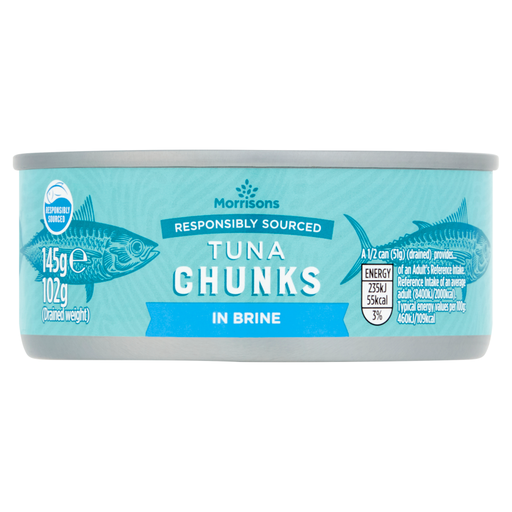
This single 145g tin is packed in brine rather than spring water. Compare its salt value using the current label; the product information warns that some bones may remain, so inspect and flake the tuna before serving it to children. Contains fish.
No. Spring water describes the packing liquid, not a fixed salt level. The checked Sainsbury’s four-pack lists 0.12g salt per 100g drained, while Asda’s checked four-pack lists 0.90g and Princes’ lists 0.85g on the same basis. Compare the exact tins’ current nutrition tables.
Follow that tin’s storage instructions and move unused tuna to a covered, non-metallic container in the fridge. The checked Sainsbury’s product says to use it within one day; the checked Asda, M&S, Princes and John West product listings specify two days. Do not assume the same period applies to every pack.
No. The NHS says fresh and canned tuna do not count as oily fish, so a tuna lunch does not fulfil the oily-fish portion in its general fish-intake guidance.
Check the current pack’s fish-allergen statement and any preparation warnings. Tuna is unsuitable for a child with a fish allergy. The Morrisons Fad Free brine tin in this selection warns that some bones may remain; inspect and flake tuna before serving it to younger children.