Quick-lunch planners
If your break is short, a cupboard tin can provide the tuna for a sandwich, salad, pasta dish or jacket potato. Think about whether you will finish the tin at lunch or need to store some for another meal.


For quick lunches that you can use in sandwiches, salads or pasta, spring-water tuna chunks are a flexible starting point if you do not want added oil. Choose oil-packed tuna when its flavour and texture suit the meal, but compare the exact labels rather than assuming every tin has the same nutrition. Whichever format you choose, check the drained weight, portion size and instructions for storing leftovers.
If your break is short, a cupboard tin can provide the tuna for a sandwich, salad, pasta dish or jacket potato. Think about whether you will finish the tin at lunch or need to store some for another meal.
Compare the protein, salt and other values on the exact product label, paying attention to whether the figures refer to drained tuna. The packing medium and recipe can differ between tins.
If catch method, traceability or certification affects your choice, look for the claim on the particular tin or listing. A claim shown for one product should not be assumed to cover everything under the same brand.
| Concern | What to check | Who this matters to |
|---|---|---|
| Quick, adaptable lunches | Consider chunks or a clearly labelled no-drain format for the meals you make; check the opening and draining instructions. | If lunch needs to fit between calls, I want tuna I can put into several familiar dishes without much preparation. About 33% of consumers put that quick, adaptable use first. |
| Nutrition and packing medium | Compare the ingredients and nutrition panels on the same basis, preferably per 100g drained. | When tuna is the main part of my lunch, I want to compare the labelled protein, salt and added oil before choosing a tin. For about 27% of consumers, those label differences are the primary concern. |
| Portions and leftovers | Look at drained weight as well as can size, and check the exact instructions for refrigerating opened tuna. | If one tin is more than I use at lunch, I need a portion I can finish or a plan for the remainder. Portion size and leftover handling come first for about 20% of consumers. |
| Catch and sourcing information | Check the individual tin or listing for its stated catch method, traceability or Marine Stewardship Council (MSC) certification. | When deciding what to keep in the cupboard, I want the sourcing information to apply to the tuna I am buying. About 20% of consumers make that their main consideration. |
Can weight includes the packing liquid. Tesco Groceries lists its spring-water multipack as 4 × 145g, with 4 × 10²g drained weight.
Check the drained weight when deciding how much tuna a tin will provide for your usual lunch.
Princes Food and Drinks lists 180kcal and 9.5g fat per 100g for its cited sunflower-oil tuna; Tesco Groceries lists 99kcal and 0.5g fat per 100g for the cited Princes spring-water tuna. These figures describe those products, not every tuna packed in oil or water.
Read the exact ingredients and nutrition panels, using comparable per-100g figures.
Opened-tin instructions differ by product. The cited retailer listings direct shoppers to transfer leftovers to a non-metallic container, refrigerate them and use them within one or two days, depending on the tin.
Follow your product’s label; if you rarely finish a tin at lunch, consider a smaller portion or plan the next meal.
A portion that cannot be used within its labelled storage period may go to waste.
Certification and catch-method statements in the cited listings refer to particular products or stated brand policies; they do not establish the details of every variant.
Check the exact tin for the claim that matters to you, whether that is MSC certification, a stated fishing method or traceability information.
The cited John West spring-water chunks come in a 4 × 125g multipack with an ECOTWIST® SmartStrip® opening format, according to Sainsbury's.
Princes lists tuna in spring water and sunflower oil, among other canned formats.
Tesco Groceries lists own-label spring-water tuna chunks in multipack form.
Sainsbury's lists an own-label 145g tin of skipjack tuna chunks in spring water.
Asda Groceries lists own-label skipjack tuna chunks in spring water, including a 4 × 145g multipack.
M&S lists spring-water tuna chunks as well as tuna-steak formats.
These tins cover spring-water chunks, sunflower-oil tuna with a no-drain format, and a brine-packed multipack. Choose between them by the packing medium and pack size that fit your lunches, then check the individual label for drained yield and opened-tin instructions.
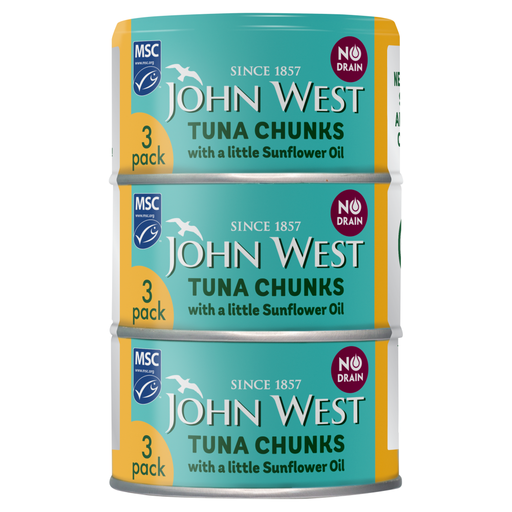 No image available
Consider this three-tin pack when avoiding a draining step matters during a short lunch break and you want tuna packed in sunflower oil. Check the exact nutrition label before comparing it with drained-tuna figures from other tins. The listing warns that some bones may remain.
 No image available
The six-tin pack suits someone keeping spring-water tuna on hand for recurring lunches. Compare its drained amount per tin with the portion you normally use, and follow the opened-tin storage instructions if any remains.
 No image available
This four-tin pack is an option for keeping spring-water chunks ready for sandwiches, salads or pasta. If skipping the draining step is important, check this tin’s instructions: the listing’s wording does not clearly establish its no-drain format.
 No image available
A single tin may fit your cupboard routine if a multipack is unnecessary. Its 145g can weight is not a drained-tuna quantity; check the label against your usual lunch portion and refrigerate any leftovers as instructed.
 No image available
This four-tin pack offers brine-packed tuna for repeat lunches if that packing medium suits your recipes. Check the drained weight and nutrition label when comparing it with spring-water or oil-packed tins. The listing notes that small fish bones may occasionally be present.
Choose spring water if you want tuna without added oil; choose oil-packed tuna if its flavour and texture suit the dish. Compare the exact labels: Princes Food and Drinks lists 180kcal and 9.5g fat per 100g for its cited sunflower-oil product, while Tesco Groceries lists 99kcal and 0.5g fat per 100g for the cited Princes spring-water product.
Follow the instructions on your tin. The cited retailer listings direct shoppers to move unused tuna into a covered, non-metallic container, refrigerate it and use it within one or two days, depending on the product.
Not necessarily: the stated can weight includes its liquid. For example, Tesco Groceries lists its 4 × 145g spring-water multipack at 4 × 10²g drained, so check the drained weight when planning portions.
No. The NHS states that fresh and canned tuna do not count as oily fish.
Do not assume so. Tesco Groceries, Sainsbury's and Asda Groceries state MSC certification for particular cited products, while Sainsbury's and Marks & Spencer describe pole-and-line catch for specified tins. Check the claim on the product you intend to buy.