People eating lunch at a desk without a kitchen
If draining a tin would be awkward, look for a no-drain or already-drained claim on the exact product. Check how the tin opens too, particularly if you will not have a tin opener.


For a desk lunch without a sink, choose a tin explicitly labelled no-drain or already drained if you want to avoid pouring off liquid. Ordinary chunks in spring water suit a lunch you can prepare where draining is practical; check the drained weight, ingredients, opening method and texture on the exact pack before buying.
If draining a tin would be awkward, look for a no-drain or already-drained claim on the exact product. Check how the tin opens too, particularly if you will not have a tin opener.
Choose the texture for the meal: a chunks-and-flakes mixture for an easily mixed filling, or steak when you want more distinct pieces. Compare pack size with drained weight if one tin needs to cover a particular lunch.
Count tuna eaten across the whole week, not just at work. The NHS says that during pregnancy you should not eat more than 4 cans or 2 tuna steaks a week because tuna can contain mercury.
Start with where you will open the tin and what you are making; then compare the exact packs on a consistent label basis.
| Priority | What to check | Your needs |
|---|---|---|
| Preparation | Check for an explicit no-drain or already-drained claim on the exact pack. Check its opening method and whether you can dispose of any liquid. | I want to put lunch together at my desk without looking for a sink or tin opener. |
| Ingredients | Read the packing medium and full ingredient list. Princes lists tuna and spring water for its spring-water chunks; other products can have different ingredients. | Spring-water tuna appeals to me, so I want to check what is in the particular tin rather than rely on the category name. |
| Texture | Distinguish chunks, chunks-and-flakes sandwich tuna and steak. Princes describes its sandwich tuna as a mixture of chunks and flakes. | For a wrap filling, I would choose a texture that mixes easily; for a salad, I might want more distinct pieces. |
| Portion and label basis | Compare the labelled drained weight as well as the tin size. When comparing protein or salt, use figures stated on the same basis, such as per 100 g drained. | I want to know how much tuna a tin provides for one lunch, without confusing the total contents with the drained portion. |
| Leftovers and dietary checks | Read the exact pack’s fish-allergen and opened-product instructions. Sainsbury’s says to seal and refrigerate leftovers from its listed Princes chunks and use them within 2 days; M&S gives a non-metallic-container instruction for its listed chunks. | If I will use only part of a tin, I need to store the rest as directed. If I am pregnant, the NHS weekly tuna limit applies across all my meals. |
Spring water describes the packing medium, not whether you will have liquid to pour away at your desk.
If you cannot drain a tin conveniently, look for no-drain or already-drained wording on the exact product.
A tin’s total weight and its drained weight are different measures, while some nutrition panels specify values per 100 g drained.
Use the labelled drained weight to judge the portion and compare nutrition figures on the same stated basis.
Princes describes its sandwich tuna as chunks mixed with flakes, whereas a tuna steak is sold as a different format.
Choose a mixture for an easily mixed filling, or consider steak if distinct pieces matter for your salad.
The NHS limit concerns tuna eaten during the week, including meals away from work.
During pregnancy, count all tuna meals towards the NHS limit of no more than 4 cans or 2 tuna steaks a week.
These examples show why the exact product line matters: pack formats, ingredients and preparation instructions can differ within a brand.
John West has conventional spring-water chunks and a separately listed No Drain range. Check which one the pack names before planning a desk lunch around it.
Princes lists both spring-water chunks and sandwich tuna, giving shoppers a choice between chunks and a chunks-and-flakes mixture.
Tesco’s tinned-tuna listing includes own-label chunks in spring water and steaks with a little spring water.
M&S lists spring-water chunks and a separately described already-drained tuna steak.
These options cover no-drain chunks, spring-water chunks and a tuna steak for different desk-lunch preparation and texture preferences. Check each pack before relying on a particular opening method or drained portion.
 No image available
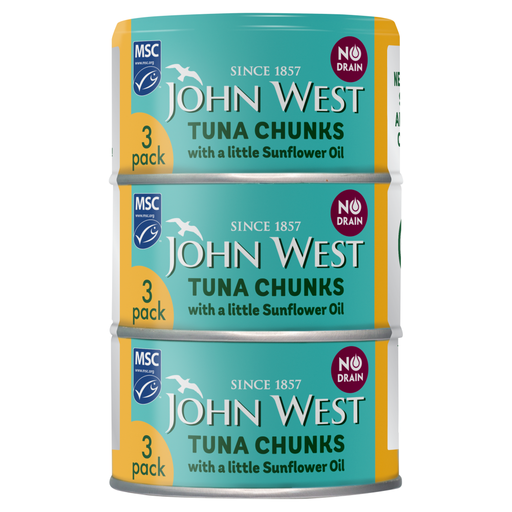
The No Drain format is worth considering when you want chunks for a desk lunch without pouring away packing liquid. The pack contains three 100g tins; check the opening method if you will not have a tin opener, and use the labelled drained weight when comparing portions.
 No image available
This is a no-drain chunk option for a lunch where pouring off liquid would be inconvenient. It contains three 100g tins and is packed in sunflower oil rather than spring water; check the pack’s portion and nutrition basis when comparing it with water-packed tuna.
 No image available
Choose the steak format if you want more distinct pieces for a salad rather than a chunks-and-flakes filling. This tuna is packed in sunflower oil; check the exact pack if avoiding oil handling at your desk is important.
 No image available
The four-tin pack suits planning several lunches with spring-water chunks. Each tin is labelled 125g; check its drained weight, opening method and any no-drain wording on this exact pack before deciding how to prepare it at your desk.
 No image available
This single 145g tin offers spring-water chunks for a sandwich or salad. Check the drained weight and opening instructions on the exact pack, particularly if you need to assemble lunch without a sink or tin opener.
Look for an explicit no-drain or already-drained claim on the exact pack. Tesco lists John West No Drain chunks, and M&S describes its tuna steak in spring water as already drained; with ordinary chunks, plan where you will drain and dispose of any liquid.
Choose according to the ingredients and nutrition label of the particular tin, as well as how you will handle its packing liquid. Princes lists tuna and spring water as the ingredients in its spring-water chunks; do not assume another packing medium has the same composition or salt figure.
Follow that product’s storage instructions and refrigerate leftovers as directed. Sainsbury’s says to put leftovers from its listed Princes chunks in a sealed container in the fridge and use them within 2 days; M&S specifies a non-metallic container and the same period for its listed chunks.
The NHS says not to eat more than 4 cans or 2 tuna steaks a week during pregnancy because tuna can contain mercury. Count tuna across all meals during the week, not separately for each desk lunch.
Yes. Tuna is fish, and the cited Princes and M&S product information identifies fish in their tuna products. Read the label on the exact pack before eating.