What should you check?
Start with how you will open, drain and use the tin during your break, then compare portions and labels on products that fit that plan.
| Priority | What to check | Your needs |
|---|
| Portion and pack |
Check whether the listing is for one tin or several. Compare net weight with drained weight where both are stated: Tesco Groceries and Sainsbury's list 102g drained for their respective 145g Tesco and Princes spring-water tins. |
I want enough tuna for my lunch without having to store part of an opened tin. If I only want to buy one can, I need to spot multipacks before choosing. |
| Draining |
Check whether the tin is packed in spring water, brine or oil, or is labelled no-drain. For easy opening, check the physical pack rather than assuming it has a ring pull. |
There may be no convenient place to drain liquid between lectures, so a no-drain can could be easier to use. If I can prepare lunch beforehand, a tin that needs draining remains an option. |
| Nutrition and ingredients |
Compare figures on the same basis, such as per 100g drained, and read the ingredients. Tesco Groceries lists 24.9g protein and 0.90g salt per 100g drained for its spring-water tin; Sainsbury's lists 26.1g and 0.12g respectively for its own-label version. |
If salt or the ingredients matter to me, I need the declaration on the exact tin. The words ‘spring water’ alone do not tell me its salt figure. |
| Sourcing |
Look for a product-specific MSC certification statement or a stated catch method. Check the current label, as a sourcing claim does not describe the portion, salt declaration or opening method. |
I want to know which sourcing claim applies to the can I am buying, while making my lunch-format and nutrition comparisons separately. |
| Leftovers |
Read the opened-pack instructions and arrange refrigeration if you will not finish the tin. Sainsbury's specifies one day for its own-label example; Tesco Groceries specifies two days for its example. |
If I cannot refrigerate leftovers after lunch, choosing a portion I expect to finish avoids having to carry an opened tin. |
Brand and product-line references
These details concern the particular tins and ranges described by retailers, not every product carrying each brand name.
John West
Sainsbury's lists a 125g spring-water tin with 102g drained weight, as well as a separate John West no-drain range.
- The listed single tin carries an MSC statement and declares 25g protein and 0.8g salt per 100g drained.
- Check which range you are selecting: the no-drain example listed by Sainsbury's is a multipack, not that 125g single tin.
Princes
Sainsbury's lists individual 145g Princes tins in spring water and in brine.
- The listed spring-water tin has 102g drained weight and declares 23.5g protein per 100g drained.
- Choose by the exact tin's label rather than assuming the spring-water and brine versions have the same ingredients or serving instructions.
Tesco
Tesco Groceries lists a 145g own-label skipjack tuna tin in spring water.
- The listing states 102g drained weight, 24.9g protein and 0.90g salt per 100g drained.
- Check the can's current label when buying, particularly if a declared ingredient or nutrition value matters to you.
Sainsbury's
Its listed 145g own-label spring-water tin is described by Sainsbury's as pole-and-line caught and from an MSC-certified fishery.
- The product page declares 26.1g protein and 0.12g salt per 100g drained.
- Its opened-pack instructions specify transferring leftovers to a non-metal container, refrigerating and using them within one day.
Asda
ASDA Groceries lists a 145g own-label skipjack tuna tin in spring water.
- The listing declares 25g protein and 0.90g salt per 100g drained.
- Its instructions say to transfer unused tuna to a suitable non-metal container, cover and refrigerate it, and use it within two days.
M&S
M&S Food lists a 160g spring-water tin and describes its tuna as pole-and-line caught under its Forever Fish sourcing policy.
- The product page declares 23.5g protein and 0.75g salt per 100g.
- Check the portion information on the exact can before comparing it with tins whose nutrition is expressly stated per 100g drained.
Joybuy tuna options
These options include single tins in spring water, brine and sunflower oil, plus a no-drain multipack whose individual cans could be used for separate lunches. Check the pack format against whether you want one tin for one lecture day or cans for later meals.
 No image available
Morrisons Fad Free Tuna Chunks in Spring Water 145g
A single spring-water tin for a lunch you can prepare or drain before eating. Check the can's drained weight if the amount of tuna after draining matters to you; follow its opened-pack instructions if you keep any leftovers.
 No image available
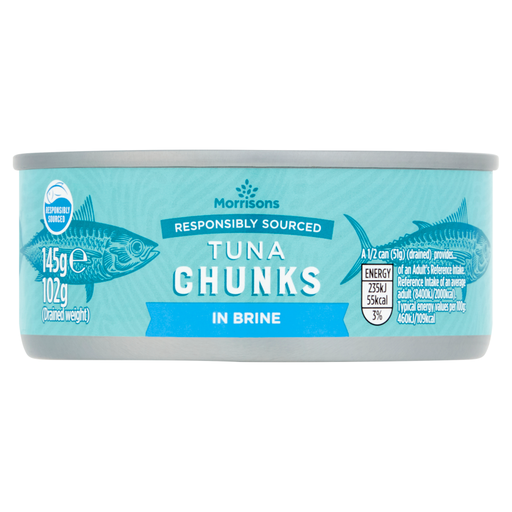
Morrisons Fad Free Tuna Chunks in Brine 145g
A single brine-packed tin if that packing medium suits your lunch. Compare its salt declaration with any spring-water alternative you are considering, and check the drained weight rather than treating 145g as the drained portion.
 No image available
John West No Drain Tuna Chunks in Springwater 3 x 100g
A no-drain format for a break when disposing of liquid is inconvenient. This listing is for three 100g cans, not a single-can purchase; check that you want the additional cans and read the nutrition basis on the pack before comparing figures with drained tuna.
 No image available
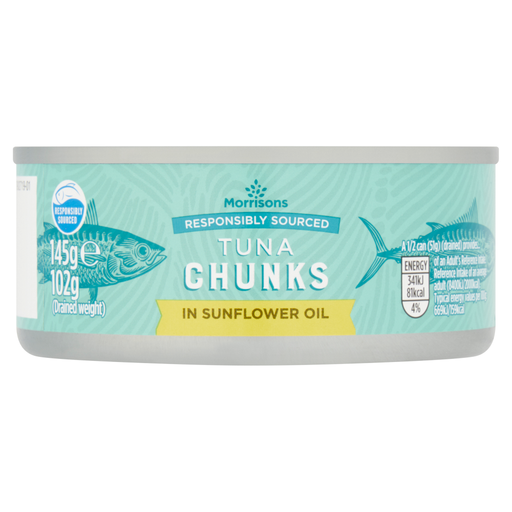
Morrisons Fad Free Tuna Chunks in Sunflower Oil 145g
A single tin packed in sunflower oil rather than spring water or brine. Decide whether that packing medium fits how you will prepare lunch, and check the drained weight if you need to compare the amount of tuna with another tin.
 No image available
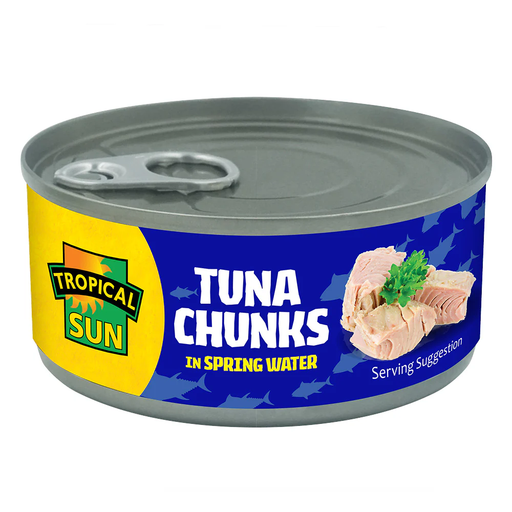
Topical Sun Tuna Chunks in Springwater 160g
A single 160g spring-water tin for a lunch ingredient. Check its drained weight and whether the nutrition figures refer to drained tuna before comparing its portion or per-100g values with another product; follow the pack's storage instructions for leftovers.
Questions about lunch and storage
Is a 145g tin enough for one university lunch?
It can supply the tuna for a lunch, but 145g is the net weight, not necessarily the amount after draining. Tesco Groceries and Sainsbury's each list 102g drained weight for their respective 145g Tesco and Princes spring-water tins. Consider what else you plan to eat with it rather than treating the tin as a complete meal.
Should I choose tuna in spring water or brine?
Choose by the particular tin's ingredients, salt declaration and the packing medium you prefer, rather than assuming one name settles the comparison. Sainsbury's lists 0.12g salt per 100g drained for its own-label spring-water tuna, while Tesco Groceries lists 0.90g for its spring-water tuna and Sainsbury's lists 0.9g for its Princes brine tin.
What should I do with tuna left after lunch?
Follow the instructions on your tin and arrange a suitable container and refrigeration if you expect leftovers. Sainsbury's tells buyers of its own-label spring-water tin to transfer unused contents to a non-metal container, refrigerate and use them within one day; Tesco Groceries gives a two-day period for its listed tin after transfer, covering and refrigeration.
Does pregnancy guidance affect how often I can have tuna?
Yes. NHS pregnancy guidance says to have no more than four cans of tuna or two tuna steaks a week. The Food Standards Agency explained in November 2024 that the can-based recommendation uses a medium-sized can with around 140g drained weight as its reference, so check the drained size rather than assuming differently sized cans match that reference exactly.
Does tinned tuna count as oily fish?
No. The NHS states that fresh and canned tuna do not count as oily fish, so a tuna lunch should not be counted as an oily-fish serving.


