For plain tinned tuna in spring water, reduced sugar is a useful label check but may not distinguish the cans you are choosing between: the checked UK examples list 0g or less than 0.5g sugars per 100g. For a school lunch, compare salt on the same nutrition basis, choose a can size or no-drain format that suits preparation, and check the current fish-allergen and storage instructions.
Who is choosing?
Parents checking sugars
For sandwiches, wraps or pasta, plain spring-water tuna offers a starting point before adding other ingredients. Checked examples from Asda, John West and Sainsbury’s list 0g or less than 0.5g sugars per 100g; compare the exact can’s salt and portion format next.
Consumers comparing salt
If salt is the deciding label value, compare products per 100g on the stated nutrition basis. The checked Sainsbury’s spring-water pack lists 0.12g salt per 100g, while checked Asda and Tesco packs list 0.90g per 100g; those figures describe the named products, not their entire ranges.
People preparing lunches quickly
A smaller can may avoid leftovers, while a no-drain product removes a preparation step. Check the pack for its fish-allergen statement, any bone warning and instructions for tuna left after opening.
What matters when buying?
Start with the exact can’s ingredients and nutrition panel, then choose the format that fits how many lunches you are preparing.
| Concern |
What to check |
Who this matters to |
| Sugars |
Read sugars per 100g and the ingredients on the exact can, particularly if it is flavoured or mixed with a sauce. |
If I want a plain filling rather than a flavoured one, I need to confirm what the pack actually contains. About 27% of consumers put this sugar-label check first. |
| Salt |
Compare salt per 100g using the stated nutrition basis, including whether values refer to drained tuna. |
Once sugars are checked, I may care more about differences in salt between cans. For about 33% of consumers, salt is the primary buying concern. |
| Preparation and portions |
Check whether draining is needed, the size of each can and any stated drained weight. |
When I am assembling a lunch quickly, draining and managing an opened can affect which format works for me. Around 20% of consumers prioritise that convenience. |
| Planning several lunches |
Check the can count, product-specific sourcing information and instructions for leftovers. |
If I am buying for several lunches, I want a pack I can portion and use as directed after opening. About 20% of consumers make that planning need their first priority. |
What is easy to overlook?
-
Choosing by sugars alone
Checked plain spring-water tuna products list 0g or less than 0.5g sugars per 100g, but their salt values differ. A sugar figure does not establish how the rest of the nutrition panels compare.
Confirm sugars on the exact pack, then compare salt per 100g on the same stated basis.
-
Treating fish and shellfish as the same allergen
Princes identifies tuna as fish in its spring-water product ingredients. The Food Standards Agency identifies crustaceans and molluscs separately; tuna alone does not establish that a product contains either.
For anyone with an allergy, read the current ingredients, allergen emphasis and precautionary statements on the particular pack, especially for mixed or flavoured tuna.
-
Opening a large can without a plan for the remainder
An opened can may leave tuna that needs prompt refrigeration and use according to its own label instructions.
Choose a smaller can for a single portion, or check the larger can’s storage directions before planning another lunch.
Any remainder that cannot be stored and used as directed may go to waste.
-
Overlooking bone warnings
Some checked tuna products warn that small bones may remain, despite preparation.
Read the warning on the exact pack and check the tuna before serving it to children.
Brands to consider
John West
Its checked range includes spring-water chunks and a No Drain spring-water multipack for different lunch-preparation routines.
- The checked No Drain 3 x 100g product lists 0g sugars and 0.80g salt per 100g.
- Those values apply to that product; check the current pack for allergens and any bone warning.
Princes
Its tuna range includes spring-water chunks and other formats, so the exact product matters.
- Princes lists tuna and spring water as ingredients for its checked Tuna Chunks in Spring Water.
- Do not assume a sandwich filling or another variant has the same ingredients or nutrition panel.
Tesco
Its checked own-label spring-water chunks provide a plain-tuna option.
- The checked 145g product lists 0g sugars per 100g.
- Tesco lists 0.90g salt per 100g for that product, so compare its panel if salt is your main concern.
Sainsbury’s
Its checked 4 x 145g spring-water pack is relevant when comparing both sugars and salt.
- Sainsbury’s lists less than 0.5g sugars and 0.12g salt per 100g for that pack.
- Apply those figures and its opened-can instructions to the named product, not every Sainsbury’s tuna variant.
Asda
Checked own-label spring-water tuna includes smaller 80g cans and a 4 x 145g pack.
- The 80g-can format offers a way to plan individual portions.
- Asda lists 0.90g salt per 100g for the checked 4 x 145g product; use the panel of the size you buy.
M&S
Its checked Tuna Chunks in Spring Water is another plain-tuna label to compare.
- Marks & Spencer lists 0g sugars and 0.75g salt per 100g for the checked product.
- Check the current pack rather than extending these figures to other M&S tuna products.
Joybuy tuna selections
These spring-water tuna selections cover a no-drain multipack, smaller and larger single cans, and multipacks for preparing several lunches. Compare the current labels and serving formats against your own priorities.
 No image available
John West No Drain Tuna Chunks in Springwater, 3 x 100g
The no-drain format suits lunch preparation when you want to skip that step. This is a three-can pack; the checked John West product lists 0g sugars and 0.80g salt per 100g. Check the current fish-allergen information and any bone warning before serving.
View on Joybuy
 No image available
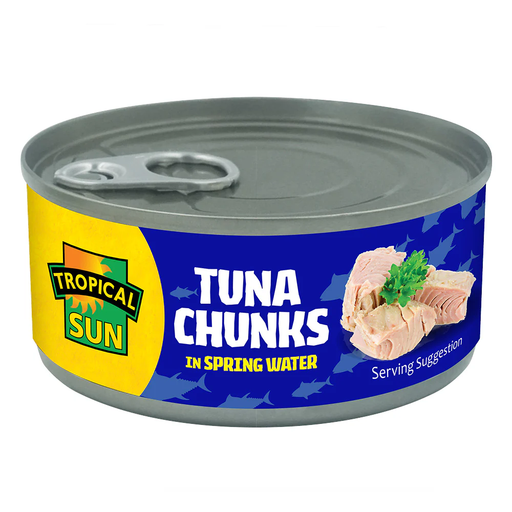
Topical Sun Tuna Chunks in Springwater, 160g
This single can is an option when you do not need a multipack. Compare its current sugars and salt panel with other plain spring-water tuna, and check the pack’s draining instructions and allergen statements before preparing lunch.
View on Joybuy
 No image available
Morrisons Fad Free Tuna Chunks in Spring Water, 6 x 145g
The six-can format suits planning several lunches without opening every can at once. Compare salt on the current label if that is your deciding factor, and follow the pack’s instructions for any opened-can remainder.
View on Joybuy
 No image available
John West Tuna Chunks in Springwater, 4 x 125g
Four individual cans offer a repeat-lunch format. If avoiding draining is important, confirm this exact pack’s preparation instructions rather than assuming it has the No Drain format; compare its salt panel and check its fish-allergen statement too.
View on Joybuy
 No image available
Morrisons Fad Free Tuna Chunks in Spring Water, 145g
This single 145g can suits a purchase that does not call for a multipack. Read its current sugars and salt values on the stated nutrition basis, and check storage directions if you plan to keep any tuna after opening.
View on Joybuy
Common questions
Is reduced sugar a useful filter for plain tinned tuna?
It is a useful initial label check, but it may not separate plain spring-water products: checked examples from John West and Tesco list 0g sugars per 100g, while checked Asda and Sainsbury’s examples list less than 0.5g. Compare salt and can format next, and check flavoured or mixed products individually.
Does tinned tuna contain fish or shellfish?
Tuna is fish; a tuna ingredient does not by itself mean a product contains shellfish. The Food Standards Agency identifies crustaceans and molluscs as separate allergen categories. Read the ingredients and allergen statements on the exact can, particularly when it contains other ingredients.
What should I do with tuna left after opening a can?
Follow that product’s refrigeration, container and use-by instructions rather than applying another can’s directions. If one can regularly leaves more than you can use as directed, a smaller format may fit your lunch preparation better.


