For school-holiday lunches, check for the blue MSC ecolabel on the exact tin or multipack rather than assuming a brand claim or no-drain format establishes certification. A no-drain tin saves a preparation step; chunks in spring water or brine also work if you are happy to drain them. Check the packing liquid, fish allergen declaration and storage instructions, and follow the NHS tuna limit if you are pregnant.
Who is shopping for these lunches?
Parents making quick school-holiday lunches
If tuna is going into sandwiches, wraps, salads or jacket potatoes, consider whether you want a no-drain tin or are content to drain standard chunks. Check the MSC ecolabel on the particular pack if certified sourcing matters to you.
Shoppers checking sustainable sourcing
The blue MSC ecolabel gives you a claim to check on the product itself, rather than relying on wording about a brand. The Marine Stewardship Council’s 2026 UK Tuna Shopper Report identified 138 MSC-labelled shelf-stable tuna products.
Households checking ingredients and storage
Compare the packing liquid, fish allergen declaration and instructions for leftovers on the exact tin. If someone eating the tuna is pregnant, the NHS tuna limit is a separate consideration.
What should you check on the tin?
Start with the certification on the exact pack, then choose a format that fits lunch preparation and check the label before serving.
| Priority |
What to check |
Your needs |
| Certified sourcing |
Look for the blue MSC ecolabel on the exact tin or multipack. Check that the current product listing describes the same variant. |
I want a sustainability claim I can check for the tuna I am buying, not just a general statement about its brand. |
| Lunch preparation |
Check whether the tuna is labelled no-drain or packed in liquid to drain. Compare the number of tins and their stated weights with the lunches you plan to make. |
A no-drain tin would save me a step when making sandwiches or salads; for other lunches, I am happy to drain chunks. |
| Ingredients and leftovers |
Read the packing liquid, fish allergen declaration and nutrition information per 100g. Follow the exact pack’s refrigeration and use-by instructions after opening. |
I need to know what is in the filling and how to store any tuna left after lunch. |
| Pregnancy guidance |
The NHS advises no more than four cans of tuna a week or two tuna steaks a week during pregnancy. |
If I am pregnant, I need to account for tuna eaten across the week, not just in one lunch. |
Common mistakes when choosing and storing tuna
-
Assuming every product from a brand carries the same certification
A sourcing statement about a brand does not identify the certification on the particular tin you are buying.
Check the exact variant for the blue MSC ecolabel on its pack or current product listing.
-
Choosing the packing liquid without reading the label
Sunflower oil, olive oil, brine and spring water give you different ingredients to work into a lunch; nutrition information also belongs to the specific product.
Choose the flavour and format you want, then compare the current ingredients and nutrition information per 100g.
-
Leaving opened tuna in the cupboard
The cited John West and Princes Joybuy product pages instruct shoppers to refrigerate their tuna after opening and consume it within two days.
Read the instructions on your own pack, refrigerate any remainder as directed and plan to use it within the stated period.
Brand and retailer reference points
These examples show why the individual product label matters, even when a brand or retailer discusses certified tuna.
John West
Tesco lists John West No Drain Tuna Chunks with a Little Brine MSC 3x100g as coming from an MSC-certified sustainable fishery.
- The cited no-drain format avoids draining liquid before preparing a filling.
- Check the certification and packing liquid on the precise John West variant; the brine listing does not describe every product in the range.
Princes
Princes says it has completed its commitment to having all its tuna MSC certified. Its product catalogue describes MSC tuna chunks in sunflower oil, with brine and spring-water variants also available.
- The catalogue offers packing-liquid options for different lunch preparations.
- Confirm the ecolabel, ingredients and tin size on the particular Princes product you choose.
Tesco
Tesco’s product listings provide individual examples of MSC-labelled tuna, including a John West no-drain brine multipack and Rio Mare tuna fillets in olive oil.
- Individual listings let shoppers compare the stated certification and packing format.
- Read the current product label for ingredients, nutrition, allergens and storage instructions rather than applying one listing’s details to another tin.
Tinned tuna options on Joybuy
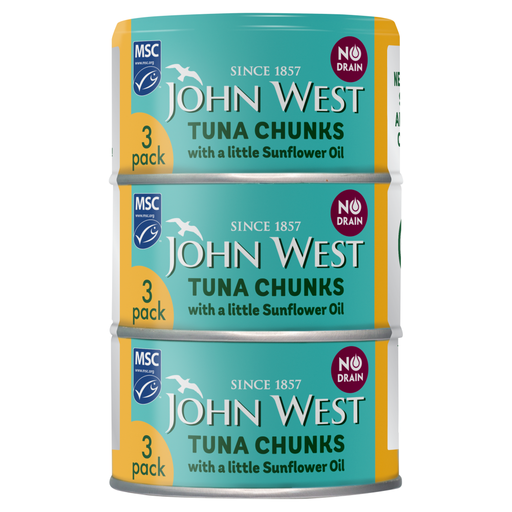
This no-drain John West sunflower-oil multipack is an option for lunches where you want to skip draining the tuna. If MSC certification is part of your decision, check the blue ecolabel on the exact pack.
 No image available
John West No Drain Tuna Chunks in Sunflower Oil, 3 x 100g
The three 100g tins offer a no-drain format for preparing lunches without that step. The listing describes the tuna as coming from an MSC-certified fishery; check for the blue MSC ecolabel on the exact pack. It contains fish, and the listing warns that some bones may remain. Refrigerate after opening and use within two days, as directed in the listing.
View on Joybuy
Questions about tinned tuna for lunch
How can I check a tuna tin’s sustainability claim?
Look for the blue MSC ecolabel on the exact tin or multipack, and make sure a product listing refers to the same variant. A brand-wide sourcing statement is not a substitute for checking the pack you intend to buy.
Does no-drain tuna automatically carry MSC certification?
No. No-drain describes how the tuna is packed, not its certification. Tesco lists a John West no-drain brine multipack with an MSC-certified-fishery claim, but you should check the label on whichever no-drain variant you choose.
What should I do with tuna left after opening a tin?
Follow the instructions on that product’s pack. The cited John West and Princes Joybuy listings say to refrigerate opened tuna and consume it within two days; the Princes listing also says to transfer leftovers to a sealed container.
Is there a tuna limit during pregnancy?
Yes. NHS pregnancy guidance advises no more than four cans of tuna a week or two tuna steaks a week. That limit applies to tuna eaten throughout the week, including tuna in lunches.


