For a sustainability-led choice, check the blue MSC ecolabel or an exact-product MSC statement on the tuna you intend to buy; a brand-wide claim is not a substitute. For a filling, choose chunks if you plan to mix in other ingredients, or a no-drain format if skipping the draining step matters. Check the packing liquid separately, especially if you want to control the oil added to the recipe.
Who this is for
MSC-first Pancake Day shoppers
You want a sourcing credential on the exact tuna pack before choosing a filling format. The Marine Stewardship Council says its blue ecolabel identifies wild-caught seafood from fisheries independently assessed against its environmental requirements.
Quick savoury-filling cooks
You want tuna that is straightforward to combine with other filling ingredients. Chunks, no-drain products and drained steak formats offer different preparation steps and piece sizes, so check which format the pack contains.
Multipack shoppers
You are making several fillings or stocking the cupboard. Compare the number of tins and the drained weight, then decide whether you will use the quantity in the pack.
What matters when choosing
For savoury Pancake Day fillings, check the sourcing claim on the exact product, then choose a format and packing liquid that suit your recipe.
| Concern | What to check | Who this matters to |
|---|
| Verified sourcing |
Look for the blue MSC ecolabel or an exact-product MSC-certified-fishery statement. Check for a separate pole-and-line statement if the catch method matters to you. |
I want the sustainability claim to apply to the tuna in my basket, not just its brand; for about 42% of consumers, verifiable sourcing would be the primary concern. |
| Preparation and texture |
Check for chunks, steaks or a no-drain format, along with the packing liquid. |
When I need to assemble a filling quickly, draining and the size of the tuna pieces can affect my choice. Quick preparation and texture would come first for about 25% of consumers. |
| Quantity |
Compare tin count and drained weight with the amount your filling calls for. |
If I am making pancakes for several people, I need enough tuna without choosing a pack I will not use; that would be the main consideration for about 17% of consumers. |
| Dietary suitability |
Read the ingredients and fish-allergen declaration; compare the packing liquid and salt information on the exact pack. |
I need to know whether the tuna and its ingredients suit everyone eating the filling. For about 16% of consumers, those dietary checks would take priority. |
Buying mistakes to avoid
-
Assuming a brand claim applies to every tin
Certification and catch-method statements can differ between products. For example, M&S describes pole-and-line sourcing for its canned tuna, but that statement alone does not establish an MSC ecolabel on a particular tin.
Check the exact pack for an MSC mark or product-specific certification statement, and check the catch method separately.
-
Choosing the packing liquid without checking the recipe
Spring water and sunflower oil give the filling different starting points. Sainsbury's listings for John West No Drain tuna give 0.9g fat per 100g for the spring-water variety and 6.9g per 100g for the sunflower-oil variety; those figures should not be applied to other tuna.
Choose spring water if you intend to add your own sauce or oil; choose the oil-packed variety if you want that oil in the filling.
-
Overlooking the fish-allergen declaration
Tuna contains fish, and a sustainability credential does not address allergen suitability.
Read the ingredient and allergen information on every pack before preparing a filling for someone with a fish allergy.
Brands to consider for specific ranges
John West
Its No Drain 3 x 100g tuna chunks include spring-water and sunflower-oil products identified as from MSC-certified fisheries on the cited Sainsbury's listings.
- The stated No Drain format removes a draining step when preparing a filling.
- Packing liquid and nutrition differ by variety; check the exact multipack.
Princes
Princes' 2026 catalogue identifies MSC tuna chunks in 145g and 4 x 145g formats, with different packing liquids.
- The listed formats provide choices between individual tins and multipacks.
- Confirm the MSC statement, packing liquid and chunks-or-steaks format on the exact product or bundle.
Sainsbury's
Its own-label product pages for spring-water tuna chunks and steaks state pole-and-line catching and sourcing from fisheries certified to the MSC standard.
- These product descriptions state both the certification and catch-method details.
- Check the exact pack and current availability when shopping.
M&S
M&S says its canned tuna is pole-and-line caught and describes its tuna chunks as responsibly sourced under its Forever Fish policy.
- The cited chunks and steak pages state the catch method.
- If MSC certification is essential, look for the ecolabel on the exact tin rather than treating the retailer's sourcing statement as equivalent.
Tesco
Tesco lists tinned-tuna formats that include MSC-labelled branded products alongside its own-label range.
- Its listings let shoppers compare pack formats and packing liquids.
- An MSC label on a branded listing does not establish certification for every Tesco own-label tin.
Joybuy tuna for savoury pancakes
These selections include no-drain chunks for a filling you want to prepare quickly and a larger brine-packed bundle for multiple uses. Check the sustainability marking on the exact pack, particularly where the bundle differs from a catalogue-listed format.
 No image available
John West No Drain Tuna Chunks in Spring Water, 3 x 100g
For a mixed savoury filling when you want chunks without a draining step. The three 100g tins are packed with spring water; the matching John West product is identified as from an MSC-certified fishery in Sainsbury's listing. Contains fish.
View on Joybuy
 No image available
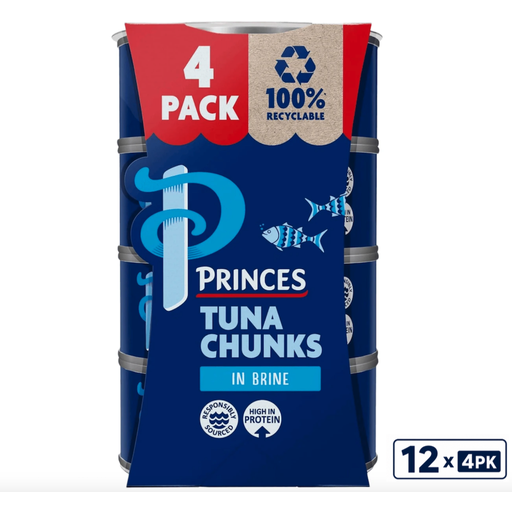
Princes Tuna Chunks in Brine, 4 x 145g x 12 Packs
For several fillings or cupboard stocking when a large bundle suits your plans. It contains 12 packs of four 145g tins of chunks in brine. Princes' catalogue identifies MSC chunks in a 4 x 145g brine format; check the MSC marking on this exact 12-pack bundle before relying on that claim. Contains fish, and small bones may remain.
View on Joybuy
 No image available
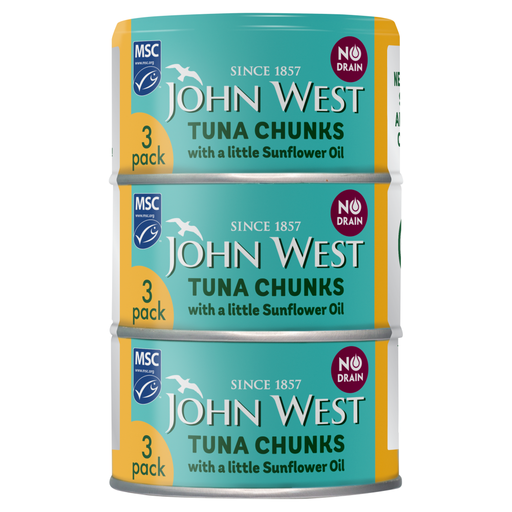
John West No Drain Tuna Chunks in Sunflower Oil, 3 x 100g
For a filling where you want chunks packed with sunflower oil and no draining step. The product is a 3 x 100g pack, and its description states that the tuna comes from an MSC-certified fishery. The listed fat content is 6.9g per 100g. Contains fish, and some bones may remain.
View on Joybuy
Questions about choosing tuna
What does the blue MSC label mean on tinned tuna?
The Marine Stewardship Council says the label identifies wild-caught seafood from fisheries independently assessed against its environmental-sustainability requirements. Look for the label or an exact-product MSC statement on the tin or multipack you intend to buy.
Does MSC-certified tuna have to be pole-and-line caught?
No particular catch method follows from the MSC label alone. If pole-and-line catching matters to you, check for a separate statement on the exact product; Sainsbury's spring-water tuna chunks and steaks are examples whose product pages state both details.
Should I choose spring water, brine or oil for a pancake filling?
Choose spring water or brine if you want to add your own sauce or oil; choose an oil-packed product if its oil suits your recipe. Packing liquids also change the product's nutrition: Sainsbury's listings give 0.9g fat per 100g for John West No Drain tuna in spring water and 6.9g per 100g for its sunflower-oil version.
How should I keep tuna after opening a tin?
Follow the instructions on the exact pack. The Princes Joybuy listing for the brine-packed chunks says to refrigerate opened tuna, transfer leftovers to a clean sealed container and consume them within two days.
Is tinned tuna suitable for someone with a fish allergy?
No: tuna contains fish. Check the exact pack's ingredient and allergen information, including the information for any other ingredients you plan to put in the pancake filling.


