Households making several portions
Separate tins can help you prepare tuna toast, bagels, omelettes or sandwiches across a weekend. Compare the number of tins and the stated drained weight when deciding how much tuna the pack provides.


For several weekend breakfast portions, start with a tuna multipack and compare its stated drained weight: the weight on the outside of the pack also includes liquid. Choose spring water if you want tuna without added oil, brine if its ingredients suit your recipe, or sunflower oil if you want oil-packed tuna; check the exact pack’s nutrition, fish-allergen and after-opening instructions before buying.
The useful pack size depends on how many breakfasts you are making and whether you have another use for any opened tuna.
Separate tins can help you prepare tuna toast, bagels, omelettes or sandwiches across a weekend. Compare the number of tins and the stated drained weight when deciding how much tuna the pack provides.
If you want tuna packed without added oil, look at spring-water options. Compare protein, fat and salt using the same per-100g basis on the exact packs you are considering.
If certification or a sourcing programme matters to you, check the wording and any certification mark on the particular multipack. A statement about a retailer or brand range need not describe every can it sells.
Work out how many tins you are likely to open, then compare packing liquid, labels and storage instructions on packs that fit that plan.
| Priority | What to check | Your needs |
|---|---|---|
| Usable quantity | Check tin count, net weight and drained weight. Tesco Groceries lists 4 × 10²g drained weight for its 4 × 145g spring-water pack. | I’m making several portions, but I want to know how much tuna remains after draining each tin. |
| Packing liquid | Read the ingredients for spring water, brine or sunflower oil. ASDA Groceries lists tuna and spring water in one four-pack; its brine version also lists salt. | For tuna toast or sandwiches, I’d choose the liquid that fits the recipe rather than assuming the three formats are interchangeable. |
| Nutrition and allergens | Compare nutrition figures on the same per-100g basis, especially fat and salt. Check the current ingredient and allergen label: the tuna products examined declare fish. | I want to see what is in the tuna before adding other breakfast ingredients, particularly if salt or a fish allergy matters in my household. |
| Sourcing | Look for a certification mark or a specific sourcing statement on the exact pack. Distinguish third-party certification from a brand’s or retailer’s own policy. | A sourcing claim matters to me, so I want to know which product it applies to—not just which company makes it. |
| After opening | Read the pack’s storage instructions before opening more tins than you need. Tesco Groceries and ASDA Groceries instruct shoppers to move unused tuna to a suitable non-metallic container and refrigerate it. | If breakfast uses only part of a tin, I’ll need a plan for the remainder that follows that pack’s instructions. |
Packing liquid contributes to net weight. Tesco Groceries lists its spring-water four-pack as 4 × 145g net, but 4 × 10²g drained.
Use the stated drained weight when comparing how much tuna different packs will provide.
The ingredients and nutrition differ. ASDA Groceries lists 1.0g fat per 100g for its spring-water tuna and 6.4g per 100g for its sunflower-oil version; its brine ingredients include salt.
Pick the packing liquid for the dish you intend to make, and compare the nutrition labels on the exact packs.
Instructions on the Tesco, ASDA brine and M&S products examined call for unused tuna to be transferred to a non-metallic container and refrigerated.
Follow your pack’s after-opening directions and plan when you will use the remainder. Those product instructions specify use within two days.
Certification marks and sourcing wording need to be checked against the particular multipack, not inferred from the brand name.
Read the exact pack if a certified or retailer-stated sourcing approach is part of your choice.
These examples show differences between specific tuna lines; they do not describe every product sold by each brand or retailer.
Tesco Groceries lists a four-pack of tuna chunks in spring water.
ASDA Groceries lists 4 × 145g tuna-chunk packs in both spring water and brine.
A Princes 4 × 145g tuna-chunks-in-brine pack is listed by ASDA Groceries and Joybuy.
John West describes a four-pack of tuna chunks in brine with tuna, water and salt as ingredients.
Marks & Spencer lists a four-pack of tuna chunks in spring water and describes its sourcing as sustainable.
These options include four- and six-tin multipacks and a bundle of twelve four-tin packs, across spring-water, brine and sunflower-oil formats. Check the tin count and packing liquid closely: the two Princes listings contain different quantities.
 No image available
Six tins give you separate portions to open across a weekend, with spring water as the stated packing liquid.
Check the pack’s drained weight to work out the quantity of tuna after the liquid is removed. The product description also cautions that some bones may remain.
 No image available
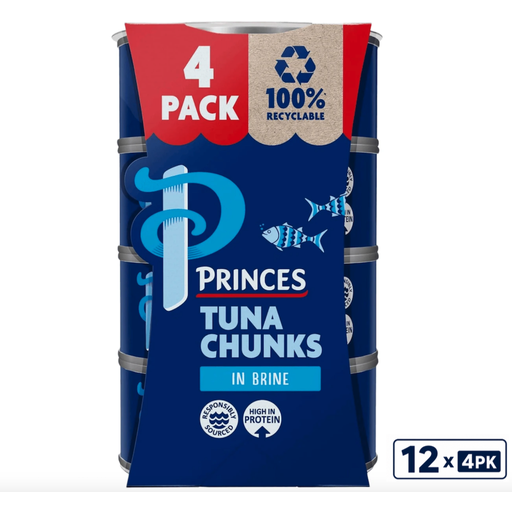
This larger bundle suits a plan that calls for multiple four-tin packs, rather than a single weekend’s four-pack.
Allow space for twelve packs and check the stated drained weight when working out the total usable tuna. The product description cautions that small fish bones may remain.
 No image available
Four tins provide an oil-packed option when sunflower oil suits the breakfast dish you have in mind.
Compare its fat figure with water-packed alternatives on the same label basis, and check the pack’s drained weight before comparing usable quantities.
 No image available
This four-tin spring-water option fits breakfasts where you want tuna without added oil.
Its 125g tin size differs from the 145g tins in several other packs here. Check drained weight as well as net weight when deciding how many tins to open.
 No image available
This is the single four-tin Princes pack, rather than the bundle of twelve packs shown above.
Joybuy lists tuna, water and salt as its ingredients. Check the stated drained weight for portion planning and the current label for allergen and after-opening instructions.
Use drained weight to compare how much tuna remains after the liquid is removed. Tesco Groceries lists one spring-water four-pack as 4 × 145g net but 4 × 10²g drained, illustrating why the two figures answer different questions.
The packing liquid and listed nutrition differ, so choose according to the dish and the label figures that matter to you. ASDA Groceries lists 109 kcal and 1.0g fat per 100g for its spring-water tuna, compared with 160 kcal and 6.4g fat per 100g for its sunflower-oil product; those figures describe the ASDA examples, not every tuna pack.
Follow the exact pack’s storage directions. The Tesco, ASDA brine and M&S products examined instruct shoppers to transfer unused tuna to a suitable non-metallic container, refrigerate it and use it within two days.
Yes. Tuna is fish, and the product listings examined declare fish as an allergen. Check the current pack label before serving it to anyone who needs to avoid fish.
Check the exact multipack for a certification mark or a specific retailer or brand sourcing statement. A company’s general policy does not, by itself, establish that every tuna product it sells carries third-party certification.