Families making pasta bakes or jacket potatoes
Check how much tuna remains after draining before deciding whether a multipack will cover the meal.


For a pasta bake or jacket-potato filling, start with a four-can multipack and check its drained weight: the weight on the front of each can is not necessarily the amount of tuna you can use. Choose the packing medium to suit the dish and its seasoning. A three-can no-drain pack avoids a preparation step, but check its usable quantity before relying on it for a shared meal.
Check how much tuna remains after draining before deciding whether a multipack will cover the meal.
A no-drain format removes the draining step. Check the number of cans and their usable quantity if several people will share the dish.
Compare the packing medium, salt figure and any sourcing statement on the exact variant rather than treating all tuna chunks as interchangeable.
Work out how much tuna the recipe needs, then choose the packing medium and preparation format that fit the meal.
| Priority | What to check | Your needs |
|---|---|---|
| Usable quantity | Check both the can count and drained weight. Tesco lists 4 x 10²g drained for its 4 x 145g brine pack; do not apply that figure to another variant. | Will the drained tuna cover my pasta bake or filling, with enough flexibility to open only the cans I need? |
| Packing medium | Read the ingredients and nutrition panel for the exact can. Princes lists tuna and spring water in its spring-water chunks; Tesco lists tuna, water and salt in its brine chunks. | For this dish, would I rather season spring-water tuna myself, use brine, or include the oil from an oil-packed variant? |
| Salt in the recipe | Compare salt per 100g drained on matching label bases. Tesco lists 1.00g for its brine chunks and Princes lists 0.85g for its spring-water chunks; these are product-specific figures. | If the dish also contains cheese or olives, I want to account for the tuna’s salt when seasoning it. |
| Preparation | Check whether the pack is labelled no-drain and how many cans it contains. Tesco lists a John West No Drain format as 3 x 100g. | Skipping the draining step matters to me, but the pack still needs to provide enough tuna for the meal. |
| Sourcing claims | Look for a certification or sourcing statement on the exact product; distinguish a brand statement from a claim about every pack in its range. | If catch method or traceability matters to me, I want to check the particular can I am buying. |
| Allergens and leftovers | Read the ingredients and storage instructions on the exact pack. GOV.UK identifies fish as an allergen that must be declared when present in prepacked food. Tesco and M&S instruct shoppers to refrigerate unused contents of their checked products and eat them within two days. | I need to check ingredients before serving and plan what to do if I open more tuna than the recipe uses. |
Tesco lists 1.00g salt per 100g drained for its brine chunks, while Princes lists 0.85g per 100g drained for its spring-water chunks. Those figures describe different products, not every can packed in either medium.
Read the nutrition panel on the variant you choose and account for the other ingredients when seasoning the dish.
Tesco’s 4 x 145g brine pack states 4 x 10²g drained. Opening more cans than the meal needs also leaves tuna to store.
Check the drained weight against your recipe. For Tesco’s checked pack, its instructions say to transfer unused contents to a non-metallic container, refrigerate them and eat them within two days.
A sourcing statement or easy-open feature does not tell you the drained quantity, ingredients or nutrition of that variant.
Check the claim on the exact pack, then read its ingredients, drained weight and opening instructions separately.
These examples show formats and product-specific label details to compare; a brand name alone does not identify the right variant for a recipe.
Tesco lists standard 4 x 145g tuna-chunk multipacks, including spring-water and brine variants.
Sainsbury’s lists own-label 4 x 145g tuna chunks in spring water and in brine.
Princes lists spring-water tuna chunks in 4 x 145g, 6 x 145g and 8 x 145g multipacks.
John West examples include a 4 x 125g brine multipack and a 3 x 100g No Drain format.
M&S lists an 800g tuna-steak product in spring water, a different format from a standard four-can chunks multipack.
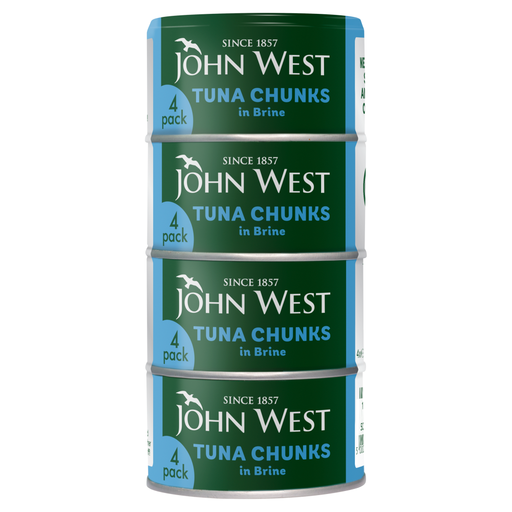
These John West packs cover four-can brine, sunflower-oil and springwater chunks, plus a three-can no-drain springwater option. Compare their can counts and packing media against the dinner you are making.
 No image available
Four separate cans offer flexibility for a pasta bake or more than one dish. Sainsbury’s lists 102g drained per can for this John West brine product; check its salt figure when seasoning the meal.
 No image available
The no-drain format removes a preparation step for sandwiches, salads or pasta. It contains three 100g cans; check the usable quantity against the number of diners before choosing it for a shared meal.
 No image available
Choose the four-can sunflower-oil format when that packing medium suits your pasta or salad. Check the drained weight and ingredients on the pack when planning the recipe.
 No image available
This four-can springwater format is an option for pasta or fillings when you do not want tuna packed in oil. Check its drained weight to work out how many cans the dish needs.
Use the recipe’s required amount and compare it with the pack’s drained weight, not just the front-of-can weight. Tesco states 4 x 10²g drained for its checked 4 x 145g brine pack, or 408g across all four cans; check other products individually.
Choose the medium that suits the recipe, then check the exact ingredients and nutrition panel. Princes lists tuna and spring water in its checked spring-water chunks, while Tesco’s checked brine chunks list tuna, water and salt; assess an oil-packed variant from its own label.
Follow the instructions on your can. Tesco and M&S instruct shoppers to transfer unused contents of their checked products to a non-metallic container, refrigerate them and eat them within two days.
Check the ingredients list on the exact multipack, particularly if it contains oil, sauce or a dressing. GOV.UK says fish is one of the allergens that must be declared when present in prepacked food.
Use the listing to compare formats, then read the can you receive before use. Its drained weight, ingredients, allergen declaration and storage instructions are the details to check for the chosen variant.