Bulk family-meal planners
If tuna regularly goes into pasta bakes, jacket potatoes, sandwiches or salads, compare the number of tins with their drained quantity so the pack fits the meals you have planned.


For regular family meals, compare the drained quantity in each tin and choose a pack size that fits the meals you plan to make; the number of tins and their nominal weight do not tell you how much tuna you can use. Check the exact can for salt, fish-allergen information, sourcing statements and instructions for storing leftovers, especially when different people in the household have different needs.
If tuna regularly goes into pasta bakes, jacket potatoes, sandwiches or salads, compare the number of tins with their drained quantity so the pack fits the meals you have planned.
If you keep tuna for repeat meals, check the usable amount per tin rather than treating every multipack with the same tin count as equivalent.
If catch method or certification matters to you, read the statement on the exact product. Check its ingredients, nutrition panel and storage instructions too.
Start with the amount of tuna you can use across your planned meals, then compare the product labels for the needs that matter in your household.
| Concern | What to check | Who this matters to |
|---|---|---|
| Usable quantity | Compare drained weight per tin and pack count, not nominal tin weight alone. | When tuna needs to stretch across several family meals, I want to know how much fish is available after draining. About 36% of consumers put usable quantity first. |
| Meal format | Check whether the tin contains chunks or another format, and follow its instructions for opened leftovers. | If I am planning sandwiches and a pasta bake on different days, tin size and leftover storage affect how I use the pack. Meal fit is the primary need for about 29% of consumers. |
| Sourcing statements | Read any catch-method or certification statement on the exact product. | I may want a stated catch method before choosing tuna for the cupboard. About 21% of consumers chiefly want product-specific sourcing information. |
| Household label needs | Read the ingredients, fish-allergen declaration and salt figure; check individual tuna intake where pregnancy guidance applies. | Where someone in my household needs a particular label check, I cannot choose by pack format alone. For about 14% of consumers, nutrition or safety labelling is the primary concern. |
The reviewed spring-water packs include both 145g and 132g nominal tin sizes. Nominal weight also differs from the amount left after draining.
Check drained weight per tin before deciding how many tins your planned meals need.
The reviewed Sainsbury's spring-water chunks list 0.12g salt per 100g drained; the reviewed Asda and Princes examples list 0.90g per 100g drained. These figures apply to those products, not their brands as a whole.
If salt matters in your household, compare the current panels on the cans you are choosing.
Instructions on the reviewed products differ: Sainsbury's specifies use within one day after opening, while the reviewed Asda and Princes products specify two days.
Plan when you will use a partly opened tin and follow its own transfer and refrigeration instructions.
Fish is an allergen. The Food Standards Agency also gives a weekly tuna limit for someone who is pregnant or trying for a baby; a household purchase does not change that person's individual guidance.
Read the allergen label on each product and account for the affected person's total tuna intake across the week.
Tesco lists own-label tuna chunks in spring water in a 4 x 145g pack.
Sainsbury's lists 4 x 145g spring-water chunks with product-specific pole-and-line and MSC-certified-fishery sourcing statements.
The reviewed Asda own-label pack contains 4 x 145g spring-water skipjack chunks and carries an MSC certification statement.
The reviewed Princes spring-water chunks come as 4 x 145g tins, with 102g drained weight stated for each tin.
The reviewed John West spring-water chunk multipack contains 4 x 132g tins.
M&S describes its reviewed 160g spring-water chunk tin as pole-and-line caught under its Forever Fish policy.
These chunk multipacks offer different tin counts and packing liquids for planned family meals. Check drained quantity and the current can label before choosing a format.
 No image available
Six tins may suit a plan covering several pasta, sandwich or jacket-potato meals. Check drained weight per tin when working out the usable quantity; the listed salt figure is 1.0g per 100g drained, so compare the current can label if salt matters to you.
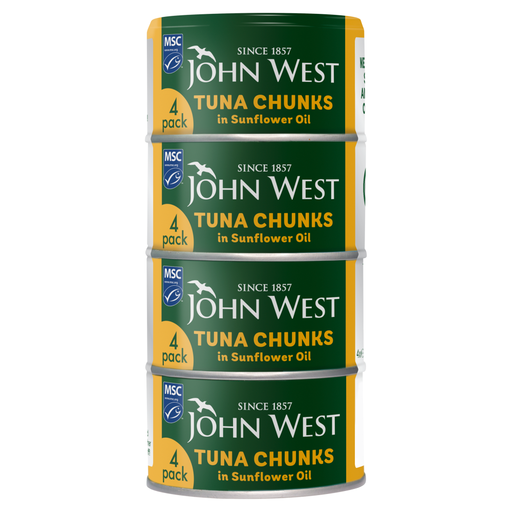 No image available
A four-tin option for planned sandwiches, salads or pasta. The listing gives 0.90g salt per 100g drained and warns that some bones may remain; check the current label and take care when serving.
 No image available
Four springwater tins can be allocated to separate sandwich, salad or pasta-bake meals. Check drained weight per tin for your portions; the listed salt figure is 0.80g per 100g drained.
 No image available
Four brine-packed tins offer portions to allocate across planned salads, sandwiches or pasta meals. Check the drained quantity on the pack; the listing states 0.90g salt per 100g drained.
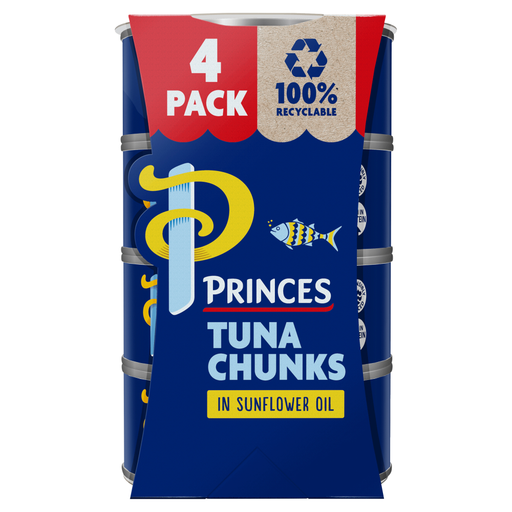 No image available
This four-tin sunflower-oil pack is another format for planned salads, pasta or sandwiches. Check drained weight per tin and the current nutrition panel; the listing states 0.90g salt per 100g.
Check the drained weight per tin as well as the pack count. The reviewed four-packs include both 145g and 132g nominal tins, so an equal number of tins does not establish an equal usable quantity.
No. The NHS says fresh and canned tuna do not count as oily fish in its dietary guidance.
Yes, for someone who is pregnant or trying for a baby. The Food Standards Agency advises no more than four medium cans of tuna or two tuna steaks a week for that person; its medium-can reference is about 140g drained. Consider that person's total weekly intake, not the household's pack size.
Read the ingredients on the exact prepacked product each time. GOV.UK identifies fish as one of the allergens that must be clearly labelled when present in prepacked food.
Follow the storage instructions on that tin. The reviewed Sainsbury's product says to transfer leftovers to a non-metallic container, refrigerate and use within one day; the reviewed Asda, Princes and M&S products specify refrigerated use within two days after transfer.