People short of time in the morning
A no-drain pack removes the draining step when making toast or a wrap filling. Check the exact variant: an easy-open tin is not necessarily a no-drain product.


Choose no-drain tuna when you want to open a tin and use it straight away; standard chunks suit a cupboard you stock for several meals if draining is not a problem. For a sandwich filling, consider chunks and flakes, then check the exact pack for drained weight, salt, storage instructions and any sourcing label that matters to you.
A no-drain pack removes the draining step when making toast or a wrap filling. Check the exact variant: an easy-open tin is not necessarily a no-drain product.
Standard tins and multipacks offer separate portions for breakfasts and other meals. Choose the can size with opened leftovers in mind, and compare net weight with drained weight when the latter is shown.
Compare the packing medium and nutrition for the exact product. Fish-allergen declarations, storage instructions and any named sourcing certification also belong in that pack-level check.
Start with how you will use the tuna at breakfast, then compare the portions and labels of formats that fit.
| Priority | What to check | Your needs |
|---|---|---|
| Preparation | Look for an explicit no-drain instruction if you want to use the tuna immediately. Check how the pack opens separately. | I want to make toast or a wrap filling without stopping to drain a tin. |
| Texture | Check whether the product contains chunks or a chunks-and-flakes mix. Princes describes its Sandwich Tuna in Spring Water as chunks and flakes. | For a sandwich topping, I may prefer a finer mix; for a plate with distinct pieces, I would choose chunks. |
| Portions | Compare can count, net weight and drained weight where stated. Check the exact pack’s instructions for opened leftovers. | A smaller can may fit one breakfast better if I am unlikely to use the remainder soon. |
| Packing medium | Read whether the tuna is in spring water, brine or oil, and compare nutrition on the same per-100g basis. The listed M&S sunflower-oil chunks have 9.0g fat per 100g drained, according to Ocado. | I want the packing medium to suit the recipe, and I may need to compare salt or fat on the exact labels. |
| Labels and use | Check the fish-allergen declaration and any named certification on the exact pack. If pregnant or trying for a baby, consult NHS guidance on weekly tuna consumption. | A sourcing label may matter to me, while an allergy or pregnancy changes which pack information I need to check before use. |
A standard tin’s net weight includes its packing liquid, so two tins of similar size need not provide the same drained quantity.
Check drained weight where stated and choose a can size that fits the number of people eating.
Product labels differ. For example, Ocado lists 9.0g fat and 1.00g salt per 100g drained for M&S tuna chunks in sunflower oil.
Compare the exact variants on a like-for-like per-100g basis rather than relying on the word “tuna” alone.
The cited John West no-drain and M&S product instructions call for refrigeration after opening and use within two days.
Follow your pack’s storage instructions and choose a portion you expect to use within its stated period.
An oversized opened portion can go unused if there is no planned second meal.
The NHS says fresh and canned tuna do not count as oily fish. NHS guidance also limits tuna to no more than four cans a week during pregnancy.
If you are pregnant or trying for a baby, check the current NHS guidance when planning how often to eat tuna.
These examples describe particular products and ranges, not every tin carrying the same brand.
Its No Drain Tuna Chunks in Spring Water 3 x 100g is a ready-to-use option for a quick filling; the cited product carries an MSC label.
The cited range includes brine chunks and a Sandwich Tuna in Spring Water made with chunks and flakes.
Tesco’s cited online assortment includes own-label tuna chunks in different packing media and pack sizes.
Ocado lists M&S tuna chunks in sunflower oil with product-specific ingredients, nutrition and storage instructions.
These options cover no-drain tuna and standard chunks for weekday breakfasts. Check each pack’s preparation instructions before choosing it for an especially rushed morning.
 Image unavailable
The no-drain format removes a preparation step for a toast or wrap filling. This is a three-can, 100g-per-can pack; John West lists 27g protein and 0.8g salt per 100g for this product. Follow the pack’s instructions for any opened portion.
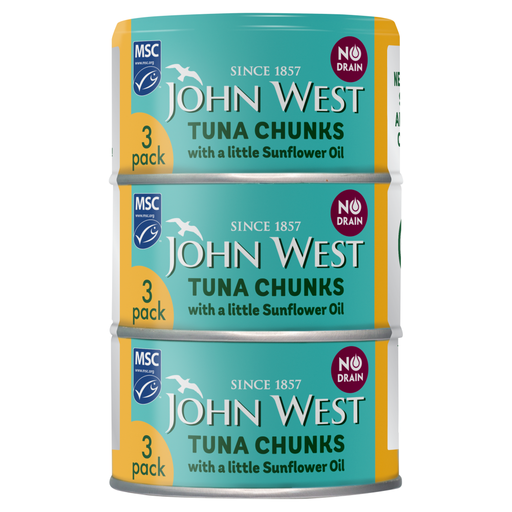 Image unavailable
Choose this no-drain variant when sunflower oil suits the breakfast recipe. The pack contains three 100g cans; compare its nutrition label with a spring-water variant if the packing medium matters to you.
 Image unavailable
This four-can pack suits cupboard stocking when draining is acceptable. Princes lists 23.5g protein and 0.9g salt per 100g drained for its brine chunks; check drained weight when planning portions.
 Image unavailable
Six separate cans provide portions for several uses. Check the preparation instructions if avoiding a draining step is important, and follow the pack’s storage directions after opening a can.
 Image unavailable
This four-can spring-water pack offers separate tins for several breakfasts. If immediate no-drain use is essential, check the instructions for this exact variant before choosing it.
Choose according to the recipe and the exact pack label, rather than assuming spring water, brine and oil have identical nutrition. If salt or fat affects your choice, compare values per 100g on the same stated basis; Ocado lists 9.0g fat per 100g drained for the cited M&S sunflower-oil chunks.
Follow the instructions on that pack and refrigerate leftovers as directed. The cited John West no-drain and M&S product pages say to refrigerate after opening and consume within two days; the M&S instructions also specify a non-metallic container for unused contents.
No: tuna is fish, which the Food Standards Agency identifies as an allergen. Check the declaration on the exact product rather than relying on a previously purchased pack.
The NHS advises people who are pregnant not to eat more than four cans of tuna a week, so a tin on every weekday would exceed that limit. If you are pregnant or trying for a baby, check current NHS guidance when planning your weekly tuna consumption.
Look for a named certification or a specific sourcing statement on the exact product. The cited John West No Drain Spring Water 3 x 100g product carries an MSC label; that does not establish the certification status of other John West variants.