Busy cooks making quick dinners
Tuna chunks can be mixed into pasta or used with potatoes, rice or salad ingredients. A tin explicitly labelled no-drain removes the draining step when time and washing-up matter.


Choose tuna chunks in spring water or brine if you plan to add your own sauce or dressing; choose oil-packed chunks when the oil suits the dish. No-drain tins remove a preparation step, while a larger can makes sense only if you can use its opened contents within the period on the label.
The useful format depends on whether dinner calls for less preparation, separate portions or a particular packing liquid.
Tuna chunks can be mixed into pasta or used with potatoes, rice or salad ingredients. A tin explicitly labelled no-drain removes the draining step when time and washing-up matter.
Individual tins in a multipack allow separate meals without opening one large can. If you choose a larger can, plan how you will use any leftovers within its after-opening instructions.
Compare the packing liquid, ingredients and nutrition panel for the exact tin. If sourcing matters to you, check its species information and any certification shown on that product rather than relying on a brand-wide statement.
Start with the meal you intend to make, then check whether the tin’s liquid, format and quantity fit it.
| Priority | What to check | Your needs |
|---|---|---|
| Preparation | Look for an explicit no-drain label if you want to skip draining. Check whether the tuna comes as chunks for mixing into a dish. | I want to add tuna to pasta, a jacket potato or a salad with as little preparation as possible. |
| Packing liquid | Choose between spring water, brine and oil to suit the recipe. Compare the exact nutrition panels per 100g; for example, M&S lists 0.6g fat per 100g for its referenced spring-water chunks and 9.0g for its sunflower-oil chunks. | If I’m adding my own dressing or sauce, spring water or brine gives me a starting point. For a dish where the packed oil is useful, I’ll check the oil-packed option. |
| Pack size | Check the number of tins and the quantity in each one. Read the after-opening storage period before choosing a large can. | Separate tins suit dinners on different days; one larger can suits a meal that uses more tuna or a planned use for the leftovers. |
| Sourcing | Check the individual tin for an MSC ecolabel, species and any stated fishing method. Keep product certification distinct from a retailer’s or brand’s own sourcing claim. | I want the sourcing information to apply to the tin I’m buying, not just to another product in the same range. |
| Pregnancy guidance | The NHS advises people who are pregnant or trying for a baby to have no more than 4 cans of tuna or 2 tuna steaks a week because tuna contains higher levels of mercury than other fish. Count tuna eaten across meals. | If I’m pregnant or trying for a baby, I need to consider my tuna meals across the week, regardless of the brand or packing liquid. |
The liquid affects how tuna fits a recipe, and nutrition differs between products. M&S lists 9.0g fat per 100g for its referenced sunflower-oil chunks, compared with 0.6g for its spring-water chunks.
Match the liquid to the dish and compare the nutrition panels for the exact tins you are considering.
An unopened store-cupboard tin and its opened contents have different storage instructions. M&S directs buyers of its referenced tuna products to transfer unused contents to a non-metallic container, refrigerate them and eat them within 2 days.
Choose a tin size that fits the meal, and follow the after-opening directions on your own product’s label.
Opening more than you can use within that period can mean discarding the remainder.
An MSC ecolabel applies to a particular product; a brand’s sourcing programme is a different claim. Princes describes its own traceability programme, but that statement does not establish the certification of every Princes tin.
Check the specific pack for its ecolabel, species and stated fishing method.
The NHS says tuna contains higher levels of mercury than other fish. It advises no more than 4 cans of tuna or 2 tuna steaks a week for people who are pregnant or trying for a baby.
Include tuna from different meals when considering that weekly guidance; changing the brand or packing liquid does not change it.
These ranges illustrate different formats and label details; check the individual product rather than assuming every tin from a brand is alike.
Tesco lists John West No Drain Tuna Chunks in several packing liquids, including spring water, brine and a little sunflower oil.
Tesco lists Princes tuna-chunk multipacks, while Princes describes its sourcing programme as Caught With Care.
Tesco’s listed own-label options include a 400g can of tuna chunks in spring water.
Asda lists an own-label Skipjack Tuna Chunks in Brine product.
M&S provides product information for tuna chunks in spring water and sunflower oil, including ingredients, nutrition and storage directions.
These tins cover no-drain options for minimal preparation, spring-water chunks for adding your own sauce, and sunflower-oil chunks for dishes where that liquid fits. Compare pack sizes if you plan to use tuna across several dinners.
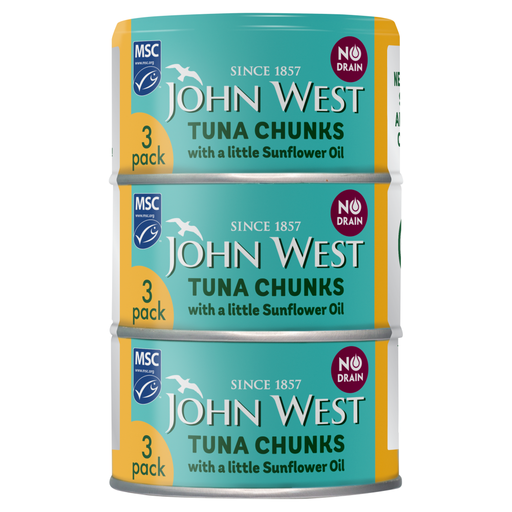 Image unavailable
The no-drain format removes a preparation step for a quick topping or pasta dish. The three 100g tins can be opened separately; choose the sunflower-oil variant when that packing liquid suits the meal.
 Image unavailable
Choose this no-drain springwater variant if you want to add your own sauce or dressing without draining the tuna first. It contains three separate 100g tins.
 Image unavailable
Six separate spring-water tins suit a cupboard stocked for several meals rather than one large opened can. Check the label if avoiding a draining step is important.
 Image unavailable
The four separate 125g tins are an option for repeat meals where sunflower-oil-packed tuna fits the recipe. Compare the nutrition panel if you are deciding between oil and spring water, and check the label if you need a no-drain format.
 Image unavailable
Four individual 125g tins can be used across different pasta, sandwich or salad meals. The springwater format leaves the choice of sauce or dressing to you; check the label if no-drain preparation matters.
Choose spring water or brine when you intend to add your own sauce or dressing, and oil-packed tuna when the oil fits the finished dish. Compare the exact labels: M&S lists 9.0g fat per 100g for its referenced sunflower-oil chunks and 0.6g for its spring-water chunks; check the salt declaration for any brine-packed tin.
A tin explicitly labelled no-drain is useful when you want to skip draining before assembling pasta, a sandwich or a salad. Tesco lists John West No Drain Tuna Chunks in different packing liquids, so check which variant suits your dish.
Follow the directions on that tin. For its referenced tuna products, M&S says to put unused contents in a non-metallic container, refrigerate them and eat them within 2 days.
The NHS advises people who are pregnant or trying for a baby to have no more than 4 cans of tuna or 2 tuna steaks a week because tuna contains higher levels of mercury than other fish. The guidance applies across tuna meals, not to a particular brand or packing liquid.
Look at the particular tin for an MSC ecolabel, its stated species and any fishing-method information. A retailer’s or brand’s sourcing statement is not, by itself, proof that every product in its range carries the same certification.