For an older adult, choose tinned tuna by the protein and salt figures on the exact product, its drained weight and whether the portion is practical to use. A smaller no-drain tin can mean less preparation, while separate tins may make regular use easier to manage; neither format establishes its salt content. NHS guidance also says tinned tuna does not count towards the recommended oily-fish portion.
Who is this for?
Older adults planning protein-containing meals
Someone with a smaller appetite, or a carer planning their meals, may want to compare how much protein a usable portion provides. Royal United Hospitals Bath NHS Foundation Trust guidance identifies protein as a nutrient deserving attention after age 65.
People keeping an eye on salt
Anyone who eats tuna regularly or has been advised to moderate salt intake needs the figure on the exact tin. Spring-water products can have different salt values, so the packing liquid alone is not enough to make the choice.
People who prefer less preparation
Smaller portions and no-drain formats may be useful when handling a tin or managing leftovers is difficult. Check the opening method and storage instructions for the particular product rather than assuming every pack works the same way.
What matters when choosing?
Start with the amount likely to be eaten, then compare protein and salt on the same labelled basis. Pack format matters most when draining or using leftovers would be difficult.
| Concern |
What to check |
Who this matters to |
| Protein per portion |
Compare protein per 100g drained and the amount of tuna likely to be eaten. |
With a smaller appetite, I want the tuna I serve to make a useful contribution to a meal. About 40% of consumers put protein first. |
| Salt on the label |
Check salt per 100g and per serving on the exact tin; note whether the figure is for drained tuna. |
If I eat tuna often or have been advised to moderate salt, its packing liquid cannot tell me enough. Salt is the primary concern for about 30% of consumers. |
| Portions and preparation |
Check drained weight, whether draining is needed and the instructions for opened leftovers. |
When shopping for one or preparing someone else’s meal, I need a portion I can handle and use within the storage period. Roughly 30% of consumers put that practical fit first. |
Sainsbury’s lists 26.1g protein and 0.12g salt per 100g drained for one 145g spring-water tuna product. Marks & Spencer lists 23.5g protein and 0.75g salt per 100g for its spring-water chunks. These product-specific figures show why it is worth reading the panel rather than treating “in spring water” as a salt figure.
What is easy to overlook?
-
Assuming spring water means less salt
Salt differs between products packed in spring water. The Sainsbury’s and Marks & Spencer examples above have different labelled values, and neither value describes every product from that brand.
Compare salt on the exact pack using matching per-100g figures, then look at the serving you expect to use.
-
Using the tin size as the edible portion
A tin’s total weight can include packing liquid, so it need not equal the amount of tuna available for a meal.
Check drained weight and pack count, then choose a portion size that fits how the tuna will be used.
-
Counting tuna as the oily-fish portion
NHS guidance says fresh and canned tuna do not count as oily fish, although tuna can be one of the fish choices in a weekly diet.
If following the NHS recommendation to include an oily-fish portion, plan that portion separately rather than relying on tinned tuna for it.
-
Opening more tuna than can be used
Instructions differ by product: Sainsbury’s says to transfer leftovers from its 145g spring-water tin, refrigerate them and use them within one day; a Marks & Spencer spring-water product specifies two days after opening.
Match tin size to usual servings and follow the storage directions on the tin being opened.
A larger opened portion may go to waste if it cannot be used within its stated storage period.
Brands to consider
John West
Its range includes no-drain tuna in smaller portions for shoppers who want fewer preparation steps.
- Joybuy describes a John West no-drain brine steak pack of three 60g portions as ready to use without draining.
- That brine product lists 1.0g salt per 100g drained; convenience does not establish a lower salt content.
Princes
A spring-water chunks option is available in separate 145g tins within a multipack.
- Sainsbury’s lists a Princes four-pack with 23.5g protein per 100g drained.
- The same product lists 0.9g salt per 100g drained. Check other Princes variants individually.
Tesco
Its own-label range provides different tuna formats for comparing portion size and packing liquid.
- Tesco’s tinned-tuna category includes chunks, steaks and products packed in brine, oil or spring water.
- Use the individual product’s nutrition and drained-weight information; a category-wide choice cannot stand in for its label.
Sainsbury’s
Its 145g spring-water chunks provide product-specific nutrition and leftover-storage information.
- Sainsbury’s lists 26.1g protein and 0.12g salt per 100g drained for this product.
- After opening, its instructions say to transfer leftovers to a non-metallic container, refrigerate and use within one day.
M&S
Its referenced products include spring-water chunks and ready-drained spring-water steak.
- Marks & Spencer lists 23.5g protein and 0.75g salt per 100g for its spring-water chunks.
- Its ready-drained steak has different nutrition figures, and its label warns that bones may remain. Check the particular product before serving.
Tinned tuna options on Joybuy
These tins cover smaller no-drain portions, spring-water multipacks and a brine-packed steak. Compare the label and preparation instructions for the pack that fits the intended meals.
 No image available
John West No Drain Tuna Chunks in Sunflower Oil, 3 × 100g
For meals where draining is inconvenient, this pack provides three separate tins. Check its salt declaration and the portion used if tuna is eaten regularly.
View on Joybuy
 No image available
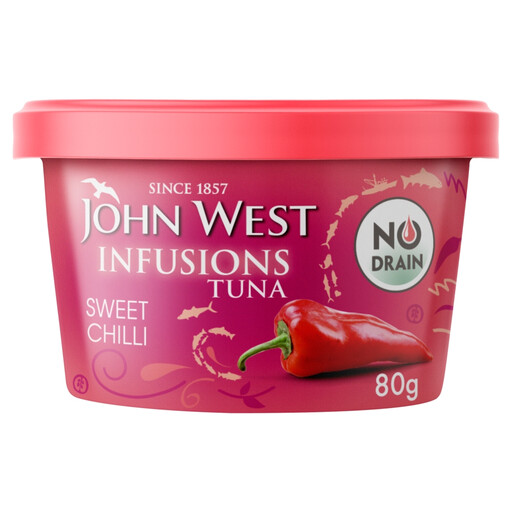
John West Infusions Tuna Sweet Chilli, 80g
This smaller flavoured tin may fit a meal needing a single portion. The product information lists sunflower oil and sugar, so check the ingredients and nutrition panel against the intended meal.
View on Joybuy
 No image available
John West Tuna Chunks in Springwater, 4 × 125g
Separate tins may suit someone using tuna across several meals without opening the whole multipack at once. Compare the salt figure on this product’s label; spring water does not establish its salt content.
View on Joybuy
 No image available
Morrisons Fad Free Tuna Chunks in Spring Water, 6 × 145g
Six separate tins may fit a household that uses tuna regularly. Consider whether each opened tin suits the usual portion and follow its instructions for refrigerating leftovers.
View on Joybuy
 No image available
Tropical Sun Tuna Steaks in Brine, 160g
This tin fits a meal in which the tuna will be cooked. Its product instructions call for thorough cooking, so do not treat it as ready to eat; check the label’s basis before comparing its nutrition figures with drained-weight figures on other tins.
View on Joybuy
Frequently asked questions
Does tinned tuna count as an oily-fish portion?
No. NHS guidance says fresh and canned tuna do not count as oily fish. Its recommendation to include an oily-fish portion therefore needs a different fish choice.
Is tuna in spring water always lower in salt?
No. Sainsbury’s lists 0.12g salt per 100g drained for one spring-water product, while Marks & Spencer lists 0.75g per 100g for its spring-water chunks. Compare the exact product labels on the same basis, including the serving likely to be eaten.
How should leftover tinned tuna be stored?
Follow the instructions on the particular tin. Sainsbury’s says to transfer leftovers from its 145g spring-water product to a non-metallic container, refrigerate and use within one day; the referenced Marks & Spencer spring-water chunks specify refrigeration and use within two days.
What should I check before serving tuna to someone who has difficulty chewing?
Check the exact product label and the food before serving: a Marks & Spencer tuna-steak label warns that bones may remain. Also check ingredients where fish allergy is a concern; tuna is fish.


