Label-focused home bakers
If you want an organic ingredient in a tuna bake, check whether the claim applies to the fish or to an added ingredient such as olive oil. Fish 4 Ever makes this distinction for its wild-caught tuna.


For a tuna bake, choose a tin described as organic only if you want the ingredient to which that claim applies. Fish 4 Ever explains that wild-caught tuna itself cannot be labelled organic under a farming standard; its Azores tuna is instead packed in organic olive oil. If the recipe calls for drained tuna and you want to control the added oil, check a spring-water or brine tin and its drained weight.
If you want an organic ingredient in a tuna bake, check whether the claim applies to the fish or to an added ingredient such as olive oil. Fish 4 Ever makes this distinction for its wild-caught tuna.
For tuna bakes, fishcakes and pastry fillings, the packing medium and drained weight help you match the tin to the recipe’s intended moisture and richness. Tesco and Sainsbury’s list spring-water, brine and oil-packed formats.
If fishing method or certification guides your choice, read those claims separately from any organic ingredient claim. Sainsbury’s describes MSC certification and pole-and-line fishing for its own-label canned tuna.
For home baking, decide whether you want organic olive oil in the finished dish, then check the tin’s packing medium and the recipe’s drainage instructions.
| Concern | What to check | Who this matters to |
|---|---|---|
| Scope of the organic claim | Read the ingredients and certification information to identify which ingredient is organic. Ocado lists organic olive oil as 33.5% of the ingredients in Fish 4 Ever Azores tuna. | If I want an organic ingredient in my bake, I need to know whether the claim applies to the oil rather than the tuna; about 36% of consumers put claim clarity first. |
| Packing medium and drainage | Check whether the tuna is packed in spring water, brine or oil, and whether the recipe specifies a drained quantity. | When a filling needs a particular moisture balance, I want to control what goes into it; around 36% of consumers make bake texture their primary concern. |
| Sourcing information | Look for sourcing marks and fishing-method wording on the specific tin; do not treat them as organic certification. | If sourcing decides which tin I buy, I want to understand what its labels actually cover; about 28% of consumers put sourcing clarity first. |
Fish 4 Ever explains that its wild-caught fish cannot itself be labelled organic under a farming standard. Ocado’s listing for its Azores tuna identifies organic olive oil as 33.5% of the ingredients.
Read the full ingredient and certification information, then decide whether organic oil is the feature you want.
The packing medium can change how much oil or liquid goes into a bake or filling.
Follow the recipe’s packing-medium and drained-weight directions. If you choose tuna in oil, decide how much of that oil belongs in the dish.
MSC and pole-and-line claims describe sourcing or fishing methods, whereas UK organic labelling addresses a different claim. Sainsbury’s makes the sourcing claims for its own-label canned tuna.
Check the exact tin for the claim that matters to you rather than substituting one type of label for another.
Tuna is fish, and baking it into a dish does not change the NHS pregnancy guidance limiting tuna to four cans or two steaks a week.
Check the allergen information for everyone eating the dish. During pregnancy, count tuna in baked dishes towards the NHS weekly limit.
A route to wild-caught tuna packed in organic olive oil when the oil is wanted in the recipe.
An own-brand range with several packing media to check against a baking recipe.
An own-brand route with different packing media and stated tuna-sourcing commitments.
A branded range to check for chunks, steaks and ready-to-use formats.
A branded range with packing and drainage formats to match to the dish.
This tuna-in-organic-olive-oil option is for bakes or fillings where you want the oil to contribute to the finished dish. Check the recipe before using it in place of drained tuna packed in water or brine.
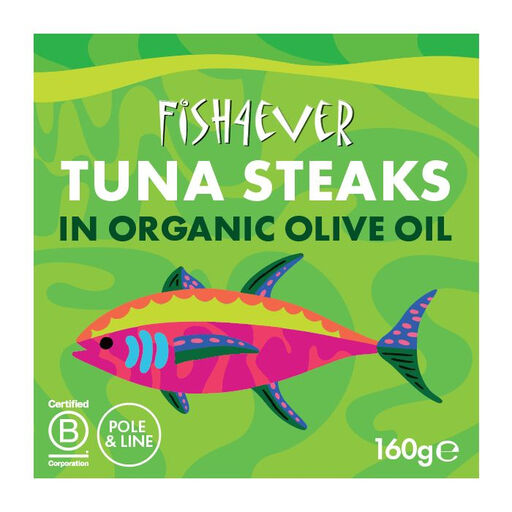 Image unavailable
Consider this tin when olive oil is an intended part of a tuna bake or filling. It contains tuna steaks in organic olive oil in a 160g pack; the organic wording refers to the oil, not to certification of the tuna. Check the drained weight if your recipe specifies a quantity of drained fish.
Not necessarily. Fish 4 Ever explains that wild-caught tuna cannot itself be labelled organic under a farming standard; Ocado lists its Azores tuna with organic olive oil making up 33.5% of the ingredients. Check which ingredient the claim covers on the exact tin. The Department for Environment, Food & Rural Affairs sets separate rules for using organic terms on food labels in the UK.
Choose spring water or brine when the recipe calls for drained tuna and you want to control the added oil yourself. Choose tuna in olive oil when you want some of that oil in the dish, and follow any drained-weight instruction rather than treating the tins as interchangeable.
No. NHS guidance says that during pregnancy, tuna consumption should not exceed four cans or two tuna steaks a week. Include tuna used in baked dishes when following that weekly limit.
No. They address sourcing or fishing method, not whether an ingredient meets organic-production rules. Sainsbury’s states these sourcing claims for its own-label canned tuna; check the specific tin separately for any organic claim.