First-shop meal planners
If tuna is on the plan for sandwiches, lunches or several family meals, choose a pack whose individual tins fit those meals. Leave room in the plan to follow the label instructions if you open a tin but do not finish it.


If several lunches or family meals are planned, a four-tin pack gives you separate tins to open as needed; for occasional use, smaller tins or a three-pack may fit better. Check the weight of each tin, the packing liquid and the instructions for any leftovers before choosing a format.
If tuna is on the plan for sandwiches, lunches or several family meals, choose a pack whose individual tins fit those meals. Leave room in the plan to follow the label instructions if you open a tin but do not finish it.
A four-pack and a smaller multipack differ in both tin count and tin size. Compare the stated weights and check the drained quantity when deciding how much tuna the pack provides for your planned meals.
The exact product label matters if you are checking ingredients, salt or fat values, or a sourcing claim. Fish allergy rules out tuna for the affected person; pregnancy-specific NHS guidance may also affect how many tins to buy.
Start with the meals you expect to make, then decide whether the tin size, packing liquid and individual product label suit your household.
| Concern | What to check | Who this matters to |
|---|---|---|
| Enough for planned meals | Count the meals you expect to make; compare total pack size and stated drained quantity. | I want tuna for several meals, but not more tins than I expect to use. About 33% of consumers put matching the whole pack to their meal plan first. |
| Tin size and leftovers | Check the weight of each tin and its instructions for storing unused contents. | If I usually need only part of a tin, dealing with the remainder matters more than buying a larger pack. Roughly 27% of consumers put portion and leftover planning first. |
| Liquid and recipe fit | Read whether the tuna is packed in spring water, brine or oil, alongside the exact nutrition panel. | For a recipe where I add my own dressing, or one where I want oil included, the packing liquid shapes my choice. About 20% of consumers put liquid and nutrition-label fit first. |
| Safety and sourcing checks | Check fish allergen information, relevant NHS pregnancy guidance and any sourcing label on the chosen product. | A fish allergy makes tuna unsuitable for the affected person; other shoppers may need to check pregnancy guidance or a sourcing claim. Approximately 20% of consumers put these safety or sourcing checks first. |
Four 125g tins and four 145g tins offer the same number of openings but different stated total weights. A no-drain three-pack is another distinct format.
Check both the number of tins and the weight of each one. Where the label gives a drained weight, use it when working out how much tuna your meals require.
Product labels in the researched ranges give different salt, fat and energy values for particular spring-water, brine and oil variants. A value on one tin does not describe every tin packed in that liquid.
Read the nutrition panel on the exact pack, then choose the liquid that works with your intended recipe and any nutrition information you need to check.
Opened-storage instructions differ between products. Sainsbury's lists use within one day for its researched spring-water product, while the researched Asda and M&S products give two days after transfer and refrigeration.
Follow the instructions on the tin you buy. If you do not use it all, transfer the remainder to a suitable non-metallic container and refrigerate it as directed.
A partly used tin may go unused if its stated chilled-storage period does not fit the next planned meal.
A catch-method statement or ecolabel belongs to the product that carries it, not automatically to every tuna tin sold under the same brand.
If sourcing affects your choice, check the claim on the specific pack rather than relying on the brand name.
Princes lists spring-water tuna chunks in single 145g tins and multipacks of 4, 6 and 8 tins of 145g each; its range also includes brine and oil variants.
Tesco lists a 4 x 145g spring-water pack alongside smaller multipack formats.
Sainsbury's has a spring-water tuna multipack relevant to shoppers planning several meals.
Asda lists a 4 x 145g tuna-chunks multipack in brine.
John West no-drain tuna chunks include a smaller 3 x 100g format for quick lunches.
The identified M&S spring-water tuna is a 160g single tin, described by M&S as pole-and-line caught.
These multipacks cover four-tin brine, oil and spring-water choices for planned meals, plus a smaller no-drain spring-water format for quicker portions. Choose by the meals and tin sizes you need, rather than treating them as identical family packs.
 Image unavailable
Four separate 145g tins suit a plan that uses tuna across several meals. This is the brine variant: check its nutrition panel if the packing liquid affects your choice, and follow the pack instructions for any opened tin.
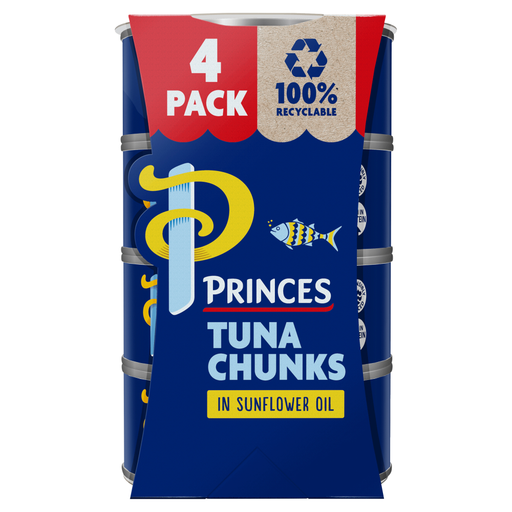 Image unavailable
Choose these four separate 145g tins if sunflower oil fits meals such as sandwiches or pasta. Check the exact pack's nutrition panel before comparing it with spring-water or brine tuna, especially where labels use different weight bases.
 Image unavailable
This pack provides four separate tins for repeated meals, with 125g in each tin rather than the 145g of the larger four-tin format discussed above. Check whether that individual tin size fits the portions you plan to make.
 Image unavailable
Three 100g tins offer a smaller no-drain format for lunches or meals where a larger tin would leave unused tuna. It is not the same quantity as a four-tin family pack, so match it to the number of meals planned.
A four-tin pack makes sense if several meals are already planned, because you can open the tins separately. If you are unsure how often you will use tuna, compare the individual tin sizes in a smaller multipack with the portions you expect to need.
No such conclusion follows from the packing liquid alone. The researched Princes spring-water product states 0.85g salt per 100g drained, while the identified Asda brine product states 0.90g per 100g drained; those figures describe those products, not every spring-water or brine tin. Compare labels on the exact products you are considering.
Follow the instructions on the individual product and transfer unused tuna to a suitable non-metallic container for refrigeration. The researched Sainsbury's product directs use within one day, whereas the identified Asda and M&S products give two days; use the instruction on the tin you open.
Yes. For someone who is pregnant, the NHS advises no more than four cans of tuna a week or two tuna steaks a week. Plan a multipack around that limit rather than assuming its full contents are intended for one person in a week.
Tuna is fish and is unsuitable for someone with a fish allergy. For prepacked food, Food Standards Agency guidance says the ingredients list must emphasise allergens present; check the packaging of any food you are considering rather than relying on a range name.