Regular cupboard stockers
If you use tuna for repeat meals, a multipack can save you from buying individual tins each time. Compare the tin count and usable quantity across formats, particularly when moving between four-packs and six-packs.


For regular cupboard stocking, start with a conventional multipack and compare the number of tins, their drained quantity and the packing liquid on the exact product. A smaller no-drain pack makes more sense when avoiding preparation matters to you; a branded four-pack is another option if its particular format or stated sourcing features matter, but neither choice establishes more usable tuna without a like-for-like check.
If you use tuna for repeat meals, a multipack can save you from buying individual tins each time. Compare the tin count and usable quantity across formats, particularly when moving between four-packs and six-packs.
If you prefer tuna in spring water or brine, check the ingredient list and per-100g nutrition panel of the exact variant. ASDA Groceries lists tuna and spring water for one of its four-packs, while its brine version lists tuna, water and salt.
If draining a tin is awkward when making lunch, a no-drain format may be useful. Check its tin size and total pack quantity against a conventional chunks multipack rather than assuming the formats are interchangeable.
Decide whether cupboard quantity, the exact ingredients or preparation convenience matters most, then compare products on that basis.
| Concern | What to check | Who this matters to |
|---|---|---|
| Multipack quantity | Compare tin count, nominal size and stated drained quantity on the same basis. | If tuna goes into meals throughout the week, I want enough usable fish without repeatedly restocking. About 46% of consumers put multipack quantity first. |
| Packing liquid and label | Read the ingredients and per-100g nutrition panel for the exact spring-water, brine or oil variant. | For everyday meals, I want to know what liquid the tuna comes in and what the label says about that tin. Ingredient and nutrition details are the primary need for about 36% of consumers. |
| Preparation and format | Check whether the product is no-drain and compare its tin size with conventional chunks. | When making a quick lunch, I may care more about avoiding draining or choosing a particular tin size. That preparation or format need comes first for about 18% of consumers. |
A four-pack of 125g tins and one of 145g tins have different stated net quantities. The amount after draining may differ too.
Check both the tin size and any stated drained weight before treating two packs as equivalent.
Spring-water, brine and oil variants have different ingredient lists, and nutrition figures belong to the specific product. The liquid you want for a salad may not be the one you want for another dish.
Choose the packing liquid for its intended use, then read that variant's ingredients and per-100g panel.
The John West no-drain examples listed by Joybuy use a 3 x 100g format, while the conventional packs discussed here include 4 x 145g tins. Less draining does not make the quantities equivalent.
Choose no-drain tuna when that preparation step matters, and check the total quantity if the pack must also cover several meals.
Fish is an allergen that must be declared when it is an ingredient in prepacked food, according to GOV.UK. Tuna products therefore need particular attention in a household managing fish allergy.
Read the ingredients and allergen information on the exact pack before use.
ASDA Groceries lists own-label tuna chunks in spring water and brine as 4 x 145g multipacks.
Tesco Groceries lists own-label 4 x 145g tuna chunks in spring water, brine and sunflower oil, alongside other tin sizes.
Sainsbury's lists own-label 4 x 145g tuna chunks in spring water, brine, sunflower oil and olive oil.
Princes has conventional 4 x 145g tuna-chunk multipacks; its own range also lists 6 x 145g and 8 x 145g spring-water formats.
John West appears in conventional 4 x 125g tuna-chunk and smaller no-drain 3 x 100g formats in the supplied listings.
Marks & Spencer lists a 160g spring-water tuna-chunks tin, described by M&S as pole-and-line-caught under its Forever Fish policy.
These conventional tuna-chunk multipacks offer brine, spring-water and sunflower-oil options for cupboard stocking. Check each pack's quantity and drained amount against the meals you plan to make.
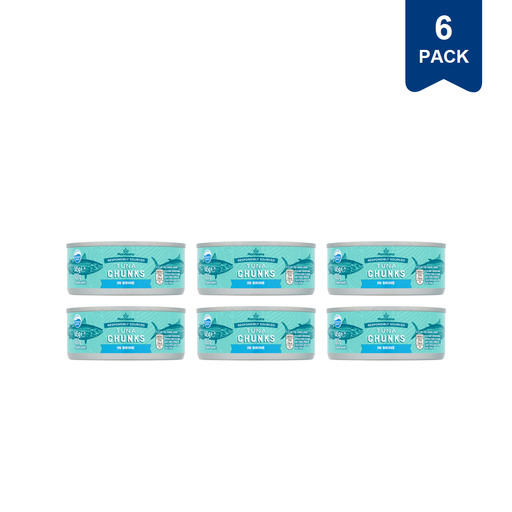 No image available
A six-tin brine pack for regular cupboard use, including sandwiches, pasta and salads. Check the drained quantity if you are comparing usable fish with another multipack.
 No image available
A six-tin spring-water option for stocking tuna for sandwiches, pasta or salads. Compare its drained quantity with other packs if usable fish per tin is important to your choice.
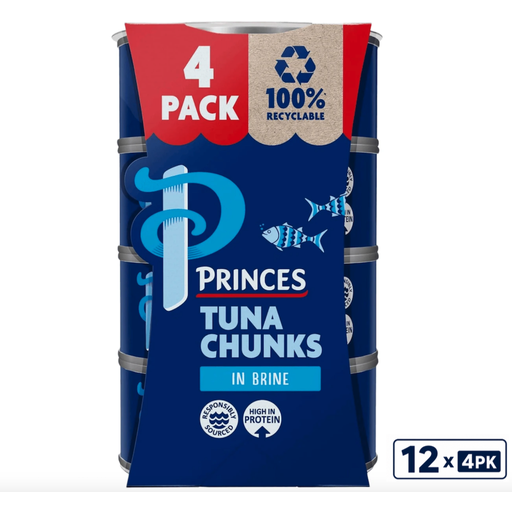 No image available
A brine option for shoppers considering a larger cupboard order. The listing title says 4 x 145g x 12 Packs, while its description details a four-tin pack; confirm the total bundle quantity before ordering. Check the drained quantity separately.
 No image available
A four-tin choice when sunflower oil is the packing liquid you want for your meals. Compare the exact label and drained quantity with water- or brine-packed alternatives rather than treating the liquids as equivalent.
 No image available
A four-tin spring-water pack for cupboard meals. Its stated 125g tin size differs from the 145g tins above; Sainsbury's lists 102g drained per tin for the corresponding 4 x 125g product, so check the exact pack when comparing usable quantity.
Start with the number and nominal size of the tins, then check whether a drained quantity is stated. A 4 x 125g pack and a 4 x 145g pack do not contain the same stated net quantity, and net and drained weights should not be treated as interchangeable.
No general rule follows from the packing liquid alone. The supplied ASDA product details give 0.90g salt per 100g drained for both its spring-water and brine 4 x 145g variants; read the nutrition panel on the exact product you choose.
Check the current ingredients and allergen information on the exact tin. GOV.UK identifies fish as an allergen that food businesses must declare when it is an ingredient in prepacked food.
Follow the instructions on that product's label. The supplied Princes brine listing says to empty and cover unused contents, refrigerate them and use them within two days; do not assume every product has identical instructions.