Households preparing several tuna meals
If tuna is used across family lunches or dinners, compare the drained amount in each can as well as the number of cans. A larger multipack is useful only if its individual portions fit the meals you make.


For repeated family meals, compare drained weight per can with protein per 100g drained before choosing a pack by its can count or headline weight. Check the exact variant’s packing medium and salt, then choose a can size your household can finish within its opened-storage instructions.
If tuna is used across family lunches or dinners, compare the drained amount in each can as well as the number of cans. A larger multipack is useful only if its individual portions fit the meals you make.
The packing medium deserves a separate look from protein. Princes’ spring-water and sunflower-oil variants list the same protein per 100g drained, but the oil-packed variant has a different energy and fat profile.
Salt values and opened-storage instructions differ between the cited Tesco and Sainsbury’s packs. Compare the exact labels if either factor determines whether a particular can size works for your household.
Start with the tuna available after draining, then compare the nutrition panel and whether individual cans fit your usual portions.
| Concern | What to check | Who this matters to |
|---|---|---|
| Protein per usable portion | Compare drained weight per can and protein per 100g drained; use both figures to work out the amount in your usual portion. | When planning repeated family meals, I want enough drained tuna in each can for the portions I make; about 45% of consumers would put usable protein yield first. |
| Energy, fat and salt | Read the per-100g values on the exact spring-water, brine or oil-packed variant. Check salt separately from protein. | If energy, fat or salt affects the meals I plan, I need the chosen variant’s nutrition panel to fit those priorities; about 33% of consumers would make that their main concern. |
| Can size and leftovers | Match individual cans to the amount normally used at once, and follow the product’s opened-storage instructions. | When a recipe uses only part of a can, I need a practical way to finish the rest; about 22% of consumers would prioritise portion fit and leftovers. |
The Princes and Tesco 145g spring-water cans cited by Tesco Groceries each declare 102g drained weight. The larger figure includes packing liquid, so it cannot be used directly to work out protein per can.
Use drained weight with the label’s protein-per-100g-drained figure, then calculate for the portion you expect to eat.
Princes’ spring-water and sunflower-oil products both list 23.5g protein per 100g drained. Tesco Groceries lists 180kcal and 9.5g fat per 100g drained for the cited oil-packed variant, so matching protein figures do not make their nutrition panels interchangeable.
Compare the exact variants if energy or fat matters to your choice; choose oil-packed tuna when that format suits the meal you are making.
The cited Sainsbury’s label says to use opened tuna within one day; the cited Tesco and Princes labels allow two days when stored as instructed. An individual can that is routinely left unfinished may be less practical despite a larger multipack.
Choose a can size that fits your normal meal, and follow the exact label for transferring and refrigerating leftovers.
Tuna left beyond its label’s opened-storage period may have to be discarded.
The NHS advises people who are pregnant or trying for a baby to have no more than four cans of tuna a week, or two tuna steaks a week, because tuna contains more mercury than other fish.
Account for tuna eaten across the week when deciding how many cans to buy for those circumstances.
Princes lists spring-water tuna in several sizes, including 4 x 145g, 6 x 145g and 8 x 145g formats.
Tesco Groceries lists its own-label spring-water tuna as four 145g cans, each with 102g drained weight.
The cited Sainsbury's spring-water pack contains four 145g cans.
Tesco Groceries lists a John West No Drain tuna multipack in a 3 x 100g format.
M&S lists tuna chunks in spring water in a 160g can.
These multipacks include spring-water, brine, sunflower-oil and no-drain tuna. Choose among them by the packing medium and individual can size that fit your meals, then check the current label for drained weight and nutrition.
 No image available
A six-can spring-water format for households planning several tuna meals. The 145g figure is the nominal weight of each can; check drained weight on the label before working out protein per portion.
 No image available
A four-can spring-water option when that individual nominal can size suits your meals. Check its drained weight and protein label to calculate the amount in each portion.
 No image available
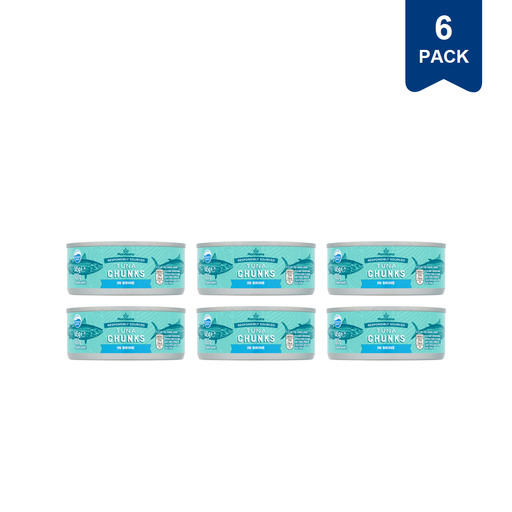
A six-can format for households choosing tuna in brine rather than spring water. Check the exact salt value and drained weight on the label before comparing it with another multipack.
 No image available
A four-can option when sunflower oil is the packing medium you want. Compare the exact energy and fat values with other variants, and check drained weight before calculating protein per can.
 No image available
A three-can no-drain format for meals where avoiding the draining step matters. Check how the current label states protein values before comparing its per-can yield with tuna labelled by drained weight.
Use the drained weight of the portion you will eat and the pack’s protein per 100g drained. Tesco Groceries lists 102g drained weight for each 145g can in the cited Tesco and Princes packs, showing why nominal can weight alone is not enough.
No single packing medium suits every meal. The cited Princes spring-water and sunflower-oil variants both list 23.5g protein per 100g drained; compare their energy and fat panels if those values influence whether you choose water or oil.
Follow that product’s label for transferring, refrigerating and using the contents. The cited Sainsbury's pack specifies one day after opening, while the cited Tesco and M&S packs specify two days; Food Standards Scotland also advises checking opened-food storage instructions.
Yes. The NHS advises people who are pregnant or trying for a baby to have no more than four cans of tuna a week, or two tuna steaks a week, because tuna contains more mercury than other fish. That limit matters when planning how often to use a multipack.
No. The NHS states that fresh and canned tuna do not count as oily fish, so a tuna multipack does not fulfil that part of oily-fish guidance.