Budget-first cupboard shoppers
If you stock several tins for everyday meals, the weight of tuna left after draining is more useful than the tin’s total weight when comparing pack sizes.


For a budget shop, do not choose plain tinned tuna on a “reduced sugar” claim alone: the checked Tesco, Princes, John West and M&S products list 0g or 0.0g sugars per 100g. Compare drained weight to understand how much tuna a pack provides, then check the exact tin’s ingredients and nutrition label. A no-drain pack is a separate convenience choice, not a sugar-reduction route.
If you stock several tins for everyday meals, the weight of tuna left after draining is more useful than the tin’s total weight when comparing pack sizes.
If “reduced sugar” brought you to the tuna shelf, read the “of which sugars” line on the exact product. The checked plain-tuna examples from Tesco Groceries, Princes Food and Drinks, John West and M&S already list 0g or 0.0g sugars per 100g.
If you want tuna ready for a sandwich or salad with less preparation, a pack explicitly labelled no-drain addresses that need. Check its usable quantity rather than assuming it is interchangeable with a standard tin.
For plain tinned tuna, check usable quantity and the nutrition label before deciding whether the packing liquid or a no-drain format suits the meal.
| Concern | What to check | Who this matters to |
|---|---|---|
| Usable tuna quantity | Compare drained weight across standard tins and multipacks; distinguish it from total tin weight. | When stocking the cupboard, I want to know how much tuna remains once the liquid is drained. About 46% of consumers put comparable usable quantity first. |
| Sugar-label reassurance | Read “of which sugars” per 100g and the ingredients on the exact product, particularly for flavoured tuna. | If I am seeking a low-sugar-labelled tin, I want the nutrition panel to confirm it rather than relying on the packing liquid. For about 36% of consumers, checking sugar is the primary need. |
| Minimal preparation | Check whether the pack explicitly says no-drain or ready to eat, and compare its usable content with a standard tin. | For a quick lunch, I may prefer opening the pack without draining it. That convenience comes first for about 18% of consumers. |
In Princes Food and Drinks’ labels for tuna chunks, spring water, brine and sunflower oil each show 0.0g sugars per 100g drained. The differences relevant to a particular meal lie elsewhere on those labels: the oil-packed version lists 180 kcal per 100g drained against 99 kcal for spring water, while brine lists 0.9g salt against 0.85g for spring water.
The checked plain-tuna labels from Tesco Groceries and Princes Food and Drinks show 0g or 0.0g sugars across different packing liquids. A sugar figure alone does not describe the tin’s salt, energy or usable quantity.
Read the sugars line alongside the ingredients and other nutrition values on the exact pack.
Some of a standard tin’s labelled weight is packing liquid, so tins of different sizes cannot be compared by total weight alone.
Use drained weight where it is shown, and check the usable content of no-drain packs separately.
Princes Food and Drinks lists 0.0g sugars per 100g drained for its checked spring-water, brine and sunflower-oil chunks. Its oil and brine versions differ from spring water in other listed nutrition values.
Choose the liquid for the recipe you are making, then compare energy, fat or salt if those details matter to you.
Fish is an allergen in these tuna products. The checked John West and M&S product information also specifies refrigeration after opening and use within two days.
Read the allergen declaration and follow the storage and opened-pack instructions for the product in hand.
Tesco’s own-label Tuna Chunks in Spring Water provide a standard-tin reference for checking drained weight and nutrition.
Princes Food and Drinks has checked tuna-chunk labels for spring water, brine and sunflower oil, allowing a product-specific packing-liquid comparison.
John West’s checked No Drain Tuna Chunks in Springwater 3 x 100g pack is an option when opening and using tuna immediately matters.
M&S Tuna Chunks in Spring Water provide another plain-tuna label to compare.
These packs cover standard spring-water chunks, brine-packed chunks and a no-drain spring-water option. Check the pack format and usable quantity against your cupboard or quick-meal plans.
 No image available
The no-drain format suits a sandwich or salad when you want to use the tuna immediately. The checked John West 3 x 100g product lists 0g sugars per 100g; check its usable quantity when comparing it with standard tins.
 No image available
Four 125g spring-water tins suit cupboard stocking when you prefer several smaller packs. Joybuy’s information for this exact pack lists 0g sugars; check drained weight before comparing its usable quantity with another multipack.
 No image available
This four-pack is a brine-packed alternative if that packing liquid suits your meals. Brine is not, by itself, a reason to expect less sugar than spring water; read this pack’s sugars and salt lines before choosing.
 No image available
Six 145g spring-water tins offer a larger cupboard pack than the four-can options shown here. Compare drained weight if the amount of usable tuna is your deciding factor, and read the nutrition label on the pack.
 No image available
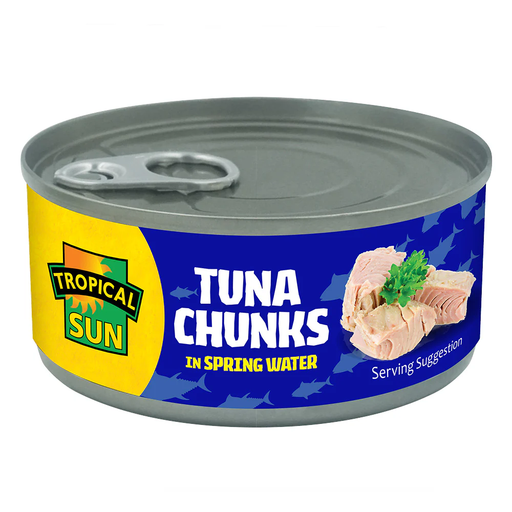
This 160g spring-water tin is another standard format for sandwiches or salads. Check its drained weight and the basis of its nutrition values before making a like-for-like comparison with other tins; read the exact pack’s allergen declaration.
For plain tuna, start with the exact tin’s sugars line rather than a reduced-sugar description. The checked Tesco Groceries, Princes Food and Drinks, John West and M&S examples list 0g or 0.0g sugars per 100g; check ingredients as well when considering a flavoured or sauce-based product.
Compare their drained weights, not just the number of tins or the weight printed prominently on each can. Packing liquid contributes to a standard tin’s total weight, while a no-drain product needs its usable content checked on its own terms.
Not in the checked Princes Food and Drinks products: both its sunflower-oil and spring-water chunks list 0.0g sugars per 100g drained. Their energy values differ—180 kcal and 99 kcal per 100g drained respectively—so read the full label if that difference affects your choice.
Follow the instructions on the exact pack. The checked Tesco Groceries and M&S products say to transfer unused contents to a non-metallic container, refrigerate them and consume them within two days.
No. The checked tuna products declare fish as an allergen, regardless of their sugar figures. Read the exact pack’s allergen information rather than using its flavour or sugar description to judge suitability.