Multipack planners
If you expect to use tuna across several meals, compare the amount in each drained tin as well as the number of tins. Separate cans can help you open only what you need.


Choose a standard multipack if you expect to use separate tins across meals; choose a no-drain format if skipping the draining step matters more during roast preparation. Compare drained contents to judge how much tuna you can use, check salt on the exact product, and treat sourcing claims as specific to the labelled variant.
If you expect to use tuna across several meals, compare the amount in each drained tin as well as the number of tins. Separate cans can help you open only what you need.
If tuna will be mixed with gravy, stuffing or condiments, the salt figure on the exact tin may matter more to your choice than whether it is packed in spring water or brine.
If you are handling several parts of a roast at once, a product expressly labelled no-drain or pre-drained removes a preparation step. Check its usable quantity alongside a conventional tin.
For roast-prep days, start with the amount of tuna you expect to use, then check the exact tin for salt, preparation instructions and any sourcing claim that matters to you.
| Concern | What to check | Who this matters to |
|---|---|---|
| Usable quantity | Compare stated drained weights, not just can count or net weight. Tesco Groceries lists 4 × 10²g drained contents for its 4 × 145g spring-water pack. | If I plan to use tuna over several meals, I need to know how much each opened tin will provide. About 36% of consumers put usable quantity first. |
| Salt and packing liquid | Read salt per 100g on the exact product and check whether that figure is for drained tuna. Labelled spring-water examples from Tesco Groceries and Sainsbury's differ: 0.90g and 0.12g salt per 100g drained, respectively. | When tuna is going into a meal with gravy or condiments, I want to check its salt figure rather than rely on the words “spring water”. Roughly 29% of consumers make the salt and packing-liquid profile their main concern. |
| Preparation mess | Check whether the exact pack is labelled no-drain or pre-drained; compare its stated usable quantity with ordinary chunks. | With several dishes underway, I would rather add tuna without draining a tin. Avoiding that step is the primary need for about 21% of consumers. |
| Sourcing claim | Look for a certification or catch-method statement on the selected variant, rather than assuming it applies across a brand. | If a stated catch method influences my choice, I need to see it on the tin I am buying. A specific sourcing claim comes first for approximately 14% of consumers. |
Net weight includes the packing liquid, while drained weight gives a clearer indication of the tuna available after draining.
Check the drained weight of each tin and the total across the pack before choosing a size for several meals.
Product labels differ. Tesco Groceries lists 0.90g salt per 100g drained for one spring-water multipack, while Sainsbury's lists 0.12g per 100g drained for a spring-water single tin.
Use the salt figure and its measurement basis on the exact product, particularly when adding tuna to a meal with salty accompaniments.
If you open more than the meal needs, the remaining tuna needs storing for later use.
Transfer leftovers to a covered, non-metallic container, refrigerate them and follow the timing on that product's label.
Certification and catch-method statements apply to particular products and may differ between variants.
Check the statement on the selected can or its product page before making it part of your decision.
An own-label option with a stated drained weight for its 4 × 145g spring-water pack.
Own-label spring-water and brine examples show why the precise variant matters.
A branded range that includes conventional multipacks and a separate drained-tuna range.
A route to consider when avoiding the draining step is a priority.
An own-label spring-water tin with a stated catch-method claim.
These packs offer separate tins for meals across a busy roast-prep day, including no-drain options and four-can packs in spring water, brine or sunflower oil. Check each pack's drained contents and label when deciding which format suits you.
 Image unavailable
For adding tuna while other parts of the meal are underway, this labelled no-drain option avoids a draining step. The pack contains three 100g cans; check the label for the quantity and nutrition basis relevant to your comparison.
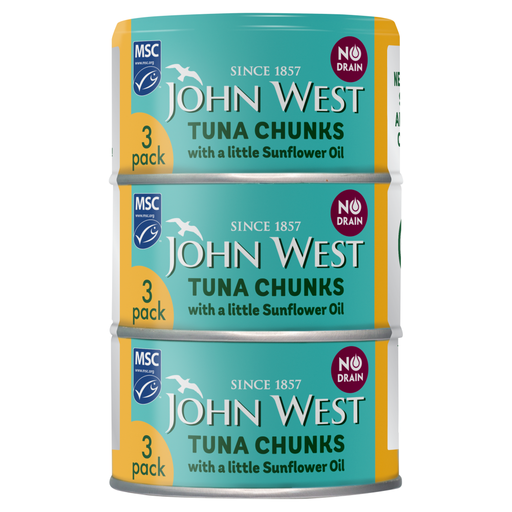 Image unavailable
Choose this labelled no-drain format when skipping the draining step matters and sunflower oil suits the dish. It contains three 100g cans; it is not the spring-water variant, so compare the exact labels if packing liquid or salt affects your choice.
 Image unavailable
Four separate tins suit plans to use tuna across several meals rather than opening the whole pack at once. This is a brine-packed 4 × 145g pack; check its drained contents and salt figure for the portions you have in mind.
 Image unavailable
This four-can spring-water pack offers separate tins for meals on different days. Each can is labelled 125g; check the exact pack's draining instructions and drained contents rather than treating it as a No Drain product.
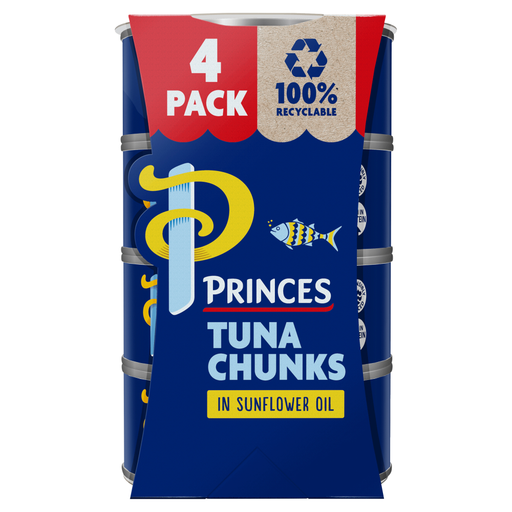 Image unavailable
For meals where sunflower-oil-packed tuna suits the recipe, this pack provides four separate 145g cans. Check the drained contents and the nutrition label's measurement basis before comparing it with a spring-water or brine pack.
Drained weight shows how much tuna remains after the packing liquid is removed, whereas net weight includes that liquid. Compare the stated drained contents of the tins you expect to use, especially when pack sizes differ.
No. The exact label matters: Tesco Groceries lists 0.90g salt per 100g drained for its cited spring-water multipack, while Sainsbury's lists 0.42g per 100g drained for its cited brine multipack. Compare figures on the same measurement basis for the products you are considering.
Move unused tuna to a covered, non-metallic container and refrigerate it. Follow the storage and use-by instructions on the exact tin, as product instructions can differ.
A claim on one product does not establish the catch method or certification of another variant. Check the selected tin or its product page for the specific statement you want.
Tuna is fish. Read the exact product's ingredient and allergen information, particularly if you are considering a flavoured or multi-ingredient version.