No-cook and low-wash-up campers
If you are assembling wraps, crackers, couscous or salads without heating the tuna, a small tin or a no-drain format can mean less liquid to handle and less food left over.


Choose a tin you can finish in one meal if you cannot reliably chill leftovers: unopened tinned tuna is convenient to pack, but the checked product labels call for refrigeration after opening. Smaller tins and no-drain formats can simplify a low-prep trip; for shared meals, compare drained weight as well as pack size, and check the exact label for packing liquid, allergens and storage instructions.
If you are assembling wraps, crackers, couscous or salads without heating the tuna, a small tin or a no-drain format can mean less liquid to handle and less food left over.
Plan to finish an opened tin when you cannot keep leftovers chilled. Checked tuna labels require refrigeration after opening, and the Food Standards Agency warns that a cool box is unlikely to keep food chilled for an extended trip.
For a shared meal, compare the drained amount per tin rather than relying on the outer pack weight. Packing liquid and sourcing statements are also worth checking on the individual product.
For camping food, start with the amount you expect to eat once a tin is opened. Then consider how much preparation the format needs and what the exact pack says about nutrition and sourcing.
| Concern | What to check | Who this matters to |
|---|---|---|
| Chilled leftovers | Compare drained weight per tin with the amount needed for one meal; read the opened-tin storage instructions. | If I cannot keep food chilled at camp, I want a tin I can finish rather than an opened remainder to store. About 33% of consumers put avoiding chilled leftovers first. |
| Preparation and disposal | Check whether the exact product is labelled no-drain and how it opens; consider where packing liquid and empty tins will go. | When washing-up or disposal facilities are limited, I want less liquid to handle and no need to heat the tuna. Minimising preparation is the primary concern for about 27% of consumers. |
| Packing liquid and nutrition | Read the packing liquid and compare the exact products’ per-100g energy, fat and salt declarations. | For a planned camping meal, I want to know whether spring water, oil or brine fits the ingredients and label values I am comparing. About 20% of consumers make packing liquid and nutrition their main consideration. |
| Sourcing information | Look for a catch-method statement or certification claim on the specific tin or multipack. | If a sourcing claim influences my choice, I want it to apply to the product I am packing, not just the brand. Checking that information comes first for about 20% of consumers. |
Checked tuna labels require opened contents to be refrigerated. The Food Standards Agency advises storing chilled food below 5°C and warns that a cool box is unlikely to maintain chilling for an extended trip.
Choose a tin you expect to finish, or make sure you can keep leftovers chilled and follow the storage instruction on that pack.
Packing liquid contributes to the stated weight. For example, Tesco lists 56g drained per tin for its 3 x 80g spring-water pack, while Princes lists 102g drained per tin for its 4 x 145g spring-water pack.
Use drained weight per tin to plan a solo serving or the amount needed for a shared meal.
For the checked M&S products, sunflower-oil tuna lists 189 kcal and 9.0g fat per 100g; spring-water tuna lists 99 kcal and 0.6g fat per 100g. Those figures describe the two products, not all oil- and water-packed tuna.
Compare the current labels if energy or fat values affect your choice of ingredients.
Cheshire Fire & Rescue Service warns against using fuel-burning devices inside a tent, camper or other enclosed shelter; opening flaps or windows does not prevent dangerous carbon-monoxide build-up.
Make a meal that does not need heating, or check the campsite’s rules before cooking outdoors.
Its checked No Drain 3 x 100g spring-water pack is relevant when opening a smaller tin without draining it matters at camp.
The checked 4 x 145g spring-water pack offers separate tins for planned group or multi-meal use.
The checked own-label spring-water packs include 3 x 80g and 4 x 160g formats, giving different per-tin amounts to consider.
Its checked range includes a 3 x 80g spring-water pack and a separate 145g product with a pole-and-line statement.
Its checked 4 x 145g spring-water pack is an option to assess by tin size and the nutrition declaration on its label.
The checked spring-water and sunflower-oil products provide two packing liquids to compare for a planned meal.
These tins cover smaller no-drain packs, multi-tin packs and a single tin for camping meals. Check the individual pack for the drained amount you need and for instructions on any leftovers.
 No image available
For a meal where draining is inconvenient, this pack has three separate 100g tins. It contains fish; refrigerate any opened remainder and use it within 2 days.
 No image available
For a low-prep meal using springwater-packed tuna, this no-drain pack contains three separate 100g tins. It contains fish; refrigerate opened contents and use them within 2 days.
 No image available
For several planned meals, this pack has four separate 125g tins. Check the individual tin if draining matters to your meal plan; transfer any opened remainder to a non-metallic container, refrigerate it and use it within 2 days.
 No image available
For group meals or several planned meals using oil-packed tuna, this pack contains four 145g tins. It contains fish; refrigerate opened leftovers and use them within 2 days.
 No image available
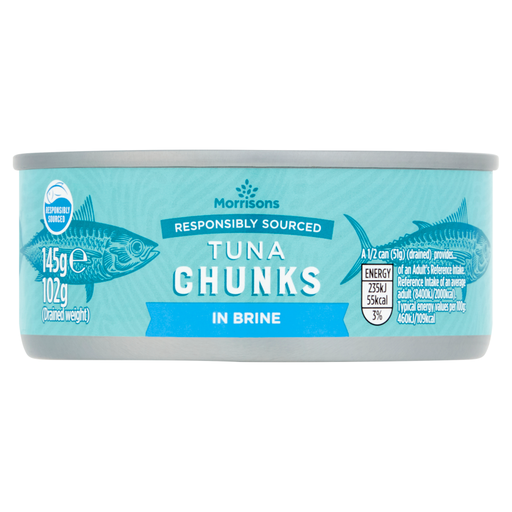
For a meal planned around one tin rather than a multipack, this is a 145g brine-packed option. It contains fish and may contain bones; refrigerate opened contents and use them within 2 days.
No. Tinned tuna can go into a cold meal without heating it. Use clean hands and utensils, protect food from contamination and follow the instructions on the tin.
Only if you can refrigerate it and meet that product’s storage instructions. Checked Tesco and Princes labels specify use within 2 days after opening, while Sainsbury's specifies 1 day for its checked 3 x 80g pack; if chilling is not dependable, choose a tin you can finish.
No. The NHS states that fresh and canned tuna do not count as oily fish, so do not treat a tin of tuna as an oily-fish portion when planning other meals.