Salt-conscious lunch planners
If tuna regularly goes into your sandwiches, salads, jacket potatoes or pasta, compare salt per 100g and in the portion you intend to eat. The packing liquid alone cannot tell you how much salt that lunch contains.


Choose tinned tuna by comparing salt on the same basis, preferably per 100g drained, then check how much is in the portion you will eat. Spring water is a useful starting point when choosing between water and brine, as the NHS suggests, but it does not establish that a tin is reduced in salt; no-drain formats can save preparation time without answering the salt question.
If tuna regularly goes into your sandwiches, salads, jacket potatoes or pasta, compare salt per 100g and in the portion you intend to eat. The packing liquid alone cannot tell you how much salt that lunch contains.
If draining a tin is awkward at lunchtime, a no-drain or drained-and-ready format may remove a preparation step. Compare its nutrition label just as you would a conventional tin.
If a stated fishing method or certification matters to you, check the exact product rather than assuming a claim applies across a brand. Consider that information separately from its salt content.
For a salt-conscious lunch, start with a comparable nutrition figure, then consider preparation and product-specific sourcing claims.
| Concern | What to check | Who this matters to |
|---|---|---|
| Salt and portion size | Compare salt per 100g on the same drained or as-sold basis, then check the amount in your portion. Do not treat spring water as a reduced-salt claim. | If I use tuna often for lunch, I want to know how much salt my actual portion contributes. About 50% of consumers put that salt comparison first. |
| Quick preparation | Check whether the exact tin needs draining, how much tuna it contains and its instructions for leftovers. | When lunch has to be assembled quickly, avoiding draining and managing an unfinished tin can shape my choice. For about 30% of consumers, ease of preparation is the primary concern. |
| Responsible sourcing | Look for a sourcing method or certification stated for the exact product; assess its nutrition separately. | I may want a stated sourcing credential before choosing between tins that meet my lunch needs. That is the leading consideration for about 20% of consumers. |
It does not establish a reduced-salt claim. Tesco Groceries lists 0.90g salt per 100g for its checked 145g spring-water tuna and 1.00g per 100g for its brine version.
Use the packing liquid as an initial filter, then decide from the exact tin’s nutrition panel.
Those figures describe different quantities. Sainsbury’s lists 0.45g salt per half-can serving and 0.75g per 100g for its checked Drained & Ready Water tuna.
Compare equivalent per-100g figures first, noting whether they refer to drained tuna or the product as sold. Then use the label to assess your planned portion.
Other ingredients can contribute salt too, so choosing a tin does not settle the amount in a finished sandwich, salad or pasta dish.
Check the labels of ingredients you plan to add, particularly sauces or other prepared foods.
Allergen information and directions for opened tuna matter when deciding whether a pack suits the meal and whether you will use it all at once.
Read the exact pack’s fish-allergen information, any bone warning and its instructions for storing leftovers.
The checked spring-water and brine listings offer a comparison within Tesco’s own-label tuna range.
The checked Drained & Ready Water tin is a format to consider when lunch preparation needs to be quick.
The checked spring-water chunks and tuna steak offer two M&S formats with separately stated nutrition figures.
The No Drain spring-water format is relevant when avoiding a draining step matters at lunchtime.
The checked spring-water multipack gives shoppers another pack format to compare for planned lunches.
These spring-water tuna options include a no-drain pack and conventional tins. Compare the exact labels for salt before choosing one for lunch.
 Image unavailable
The no-drain format suits a sandwich or salad assembled with little preparation. Compare the exact can’s salt figure on a consistent basis and check the amount in the portion you will use.
 Image unavailable
The four-tin spring-water pack suits lunches prepared on separate days. Check the exact tin’s salt per 100g and your intended portion; do not assume this variant has the no-drain format.
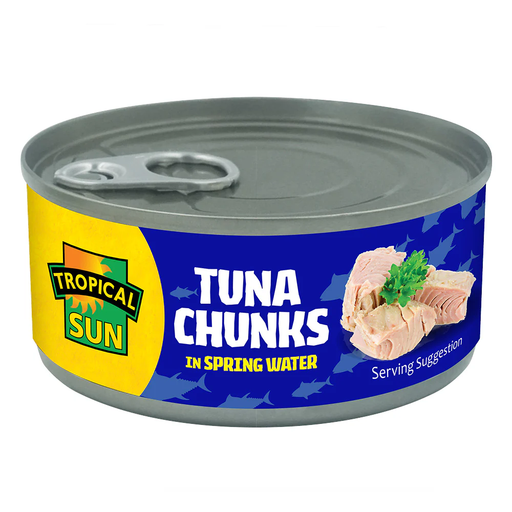 Image unavailable
This spring-water tin can be considered for a salad or sandwich, but the liquid needs draining. Check the pack’s salt figure and whether it is stated for drained tuna before comparing it with another product; read the allergen information on the exact pack.
No. The NHS suggests choosing tinned fish in water rather than brine when cutting down salt, but compare the exact products before deciding. Tesco Groceries lists 0.90g salt per 100g for its checked 145g spring-water tuna and 1.00g per 100g for its checked brine version; that pair does not establish a rule for every brand.
Start with salt per 100g on a consistent drained or as-sold basis, then work out the amount in the tuna portion you intend to eat. The NHS advises adults to have no more than 6g of salt a day, so other ingredients in the lunch matter too.
Follow the exact pack’s storage directions. The checked Tesco and M&S product information instructs shoppers to transfer unused tuna to a non-metallic container, cover it, refrigerate it and consume it within two days of opening.
Yes. NHS pregnancy guidance says not to eat more than four cans of tuna or two tuna steaks a week. That guidance concerns tuna consumption during pregnancy, not whether a particular tin is lower in salt.