Who is buying?
The useful pack depends on whether you are preparing repeated lunches, checking a particular label requirement or choosing tuna by its stated sourcing method.
Lunch planners comparing usable quantity
If you are making several sandwiches or quick family meals, compare drained weight as well as tin count. Tesco Groceries lists a 145g spring-water tin with 102g of drained tuna, illustrating why the front-of-pack weight alone does not tell you how much tuna you will use.
Families checking labels
If fish allergens, ingredients or salt affect your choice, read the current label of the exact tin. Spring-water and brine products cannot be sorted by salt content from their packing descriptions alone.
Shoppers prioritising sourcing
If a catch method or certification is decisive, look for a claim on the selected product. MSC certification, pole-and-line fishing and a retailer’s wider sourcing policy describe different things.
What matters when choosing?
For school lunches and quick family meals, establish how much tuna you can use, then check the label requirements and preparation format that matter to your household.
| Concern |
What to check |
Who this matters to |
| Usable quantity |
Compare drained weight per tin and the number of tins; check that the pack covers the lunches or meals you plan to make. |
When planning several lunches, I need to know how much tuna remains after draining, not just the weight of the filled tins. About 33% of consumers put comparable usable quantity first. |
| Allergens, ingredients and salt |
Read the current fish-allergen declaration and ingredients; compare salt figures on the same per-100g basis. |
If a lunch needs a careful label check, I want to confirm its ingredients and salt before choosing a pack. For about 27% of consumers, label and salt clarity is the primary need. |
| Lunch preparation |
Check whether the exact product is standard chunks, no-drain or ready to use, and read its opened-tin instructions. |
On a busy school morning, I may favour a format that takes fewer preparation steps. Roughly 20% of consumers put preparation convenience first. |
| Sourcing claims |
Look for certification or catch-method wording on the selected product; distinguish it from a retailer-wide policy. |
If the fishing method guides my choice, I need a claim that applies to the tin I am buying. That is the leading concern for about 20% of consumers. |
Brands to consider
These examples show differences among specific tuna products and ranges, rather than establishing one choice for every lunch or every product from a brand.
Tesco
Its own-label spring-water chunks provide a straightforward example for checking drained quantity and the nutrition panel.
- Tesco Groceries lists 102g drained weight for its cited 145g tin, alongside an MSC certification claim and FAD-free catch details for that product.
- The same listing states 0.90g salt per 100g; spring-water packing alone does not establish a lower salt figure.
Sainsbury’s
Its own-label tuna includes brine and spring-water formats, allowing a choice by packing liquid and pack format.
- Sainsbury’s states that its cited brine tuna is pole-and-line caught from MSC-certified fisheries and lists 0.42g salt per 100g drained.
- Those sourcing and nutrition details apply to the cited product, not automatically to every Sainsbury’s tuna tin.
Asda
Its own-label brine multipack is an option to examine when planning repeated meals.
- ASDA Groceries lists 0.90g salt per 100g drained and identifies fish in the allergen information for its cited four-pack.
- Asda’s corporate seafood-sourcing policy describes wider aims; check the selected tin for any product-specific certification or catch-method claim.
Princes
Its conventional tuna chunks are listed in several packing liquids and multipack formats.
- The cited Princes spring-water four-pack at ASDA Groceries lists 0.85g salt per 100g drained and carries an MSC claim.
- Compare the particular pack’s drained quantity and label rather than applying those figures to other Princes formats.
John West
Retailer listings include conventional chunks and a No Drain range for different preparation routines.
- Tesco Groceries lists a John West No Drain three-pack as well as a conventional spring-water four-pack.
- Confirm the exact pack’s drained quantity, ingredients and preparation instructions before choosing it for a particular routine.
M&S
Its own-label tuna includes spring-water chunks for shoppers comparing stated catch methods.
- Marks & Spencer describes its cited spring-water chunks as pole-and-line caught and lists 0.75g salt per 100g.
- Check the claim and nutrition panel on the particular product you select rather than extending them across the range.
Joybuy tuna selections
These Joybuy listings include spring-water and brine chunks in single tins or multipacks, plus a John West three-pack labelled No Drain. If skipping the draining step is important, confirm that pack’s instructions before choosing it.
 Image unavailable
John West Tuna Chunks in Springwater, 4 x 125g
A four-tin spring-water pack to consider when preparing tuna for several sandwiches, salads or pasta meals.
Check the drained weight and current label when comparing usable quantity, salt and fish-allergen information.
View on Joybuy
 Image unavailable
Princes Tuna Chunks in Brine, 4 x 145g
A four-tin brine pack for repeated lunches or quick meals when you prefer this packing liquid.
Use its drained weight and current nutrition panel for a like-for-like comparison with spring-water packs; check the fish-allergen declaration.
View on Joybuy
 Image unavailable
Morrisons Fad Free Tuna Chunks in Spring Water, 145g
A single spring-water tin to consider when one tin fits the lunch or meal you are preparing.
Check the drained weight, fish-allergen declaration and salt figure on the current label. If the Fad Free wording guides your choice, check the product’s specific sourcing information.
View on Joybuy
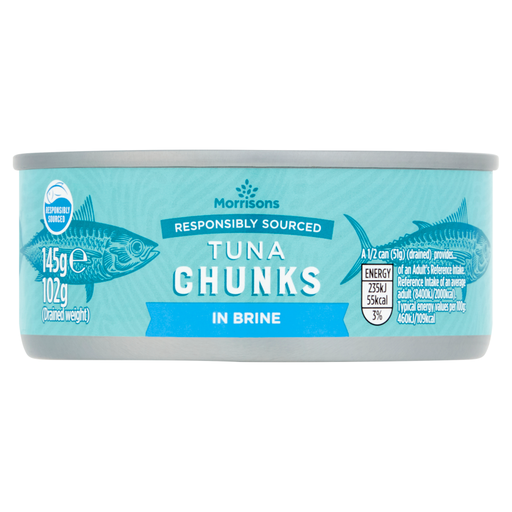 Image unavailable
Morrisons Fad Free Tuna Chunks in Brine, 145g
A single brine-packed tin for a sandwich, salad or quick family meal when a multipack is not needed.
Check its drained weight and salt figure against the spring-water alternative. The product information warns that some bones may remain; check its specific sourcing information if the Fad Free wording matters to you.
View on Joybuy
 Image unavailable
John West No Drain Tuna Chunks in Springwater, 3 x 100g
A three-tin spring-water pack to consider if a No Drain format would simplify lunch preparation.
The product descriptions give conflicting draining instructions, so confirm how this exact pack is used before relying on that convenience. Check its label for fish allergens; the description also warns that small bones may be present.
View on Joybuy
Common questions
Is tinned tuna a shellfish allergen?
Tuna is fish, not shellfish. GOV.UK lists fish, crustaceans and molluscs as separate regulated allergens and says that allergens present in prepacked food must be clearly labelled in the ingredients list. Check the exact tin for its fish declaration and any other relevant allergen or precautionary wording.
Should I check the label when buying a familiar tuna product?
Yes. Read the current tin’s ingredients, allergen declaration and nutrition panel when a particular ingredient or salt figure affects your choice; do not rely on the packing-liquid description or a label you checked previously.
How should I store tuna left after opening a tin?
Follow the chosen product’s instructions for transferring, covering and refrigerating it. The cited Sainsbury’s brine tuna says to use leftovers within one day, while the cited Asda and M&S products say within two days; use the timeframe on your own tin.
Does canned tuna count as oily fish?
No. The NHS states that fresh and canned tuna do not count as oily fish, so that classification should not be assumed from the word fish on the label.
Can I assume tinned tuna has no bones?
No. Some tuna product information warns that small bones may remain. Read the warning on the selected tin and take care when preparing it, particularly for a child’s lunch.


