Low-sugar recipe planners
You are making a savoury filling or topping and want to compare the sugar declared for the tuna itself before adding other ingredients.


For a savoury school bake-sale recipe, check plain tuna in spring water before looking for a tin labelled reduced sugar: Tesco Groceries and Sainsbury's list examples with 0g and less than 0.5g sugars per 100g drained, respectively. Compare the exact pack's drained yield and salt, then account for fish and any allergens added by the recipe. Check the school's arrangements for preparing and offering food before the event.
You are making a savoury filling or topping and want to compare the sugar declared for the tuna itself before adding other ingredients.
You need to identify fish in the tuna and check bread, pastry, mayonnaise, cheese, sauces and toppings for allergens in the finished food.
You need enough tuna after draining for multiple portions and want to compare salt declarations on the same per-100g basis.
For tuna intended for a school bake sale, check the tin's nutrition panel and the ingredients of the finished recipe before calculating how many tins to buy.
| Concern | What to check | Who this matters to |
|---|---|---|
| Sugar in the tuna | Read sugars per 100g drained and the ingredient list on the exact tin. Check sauces and toppings separately. | If I am planning a savoury filling with little sugar from the tuna itself, I want its current nutrition panel rather than relying on a reduced-sugar phrase. About 38% of consumers put that sugar check first. |
| Finished-food allergens | Record fish, then check every added ingredient and relevant cross-contact information. Keep the packaging available while preparing the food. | When I am organising food for a school event, I need to know what allergens are in each finished item before offering it. That is the primary concern for about 38% of consumers. |
| Drained yield and salt | Plan quantities using drained weight, and compare salt per 100g on the same basis. Follow the chosen tin's storage instructions after opening. | For a batch of portions, I need enough usable tuna and want to see how the salt declarations compare before choosing a pack. About 24% of consumers place yield and salt first. |
That phrase does not give the sugar amount in the tin you will use. Plain spring-water products can have different declarations, and added ingredients change the finished recipe.
Compare sugars per 100g drained on the purchased tin, then check the other ingredients in the recipe separately.
GOV.UK lists fish, crustaceans and molluscs as separate allergens. A tuna ingredient establishes fish; it does not establish that the recipe contains shellfish.
Identify fish clearly, then check the remaining ingredients and relevant cross-contact information before describing the finished food.
Pack size is not the same as the amount of tuna after draining. Salt declarations can also differ between spring-water products.
Calculate the recipe from stated drained weight and compare salt per 100g on the same basis.
The arrangements for preparing and offering food can affect which procedures the organiser needs to follow. GOV.UK provides community-event guidance for England, Northern Ireland and Wales, but a school's particular arrangements still matter.
Ask the school who is responsible for the food and its allergen information, and seek local-authority advice if the event's status is unclear.
Tesco Groceries lists a skipjack tuna-chunks-in-spring-water four-pack of 4 × 145g.
Sainsbury's lists its own-label tuna chunks in spring water as a 4 × 145g pack.
Asda lists own-label skipjack tuna chunks in spring water in a 4 × 145g pack.
Joybuy lists Princes tuna chunks in spring water in a 4 × 145g pack.
Sainsbury's lists John West tuna chunks in spring water as a 4 × 125g pack, with 4 × 10²g drained weight.
Marks & Spencer lists a 160g tuna-chunks-in-spring-water product.
These tuna-chunks-in-spring-water options cover single tins and multipacks for a savoury bake-sale filling or topping. Check each pack's nutrition, drained yield and allergen information against your recipe.
 Image unavailable
The four-tin format is an option when a recipe calls for several tins. Sainsbury's lists 4 × 10²g drained weight for this pack, with less than 0.1g sugars and 0.8g salt per 100g drained. Check the directions and drained yield on the purchased pack before planning portions; the retailer listing also warns that some bones may remain.
 Image unavailable
The six-tin pack may suit a recipe needing multiple portions. Check sugars and salt on the purchased pack's nutrition panel, and use its stated drained weight to calculate how much tuna the recipe will yield.
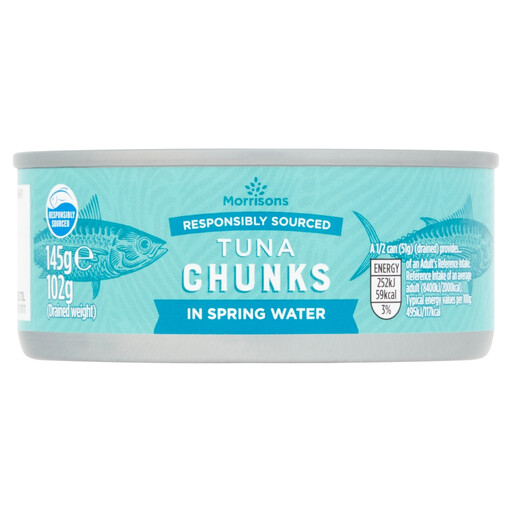 Image unavailable
This single tin is an option when the recipe does not call for a multipack. Read its current sugar and salt declarations, and check the drained weight rather than using 145g as the amount of tuna available after draining.
 Image unavailable
The No Drain format is worth considering if draining tins would complicate preparation of a small batch. Check the exact pack's preparation directions and the basis of its sugar and salt declarations before comparing them with drained-weight figures for other tuna.
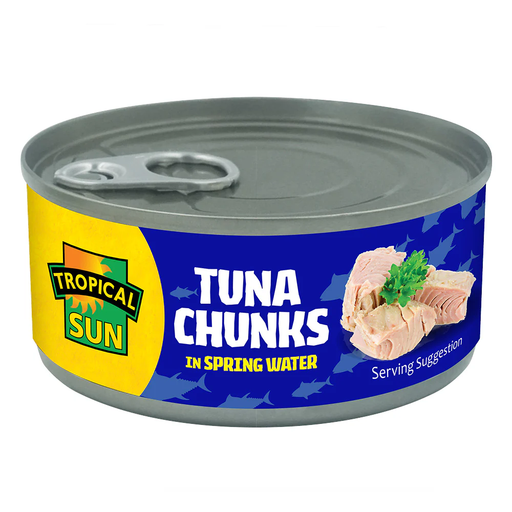 Image unavailable
This single tin is an option for a smaller savoury recipe. Check whether the pack's sugar and salt figures describe drained tuna, and read its allergen and cross-contact information alongside the labels of other recipe ingredients.
Not necessarily for a savoury tuna recipe. Tesco Groceries and Sainsbury's list plain spring-water examples at 0g and less than 0.5g sugars per 100g drained, respectively. Compare the current panel and ingredients on the tin you buy, as well as anything added to the filling.
Tuna is fish, not a reason by itself to describe a dish as containing shellfish. GOV.UK lists fish, crustaceans and molluscs separately. Check the complete recipe and relevant cross-contact information before describing its allergens.
Identify fish in the tuna and the allergens in every other ingredient, then ask the school who is responsible for preparing and offering the finished food. GOV.UK's community-event guidance for England, Northern Ireland and Wales addresses school fundraisers, but the applicable procedures depend on the activity and its arrangements. Confirm the school's policy and seek local-authority advice where needed.
Follow the storage directions on the selected tin and plan preparation around them. Product instructions can differ, so check how to store unused tuna and when to use it; calculate recipe quantities from drained weight where the product requires draining.