Households planning several meals
If tuna is on the menu more than once, separate tins let you stock the cupboard without opening the whole pack at once. Check whether the number and size of tins fit the meals you have in mind.


For a household planning several meals, separate tins in a four-pack make it easier to open only what is needed; a smaller no-drain multipack suits shoppers who put less draining and smaller portions first. A large individual tin makes more sense when one meal will use most or all of it. Compare the drained quantity, packing liquid and opening instructions for the exact product before choosing.
If tuna is on the menu more than once, separate tins let you stock the cupboard without opening the whole pack at once. Check whether the number and size of tins fit the meals you have in mind.
A smaller portion or a product explicitly labelled no-drain may be more useful than a larger pack if opening tins, pouring off liquid or managing leftovers is inconvenient.
Compare the packing liquid, ingredients, nutrition panel and fish-allergen declaration on the exact variant. If sourcing matters to you, check the individual pack for the relevant claim or certification.
Start with the meals and portions you expect to use, then decide whether handling, packing liquid or sourcing changes which format works for you.
| Concern | What to check | Who this matters to |
|---|---|---|
| Enough for planned meals | Compare tin count, size and drained weight where shown; consider whether you have room to store the pack. | If I am stocking up for several meals, I want enough separate tins without buying more than I will use. About 36% of consumers put planned-meal quantity first. |
| Opening and portioning | Check whether the exact product says no-drain, how it opens and how much is in each tin. | When draining is awkward or one large tin would leave leftovers, a manageable portion matters most; about 29% of consumers prioritise easier handling and portioning. |
| Packing liquid and label | Read the exact variant’s ingredients and its salt, protein and fat values on a consistent per-100g basis. | If the recipe calls for a particular packing liquid, I need to distinguish spring water, brine and oil before buying. About 21% of consumers make the packing medium and label their primary concern. |
| Sourcing and serving information | Look for sourcing claims on the individual pack; if preparing food for others, keep its fish-allergen information available. | For consumers chiefly concerned with the pack’s sourcing or the information needed when serving it, those details decide the purchase; the group is about 14%. |
Three-tin and four-tin packs can contain different quantities per tin. A larger total pack may also be inconvenient if its contents do not fit your planned meals.
Compare the stated tin sizes and drained weight where available, then decide whether the opening format or smaller portions matter more to you.
Water, brine and oil appear in different tuna products, and the ingredients and nutrition values belong to the exact variant rather than the brand as a whole.
Read the current label before choosing a tin for a recipe or a particular ingredient preference.
An unopened cupboard pack is convenient, but its contents need different handling once a tin is opened. Marks & Spencer instructs buyers of its spring-water tuna chunks to move unused contents to a non-metallic container, refrigerate them and eat them within two days.
Choose a tin size you expect to use and follow the storage instructions on the product you buy.
A sourcing statement does not tell you the tin size, packing liquid, opening method or ingredients.
Check any certification on the individual pack, then assess its label and format separately.
A reference point for conventional four-tin packs: Princes lists tuna chunks in brine as 4 x 145g.
Relevant when a smaller, no-drain multipack is the priority: Tesco lists a John West spring-water product as 3 x 100g with a twist opening.
Its tinned-tuna range provides own-label and branded pack formats to compare.
An alternative to a conventional multipack when a larger individual tin suits a meal.
Princes names Sainsbury's as a retailer for its 4 x 145g tuna chunks in brine.
These multipacks offer separate tins for planned meals, including a smaller no-drain option. Compare the individual listings carefully: similarly sized John West packs have conflicting packing-liquid details in the supplied product information.
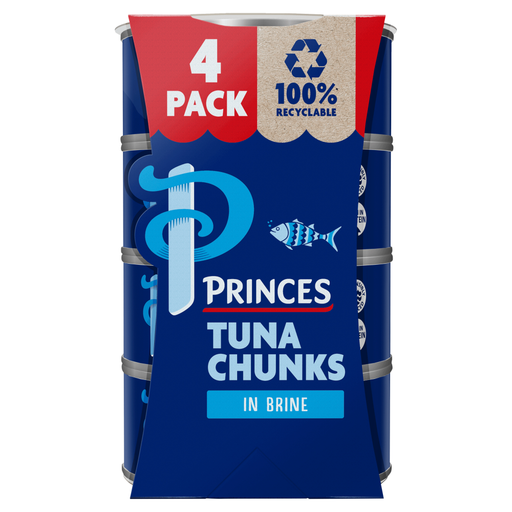 No image available
Four separate tins suit meals planned across several days. This is the brine variant; check its drained quantity and label when comparing it with other packing liquids.
 No image available
Choose this four-tin format if planned meals call for tuna packed in sunflower oil. Compare the exact label with the brine variant rather than assuming their ingredients or nutrition values match.
 No image available
Four separate 125g tins offer smaller nominal portions than the 145g four-packs shown here. Check the individual pack’s packing liquid and draining instructions before choosing this variant.
 No image available
The four-tin format may suit meals needing separate 125g portions. Confirm the packing liquid on the pack before buying, and check its opening and draining directions if handling is a deciding factor.
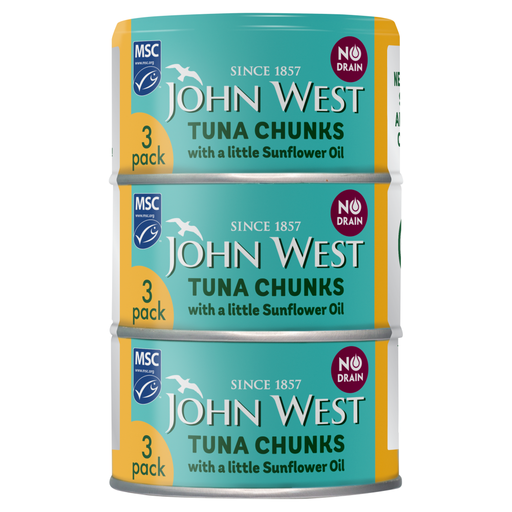 No image available
This smaller, explicitly no-drain multipack suits shoppers who want to avoid a draining step. It contains three 100g tins and is the sunflower-oil variant, so check that both the portion and packing liquid fit the meal.
A four-pack suits several planned meals when its tin size matches the portions you expect to use; a three-pack may suit you better if smaller tins or a no-drain format reduce leftover and handling concerns. Compare total and drained quantities on the exact products, not tin count alone.
Choose according to the recipe and the ingredients you want in the tin, then compare nutrition panels for the exact variants. Princes lists tuna, water and salt for its 4 x 145g brine pack; do not apply that ingredient list to its oil-packed pack or another brand’s spring-water product.
Follow the storage directions on the tin you bought. Marks & Spencer instructs buyers of its spring-water tuna chunks to transfer unused contents to a non-metallic container, refrigerate them and eat them within two days; check other products for their own instructions.
No. The NHS says fresh and canned tuna do not count as oily fish. The packing liquid does not change how tuna is classified in that guidance.
Keep the exact product’s fish-allergen information with the food you prepare. GOV.UK guidance says food business operators must provide allergen information and follow labelling rules; buying sealed tins for a private household is a different situation from operating a food business.