Students making several dinners
Spring-water chunks can be mixed into pasta bakes, jacket potatoes or sandwiches. A multipack is worth considering when you can use all its tins; compare the drained weight, not just the pack size.


For pasta bakes and jacket potatoes, start with spring-water chunks in a multipack if you will use every tin, and check the drained weight when comparing pack sizes. No-drain tuna is useful when you want to skip preparation; steak-format tuna suits a salad or bowl where its firmer flakes will remain visible.
Spring-water chunks can be mixed into pasta bakes, jacket potatoes or sandwiches. A multipack is worth considering when you can use all its tins; compare the drained weight, not just the pack size.
No-drain tuna can go straight into a quick meal without tipping away packing liquid. Consider whether that step matters for the dishes you actually make.
Steak-format tuna is worth considering when you want firmer flakes to remain visible. For a filling that will be thoroughly mixed, chunks or flakes may do the job instead.
Choose the cut for the finished dish, then check usable quantity, preparation and packing liquid.
| Priority | What to check | Your needs |
|---|---|---|
| Usable quantity | Check the number of tins and their drained weights. Decide whether you will use the full pack. | I’m cooking several dinners and can use every tin in a multipack. |
| Preparation | Check whether the tuna needs draining and whether the tin size suits one meal. | With limited kitchen time, I’d rather open a portion and mix it straight into dinner. |
| Cut and texture | Check whether the product contains chunks, a mixture of chunks and flakes, or steak-format pieces. Princes describes its Sandwich Tuna as a chunks-and-flakes mix; M&S describes its spring-water steak as firm and flaky. | For a pasta bake, I’ll break the tuna up; in a salad, I’d like the pieces to stay distinct. |
| Packing liquid | Read the ingredients and compare nutrition panels per 100 g on the same stated basis. M&S lists different energy and fat values for its spring-water and sunflower-oil tuna steaks. | I want to know whether the tuna brings water or oil into the recipe. |
| Sourcing | Check claims on the exact tin rather than assuming they apply across a brand. The Marine Stewardship Council says fishing impacts can vary by species, ocean and catching method. | If sourcing matters to me, I’ll look for product-specific information. |
No-drain tuna avoids a preparation step, but that step may make little difference when you are already mixing several ingredients.
Decide whether you need tuna ready to use immediately or whether ordinary chunks fit the way you cook.
M&S lists 159 kcal and 6.4 g fat per 100 g for its sunflower-oil tuna steak, compared with 104 kcal and 0.3 g fat per 100 g for a spring-water steak product. These figures describe different products, not every tuna tin.
Choose the packing liquid for your recipe and compare the labels of the tins you are considering.
The NHS says fresh and canned tuna do not count as oily fish. Its tuna guidance also matters for people who are pregnant or trying for a baby.
Keep those distinctions in mind when planning fish meals; the NHS advises those groups to have no more than four cans of tuna or two tuna steaks a week.
Own-label spring-water chunks offer a standard multipack format for mixed dishes.
Its range includes spring-water chunks and a Sandwich Tuna format.
Its No Drain spring-water chunks provide a format that does not require draining.
Its spring-water tuna steak is a format to consider when distinct flakes matter to the dish.
These options cover spring-water chunks for mixed dishes and no-drain chunks for meals where preparation time matters, including a sunflower-oil variant.
 No image available
Consider this four-tin pack when making several dinners with tuna mixed into pasta or a jacket-potato topping.
The stated 125 g is the size of each tin; check its drained weight when comparing usable quantities.
 No image available
The no-drain format suits a quick meal when you do not want to discard liquid before mixing in the tuna.
This pack contains three 100 g tins. John West lists tuna, spring water and salt as ingredients for this product.
 No image available
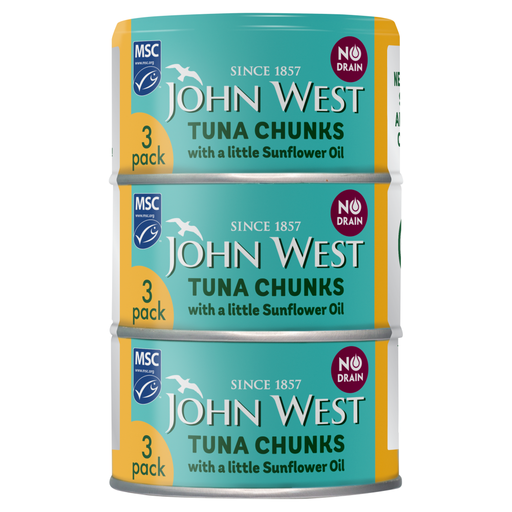
Consider this no-drain option for a quick dish in which sunflower oil fits the other ingredients.
It contains three 100 g tins and is packed in sunflower oil, not spring water. Check the product label when planning the rest of the meal.
 No image available
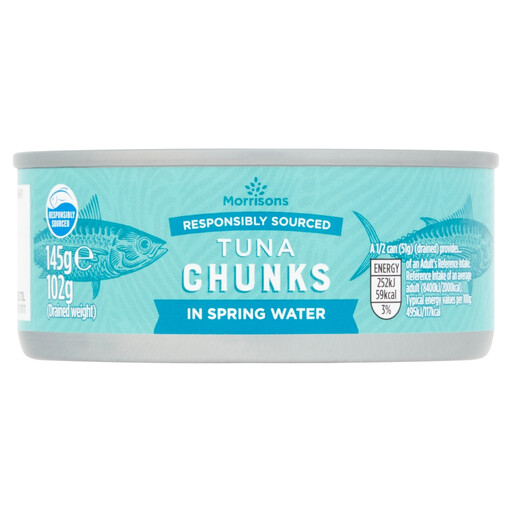
A single tin of spring-water chunks is an option when one meal calls for tuna without opening a multipack.
The stated tin size is 145 g; check its drained weight when comparing the quantity you can use.
Choose according to the dish and check the nutrition panel of the exact tin. M&S lists 159 kcal and 6.4 g fat per 100 g for its sunflower-oil tuna steak, versus 104 kcal and 0.3 g fat per 100 g for one of its spring-water steak products; those figures are for different products, not all oil- and water-packed tuna.
No. The NHS says fresh and canned tuna do not count as oily fish, so a tuna dinner does not fulfil the oily-fish part of its fish guidance.
The NHS advises no more than four cans of tuna or two tuna steaks a week for people who are pregnant or trying for a baby. Check the applicable guidance alongside the portion information on the product you use.
Follow the product label. M&S instructs shoppers to move unused tuna from its checked spring-water steak product into a non-metallic container, refrigerate it and eat it within two days.
Check the exact product rather than extending one claim across a range. John West labels the checked No Drain spring-water tuna MSC, while M&S describes its checked steak as pole-and-line caught and traceable. The Marine Stewardship Council says fishing impacts vary by species, ocean and catching method.