Students planning cupboard dinners
If tuna is going into pasta, jacket potatoes, rice or sandwiches, compare drained weight and the number of tins with the meals you intend to make.


For pasta, jacket potatoes or sandwiches, spring-water tuna chunks are a practical starting point: compare pack size and drained weight to see how much tuna you can use across meals. An own-label multipack suits repeat dinners, while a branded format or a product-specific sourcing claim may matter more to you; check salt and opened-tin instructions on the exact pack before choosing.
If tuna is going into pasta, jacket potatoes, rice or sandwiches, compare drained weight and the number of tins with the meals you intend to make.
Spring-water packs can have different ingredient lists and salt figures. Check the nutrition panel on the product you intend to buy rather than relying on the packing description.
If certification or catching method affects your choice, look for the claim on the exact tin. A claim about one product does not describe an entire retailer or brand range.
Start with the amount and format you can use, then compare the labels for nutrition, sourcing and storage.
| Priority | What to check | Your needs |
|---|---|---|
| Usable quantity | Compare the number of tins, tin weight and drained weight. Decide whether a single tin or multipack fits your planned meals. | I want enough tuna for several dinners without opening more than I can use at once. |
| Ingredients and nutrition | Read the ingredient list and compare protein and salt on the same per-100g basis. Asda Groceries, Tesco Groceries and Sainsbury's list different salt figures for their researched spring-water multipacks. | Spring water sounds straightforward, but I still want to know what is in this particular tin. |
| Sourcing | Check the exact product for an MSC label or a stated catching method. Sainsbury's describes its researched multipack as pole-and-line caught and MSC-certified; M&S makes a pole-and-line claim for its researched tin. | A product-specific sourcing claim matters to me more than a general impression of the brand. |
| Opened-tin storage | Read the pack's refrigeration and use-within instructions before planning leftovers. The researched Sainsbury's pack says to use leftovers within 1 day; the researched Tesco pack says within 2 days. | If I use only part of a tin at dinner, I need to know when I can use the rest. |
| Allergen information | Check the current ingredient and allergen information, particularly on flavoured or recipe tins with additional ingredients. | I need to identify fish and any other ingredients relevant to my household before buying. |
The weight printed prominently on a tin can include the spring water, while the amount of tuna available for a meal is its drained weight.
Check drained weight when comparing different tin sizes, then choose a pack size that fits your meal plans.
Sainsbury's researched spring-water multipack lists 0.12g salt per 100g drained, while the researched Tesco and Asda packs each list 0.90g per 100g drained, according to their retailer listings.
Compare the salt line on the current pack using the same measurement basis.
Instructions differ by product. The researched Sainsbury's pack says to use refrigerated leftovers within 1 day, while Tesco's researched pack says within 2 days.
Transfer leftovers as directed on the pack, refrigerate them and follow that product's use-within instruction.
Species, catching method and certification can differ between tuna products from the same retailer or brand.
If sourcing affects your choice, check the current tin for the specific claim or certification.
These details concern the specific products described by the retailers, not every tuna tin carrying their names.
Tesco's researched 4 x 145g spring-water chunks are an own-label multipack for cupboard meals.
Sainsbury's researched 4 x 145g spring-water chunks carry product-specific MSC and pole-and-line statements.
Asda's researched 4 x 145g spring-water chunks are another own-label cupboard format.
Princes offers spring-water chunks in 145g tins and multipacks.
John West offers different tuna formats, including chunks and no-drain tins.
M&S describes its researched spring-water chunks as pole-and-line caught under its Forever Fish policy.
These spring-water tins include single cans and multipacks for student cupboard meals. Check each listing's drained weight and current label details when comparing formats.
 No image available
Six separate tins offer a format for planning tuna across several pasta or salad meals. Check the drained weight and the opened-tin instructions on the pack.
 No image available
This four-tin spring-water format can be portioned across separate pasta or sandwich meals. Compare its drained weight with other pack sizes and follow the can's leftover-storage instructions.
 No image available
The no-drain format offers three separate tins for meals such as sandwiches or pasta. When comparing nutrition with drained tuna, check that the figures use the same weight basis.
 No image available
A single spring-water tin fits a meal plan that does not call for a multipack. If any tuna remains after opening, follow the pack's transfer and refrigeration instructions.
 No image available
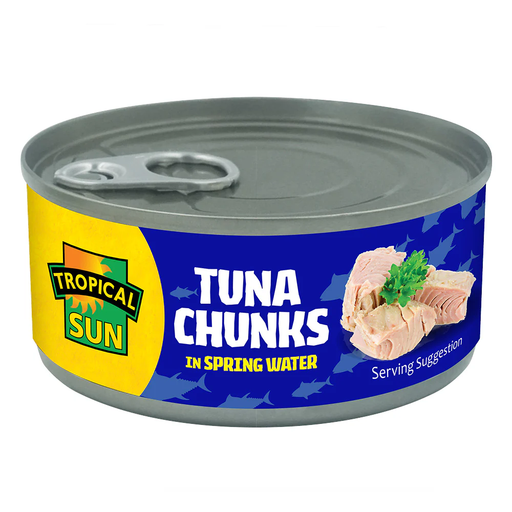
This single spring-water tin is a format to consider for pasta or rice dishes. Check its drained weight, nutrition measurement basis and allergen information on the current label.
Choose the format around the meals you plan to make: separate tins can be opened as needed, while a single tin may be enough for one meal. Check drained weight as well as the number and stated weight of the tins.
Follow the exact pack's transfer, refrigeration and use-within instructions. The researched Sainsbury's spring-water multipack says to use refrigerated leftovers within 1 day, whereas the researched Tesco pack says within 2 days.
No. The NHS classifies fresh and canned tuna separately from oily fish in its UK fish guidance.
The Marine Stewardship Council says its blue label identifies seafood from a fishery certified against its environmental standard. Check the exact tin for the label rather than assuming every product in a range carries it.
The researched tuna products identify fish in their ingredient information. Read the current label for the exact tin, especially if choosing a flavoured or recipe product that may contain additional ingredients.