If independently certified sourcing is your priority, start with the MSC ecolabel on the exact tin rather than a general brand promise. For a toddler dinner, also check the ingredients, salt declaration and fish-allergen information, inspect the tuna for bones, and choose a format that works with the rest of the meal.
Who is choosing tuna?
Parents prioritising certified sourcing
If certification is the deciding factor, look for the MSC ecolabel on the tin you intend to buy. Then check its species, packing liquid and ingredients rather than assuming that all products from a brand are alike.
Parents introducing fish or managing allergies
Tuna is fish, while fish and shellfish are separate potential allergy triggers. The NHS advises introducing foods that can trigger allergies one at a time; a child with a diagnosed allergy, eczema or relevant family history may need advice from a GP or health visitor before fish is introduced.
Parents making a quick toddler dinner
Tinned tuna can be a convenient meal ingredient: the NHS includes it among sandwich fillings for young children. Read the individual tin’s ingredients, salt information, storage instructions and any bone warning before serving.
What matters when choosing a tin?
For a toddler dinner, decide which consideration takes priority, then check the current tin for the details that matter to your child and meal.
| Concern |
What to check |
Who this matters to |
| Certified sourcing |
Look for the MSC ecolabel on the exact tin or its current product listing; check the species and packing liquid too. |
If certification is what determines my choice, I need to identify it on the product itself, not infer it from a brand statement. About 34% of consumers put that product-level check first. |
| Fish allergy and introduction |
Read the fish-allergen and ingredient information. If fish is new and your child has eczema, a diagnosed allergy or relevant family history, seek advice from a GP or health visitor before introducing it. |
When I am introducing fish or managing an allergy, I need to know what the tin contains before thinking about convenience. Fish-allergy precautions come first for about 33% of consumers. |
| Salt, ingredients and bones |
Compare salt per 100 g and the ingredient lists; inspect the tuna for bones before serving. |
A simple packing liquid does not tell me the salt content, and I need to check the tuna as I prepare my child’s plate. About 20% of consumers give these meal-preparation details priority. |
| Meal preparation |
Choose a tin size and opening format that suit the meal, and follow the product’s instructions for any unused tuna. |
On a busy evening, I want a format I can use without complicating dinner. Ease of preparation is the primary concern for about 13% of consumers. |
Checks that are easy to miss
-
Assuming a brand promise certifies every tin
A sustainability statement may concern a named range, own-label products or a wider seafood policy. It does not replace checking whether the tuna you are buying carries the MSC ecolabel.
Use brand commitments to narrow your choices, then read the current pack’s certification and ingredient information.
-
Assuming spring-water tuna is low in salt or free of bones
The packing liquid alone does not establish a tin’s salt content. An M&S spring-water tuna listing also warns that bones may be present.
Compare the salt figures on the products you are considering and inspect the tuna before serving it to a toddler.
-
Treating fish and shellfish allergies as the same thing
Fish and shellfish are separate potential allergy triggers, according to the NHS. An allergen statement for one should not be read as a statement about the other.
Check the label for fish. If fish is new to a child with eczema, a diagnosed allergy or relevant family history, speak to a GP or health visitor before introducing it.
Brands to consider
John West
John West identifies its No Drain Tuna Chunks in Spring Water as an MSC product and describes a can-code traceability service.
- The named No Drain product offers a spring-water, easy-open format.
- Check the current label of the particular tin; the named product’s certification does not establish the status of the whole range.
Princes
Princes says it has completed its commitment for all its tuna to be MSC-certified.
- The brand’s stated commitment offers a starting point for a certification-led shortlist.
- Confirm the current pack’s label, format and nutrition information for the product you choose.
Tesco
The Marine Stewardship Council describes Tesco’s UK own-brand tuna range as extensively MSC-labelled.
- Own-label tins offer products on which to look for the MSC ecolabel.
- Ingredients, packing liquid and salt can vary between products; read the individual tin.
Sainsbury's
In May 2023, Sainsbury's said its own-label canned tuna was MSC-certified and pole-and-line caught.
- The statement addresses both certification and catch method for the named own-label range.
- It does not describe every tuna brand sold by the retailer; check the current product pack.
Asda
Asda describes a wild-caught seafood policy involving MSC-certified fisheries or fisheries working towards certification.
- The policy gives context for Asda’s wider seafood sourcing.
- It does not establish MSC certification for a particular tuna tin; look for the ecolabel if that is your requirement.
M&S
M&S lists a spring-water tuna product containing skipjack tuna and describes it as pole-and-line caught.
- The named product provides ingredient and nutrition information for a product-level check.
- Its listing warns that bones may be present; pole-and-line wording alone does not establish MSC certification.
Joybuy tinned tuna for family meals
This selection is a Princes tuna-in-brine bundle for meals where you can check the current pack’s salt, allergen and sourcing information before serving.
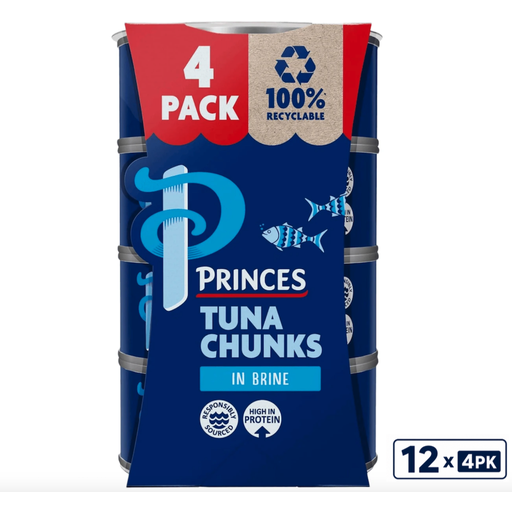 Image unavailable
Princes Tuna Chunks in Brine, 4 × 145 g × 12 packs
Tuna in brine can be used as an ingredient in a family meal. This listing is for a bundle of 12 packs, each containing four 145 g tins; check the current tins’ salt information and MSC ecolabel if either is decisive for your choice.
View on Joybuy
Questions about serving tinned tuna
Can a toddler have tinned tuna?
Yes. The NHS includes canned tuna among sandwich fillings for young children. For a toddler meal, check the tin’s ingredients, fish-allergen information and salt declaration, and inspect the tuna for bones before serving.
What about mercury in tinned tuna?
The Food Standards Agency notes that mercury occurs in tuna and that a maximum mercury level applies to tuna in Great Britain. Choose tuna as one component of varied meals rather than applying the NHS weekly tuna limit for pregnancy to a toddler; that limit is stated for people who are pregnant or trying for a baby.
Does a tuna tin contain fish, shellfish or both?
Tuna is fish; a tuna tin is not automatically a shellfish product. The NHS lists fish and shellfish separately as potential allergy triggers, so read the particular tin’s allergen statement rather than treating the two warnings as interchangeable.
How should I keep tuna left over from an opened tin?
Follow the storage instructions for the product you opened. For example, the M&S spring-water tuna listing says to transfer unused contents to a non-metallic container, refrigerate them and eat them within two days; another tin may give different instructions.


