Households stocking up for repeat meals
If tuna regularly goes into sandwiches, jacket potatoes, salads or pasta, compare the amount of drained tuna as well as the number of cans. A multipack is useful only if its portions suit how often you use it.


For regular meals, start by comparing the drained weight of standard tuna chunks with the amount your household will use. A no-drain format may make preparation easier, while an MSC ecolabel or a stated catch method may matter more if sourcing guides your choice; check the exact pack rather than assuming those features apply across a brand.
If tuna regularly goes into sandwiches, jacket potatoes, salads or pasta, compare the amount of drained tuna as well as the number of cans. A multipack is useful only if its portions suit how often you use it.
If opening and draining a can adds an awkward step, a no-drain format may be worth considering. Check the portion size too, so an opened can does not leave more tuna than you plan to use.
If an MSC ecolabel or a stated catch method guides your choice, look at the exact pack. Its packing medium, salt declaration and portion size remain separate considerations.
For a retirement household, decide which need will determine the purchase: usable quantity, label and meal planning, easier handling, or stated sourcing.
| Concern | What to check | Who it matters to |
|---|---|---|
| Usable quantity | Compare drained weight, can count and the amount you are likely to use. | For regular cupboard meals, I want to know how much tuna is left after draining, not just the weight printed prominently on the pack. About 42% of consumers put usable quantity first. |
| Labels and meal planning | Read the salt declaration and packing medium; distinguish tuna from oily fish when planning other fish purchases. | If tuna appears often in my meals, I want to compare labels and know how it fits alongside other fish. For about 25% of consumers, that is the primary concern. |
| Handling and portions | Check whether the pack is no-drain, its can size and its instructions for unused contents. | When draining a can is inconvenient or I need only a small portion, simpler handling matters more to me than a larger pack. Roughly 17% of consumers put this need first. |
| Stated sourcing | Look for an MSC ecolabel or a catch-method statement on the exact product. | I want the sourcing claim to apply to the tuna I actually take home, rather than to a brand in general. That is the leading need for about 16% of consumers. |
Total weight includes the packing liquid, so cans of similar size need not provide the same amount of tuna.
Compare drained weights and choose a can or multipack size that suits the meals you make.
The NHS says fresh and canned tuna do not count as oily fish. That distinction matters if you use fish purchases to plan a varied weekly menu.
Keep tuna and oily-fish choices separate when making your shopping list.
An MSC ecolabel or catch-method statement may apply to a particular product or range, not everything sold under the same name.
Check the wording and symbols on the exact pack you choose.
Marks & Spencer instructs shoppers to transfer unused contents of its Tuna Chunks in Spring Water to a non-metallic container, refrigerate them and eat them within two days.
Choose a manageable portion and follow the opened-can instructions on your own product.
Opening more than you can use may leave tuna that must be stored separately or discarded.
Tesco own-label and value-range chunks give shoppers standard canned formats to compare with branded and no-drain options.
John West no-drain chunks are relevant when avoiding the draining step is a priority.
Princes appeared in the Tesco Groceries listing in chunks, sandwich-tuna and steak formats.
Sainsbury's own-label canned tuna is relevant to shoppers checking certification and catch-method claims.
M&S Tuna Chunks in Spring Water provides product-level sourcing, nutrition and storage information to check when choosing a can.
These packs cover no-drain chunks and standard chunks in spring water or brine for repeat meals. Compare their portion formats and drained weights against what your household will use.
 No image available
Consider this pack if avoiding the draining step matters for regular meals. It contains three 100g cans of tuna chunks in sunflower oil.
Check the exact pack for its salt declaration, sourcing claim and drained weight.
 No image available
This is a no-drain option for someone who prefers tuna packed in spring water. The listed pack contains three 100g cans.
Check the exact pack’s salt declaration and drained weight when comparing portions.
 No image available
Consider this spring-water multipack for meals that use tuna repeatedly. The title lists six packs and 145g; check the packaging to see how that weight applies to the cans.
Check the drained weight and salt declaration on the exact pack.
 No image available
The four-can format may suit a household planning several tuna meals. Each listed can is 125g, with chunks packed in spring water.
Compare the drained weight and read the salt declaration on the pack.
 No image available
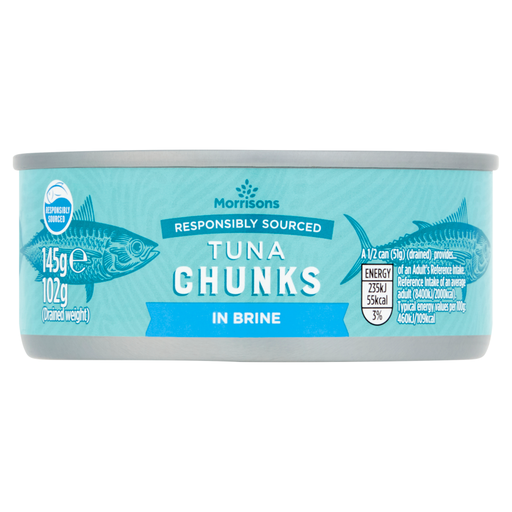
This single 145g can suits a meal plan that does not call for a multipack. It contains tuna chunks in brine.
Check its drained weight, salt declaration and instructions for any unused contents. The product description warns that some bones may remain.
No. The NHS says fresh and canned tuna do not count as oily fish, so keep that distinction in mind when planning which fish to buy.
Choose the medium that suits the meal, then compare the exact products’ ingredient and nutrition labels. The NHS notes that canned fish can be high in salt, so check the salt declaration rather than assuming it will be the same across packs.
Follow the instructions on that can. For its Tuna Chunks in Spring Water, Marks & Spencer says to transfer unused contents to a non-metallic container, refrigerate them and eat them within two days; instructions on other products may differ.
Check the drained weight, packing medium, ingredients, allergen declaration and storage instructions on the exact pack. If sourcing matters to you, also check whether that product carries the MSC ecolabel or a specific catch-method statement.