Workers with limited lunch-prep facilities
No-drain chunks or already-drained tuna can go into a sandwich or salad without finding somewhere to pour away liquid. Standard chunks remain an option if you can drain them at home or at work.


Spring-water tuna chunks suit sandwiches and wraps when you can drain the tin before lunch. If you need to open it at your desk, consider a no-drain or already-drained product; choose tuna steaks when you want larger pieces for a salad. Check the exact pack for ingredients, salt and instructions for any leftovers.
No-drain chunks or already-drained tuna can go into a sandwich or salad without finding somewhere to pour away liquid. Standard chunks remain an option if you can drain them at home or at work.
For repeated sandwiches, wraps or salads, compare the exact pack’s drained quantity, ingredients and nutrition per 100g. Plan how you will refrigerate anything left after opening.
Look for a certification or fishing-method statement on the particular product you intend to buy. A claim shown on one tuna pack should not be assumed to apply to every variant from the same brand.
Start with where you will prepare lunch, then compare the packing liquid, portion format and label of the products that fit that routine.
| Priority | What to check | Your needs |
|---|---|---|
| Preparation | Check whether the exact product says no-drain or already drained. Standard chunks may need draining before use. | I need to make lunch without using an office sink, so a no-drain format would simplify preparation. |
| Ingredients and nutrition | Compare the ingredients and nutrition panel per 100g, noting whether figures refer to drained tuna. For example, ASDA Groceries lists 0.90g salt per 100g drained for its 4 x 145g spring-water chunks; its listing of Princes 4 x 145g brine chunks also gives 0.90g. | For regular lunches, I want to compare the actual tins rather than assume that brine and spring-water products have different salt levels. |
| Pieces and portion | Check whether you are buying chunks or steaks, and compare the can size with the amount you will use. An already-drained steak product avoids a separate draining step. | Chunks will mix into my sandwich filling; for a salad where I want larger pieces, I would consider steaks. |
| Leftovers and allergens | Read the opened-pack storage instructions and check the fish allergen statement. The cited John West and M&S product information instructs refrigeration and use within two days after opening. | If I cannot refrigerate leftovers at work, I would choose an amount I can use at lunch. I also need to check the other ingredients in a prepared sandwich or salad. |
| Sourcing | Check the exact pack for a certification label or a stated fishing method; claims can differ between products and pack sizes. | I want the sourcing claim to apply to the tin I am buying, not merely to another product in the brand’s range. |
Liquid contributes to the stated pack weight of products that need draining, so two tins of similar size may provide different amounts for lunch.
Compare the drained quantity on the exact packs, then decide whether avoiding the draining step matters to your routine.
Spring-water and brine products need to be compared by their own labels. ASDA Groceries lists 0.90g salt per 100g drained for both its cited own-label spring-water chunks and the cited Princes brine chunks.
Read the per-100g panel and ingredients on the products you are considering, including any other ingredients you plan to add to lunch.
Instructions for unopened tins do not apply to tuna left after opening. The cited John West and M&S products instruct users to refrigerate unused tuna and eat it within two days.
Choose a portion you can finish, or follow the exact pack’s instructions for transferring and refrigerating leftovers.
A certification or fishing-method statement identifies the product to which it applies, not necessarily every flavour, format or pack size from that brand.
Check the claim on the exact tin or its current product page before making it part of your decision.
The cited range includes standard spring-water chunks and a No Drain spring-water product for lunches with less preparation.
The cited brine chunks offer a standard format, while Princes describes a separate drained-tuna range as ready to use.
The cited own-label 4 x 145g spring-water chunks provide a standard multipack option for lunches prepared where draining is practical.
The cited spring-water tuna steak is an already-drained option for a lunch where larger pieces are wanted.
Tesco Groceries lists own-label spring-water chunks in several pack sizes alongside a spring-water tuna steak product.
These tinned-tuna options include no-drain formats for lunch preparation with fewer steps and standard chunks for lunches where draining is practical.
 No image available
A no-drain option for adding chunks to a sandwich or salad at work. ASDA Groceries lists 27g protein per 100g for this No Drain spring-water product and instructs refrigeration and use within two days after opening. Contains fish.
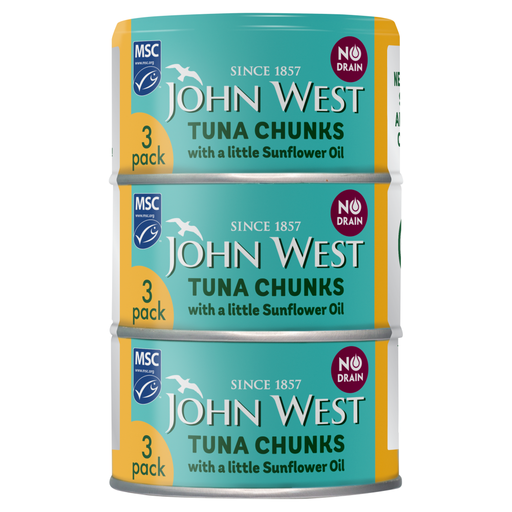 No image available
This no-drain, sunflower-oil variant suits a lunch where you do not want a separate draining step. Check its own nutrition panel rather than applying figures from the spring-water variant, and follow its instructions after opening.
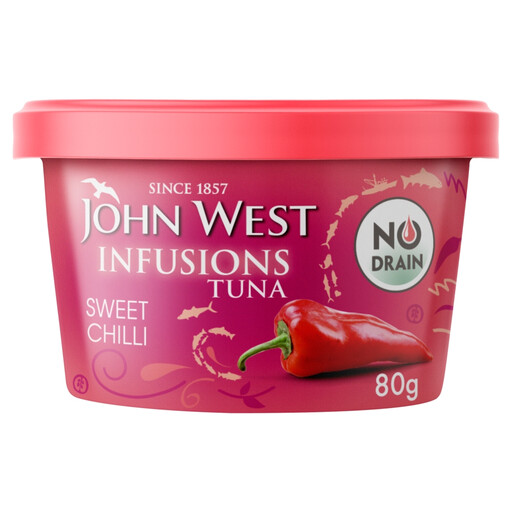 No image available
An 80g sweet-chilli tuna option for a smaller lunch portion. Check its ingredients and allergen statement if you are choosing it instead of plain tuna.
 No image available
A six-pack of spring-water chunks for sandwiches or salads prepared where draining is practical. Check the drained quantity on the pack when deciding how much to use for each lunch.
 No image available
Brine-packed chunks for sandwiches or salads when you can drain the tuna. ASDA Groceries lists 0.90g salt per 100g drained for this 4 x 145g product. Check the protein figure on the exact pack before using it in a nutrition comparison; contains fish.
Check the particular pack’s storage instructions. The cited ASDA and M&S products specify a cool, dry place for unopened tins, so consider whether your drawer meets those conditions.
Follow the exact label’s instructions for transferring and refrigerating leftovers. The cited John West and M&S product information says to refrigerate unused tuna and eat it within two days; if you cannot keep leftovers chilled at work, choose an amount you can finish.
Tuna contains fish, one of the allergens identified in UK government guidance. Read the tuna pack and the labels of anything you combine with it, such as a prepared dressing or sandwich filling.
Check the exact product for its certification label or fishing-method statement. An MSC label or another sourcing claim on one variant does not establish that every tin from the same brand carries it.
No. The NHS states that fresh and canned tuna do not count as oily fish, so do not classify a tinned-tuna lunch as an oily-fish portion.