For a quick desk lunch, check the ingredients and sugars line on the exact tin rather than assuming spring water means less sugar. Plain tuna in water, brine or oil can list 0g sugars; a no-drain pack addresses the practical problem of opening tuna where there is no place to drain it. If you can drain a standard tin, compare its portion size and storage instructions before choosing a convenience format.
Who is this for?
The right format depends on whether you can drain a tin, how closely you check ingredients and what else matters in your lunch.
Desk workers without draining space
If there is no sink or suitable place to pour away liquid, a no-drain pack removes that preparation step. John West describes its No Drain Tuna Chunks in Spring Water as ready to eat; check the pack size against what you expect to finish.
Lunch planners checking for added sugar
Plain tuna and seasoned tuna need separate label checks. Princes lists 0.0g sugars per 100g drained for its plain spring-water and sunflower-oil chunks, while sugar appears in the ingredients of its sweet-chilli tuna.
Shoppers comparing the whole nutrition panel
A zero-sugars figure does not tell you about energy, fat or salt. Compare those figures on the same per-100g basis if they affect your choice of packing liquid or the rest of your lunch.
What should you check?
Check sugar and ingredients first, then choose a format you can open, eat and store appropriately at work.
| Priority |
What to check |
Your needs |
| Sugars and ingredients |
Read both the ingredients and “of which sugars” per 100g. Check flavoured tins separately for sugar-containing sauces or seasoning. |
I want to know what is in this particular tin, rather than treating “in spring water” or “reduced sugar” as an answer. |
| Preparation at work |
Check whether the exact pack says no-drain or instructs you to drain it. Look at the individual can size, not just the multipack size. |
With no sink near my desk, I would rather open a portion without disposing of packing liquid. |
| Other nutrition figures |
Compare energy, fat and salt using the same declared basis, such as per 100g drained. Do not use the sugars figure as a substitute for the rest of the panel. |
Zero sugars matters to me, but I also want to compare what water, brine and oil versions contribute to my lunch. |
| Portions and leftovers |
Check the amount in each can and the opened-pack refrigeration instructions. Plan for a way to store leftovers if you will not finish it. |
A smaller can may be more practical when I cannot put an opened portion in a fridge. |
| Sourcing information |
Look for an MSC label or a specific sourcing statement on the exact product; do not assume it applies to every tuna tin from the brand. |
If sourcing affects my choice, I want to check the claim on the pack I am buying. |
Common buying mistakes
-
Assuming spring water means less sugar
Princes lists 0.0g sugars per 100g drained for both its plain spring-water and sunflower-oil chunks. The packing liquid alone does not establish a sugar difference.
Compare the ingredients and sugars figures for the exact tins, using the same per-100g basis.
-
Missing sugar in a seasoning
Princes lists sugar among the seasoning ingredients of its sweet-chilli tuna, unlike the plain examples. A flavoured tin needs its own label check.
If your requirement is a stated 0g sugars, check both the nutrition panel and ingredients before choosing a flavour.
-
Opening more tuna than you can store
The reviewed John West, M&S and Tesco packs instruct shoppers to refrigerate opened leftovers and use them within two days. That matters when lunch is eaten away from a fridge.
Choose a can size you expect to finish, or make sure you can follow the exact pack’s storage instructions.
Leftovers that cannot be stored as directed may have to be discarded.
-
Checking sugars but nothing else
Plain tuna can list zero sugars across different packing liquids while its other nutrition figures differ.
Once you have checked sugars, compare energy, fat and salt on a like-for-like basis and consider what you will add to the lunch.
Relevant brand references
These examples describe specific reviewed products, not the nutrition or sourcing of every tin in a brand’s range.
John West
Its No Drain Tuna Chunks in Spring Water 3 x 100g pack is relevant when draining at work is inconvenient.
- John West lists tuna, spring water and salt, with 0g sugars per 100g, for the reviewed pack.
- No-drain is a preparation feature; it does not establish a sugar advantage over every standard tin.
Princes
Its reviewed products illustrate why plain and flavoured tins should be compared separately.
- Princes lists 0.0g sugars per 100g drained for its plain spring-water and sunflower-oil chunks.
- Its sweet-chilli tuna lists sugar in the seasoning ingredients; check each flavour individually.
M&S
Its reviewed Tuna Chunks in Spring Water provides a plain option in a 160g tin and a 640g four-pack.
- M&S lists 0.0g sugars per 100g for the reviewed spring-water product.
- For unused contents, M&S instructs shoppers to transfer them to a non-metallic container, refrigerate and eat within two days.
Tesco / Stockwell & Co
The reviewed Stockwell & Co Tuna Chunks in Brine 145g is a plain brine-packed example.
- Tesco lists 0g sugars and 1.0g salt per 100g for this product.
- The salt figure belongs to this tin, not every brine-packed tuna product.
Tinned tuna options on Joybuy
These options cover a named no-drain spring-water multipack and plain spring-water or brine tins for lunches where you can manage the packing liquid. Check each product’s current label for sugars and opened-pack instructions.
 No image available
John West No Drain Tuna Chunks in Spring Water 3 x 100g
The named no-drain format is the option here for opening tuna at a desk without dealing with packing liquid. The pack contains three 100g cans; check the label for sugars and follow its instructions for any opened leftovers.
View on Joybuy
 No image available
John West Tuna Chunks in Spring Water 4 x 125g
Four separate 125g cans allow you to open one for a lunch. If avoiding the draining step is essential, confirm the format of these individual cans rather than assuming they are part of the No Drain range.
View on Joybuy
 No image available
Princes Tuna Chunks in Brine 4 x 145g
This four-can brine multipack suits separate lunches when you have somewhere to drain the tuna. The product information instructs you to drain it before use and to refrigerate opened leftovers.
View on Joybuy
 No image available
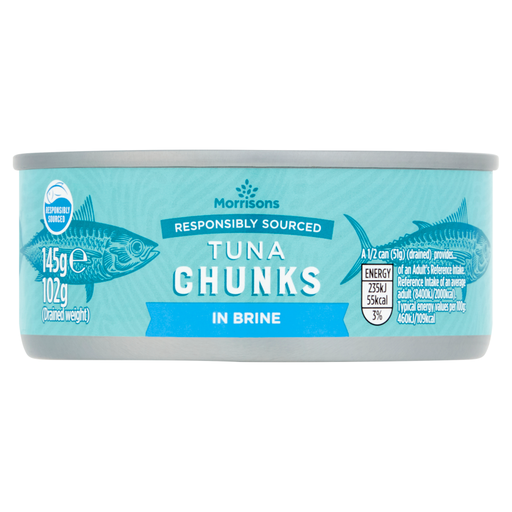
Morrisons Fad Free Tuna Chunks in Brine 145g
A single 145g brine-packed can may suit a lunch you expect to finish in one sitting. Confirm the opening and draining instructions if you will eat it away from a kitchen; refrigerate any leftovers as directed on the pack.
View on Joybuy
 No image available
Morrisons Fad Free Tuna Chunks in Spring Water 145g
This single 145g spring-water tin is another portion-size option for a desk lunch. Check its draining instructions if you cannot dispose of liquid at work, and follow the pack’s directions for opened leftovers.
View on Joybuy
Frequently asked questions
Does every tin of tuna have zero sugars?
No. Princes lists 0.0g sugars per 100g drained for its reviewed plain spring-water and sunflower-oil chunks, but its sweet-chilli tuna lists sugar in the seasoning and less than 2.0g sugars per 100g. Check the ingredients and sugars line on the exact tin.
Is spring-water tuna lower in sugar than oil-packed tuna?
Not necessarily. The reviewed plain Princes spring-water and sunflower-oil chunks both list 0.0g sugars per 100g drained. If the packing liquid affects your choice, compare energy and fat as well as sugars on the same declared basis.
When is a no-drain tin useful for a desk lunch?
A no-drain tin removes the step of pouring away packing liquid, which is useful when there is no suitable place to do that at work. John West describes its reviewed 3 x 100g spring-water pack as ready to eat; a standard tin remains an option if you can drain it and manage any leftovers.
What should I do with tuna left after opening?
Follow the exact pack’s storage instructions. The reviewed John West, M&S and Tesco products direct shoppers to refrigerate opened leftovers and consume them within two days; M&S and Tesco also specify transferring unused contents to a non-metallic container.


