Shoppers checking sugars
If you are making a quick meal for one, the “of which sugars” figure and ingredients tell you more about the particular salmon than a reduced-sugar impression.


For a one-person meal, compare the sugars declaration and ingredients on the exact tin rather than choosing by “reduced sugar” wording alone. Tesco Groceries, Sainsbury's and ASDA Groceries list plain 105g salmon examples with 0g or less than 0.5g sugars per can. Then consider how much salmon you will use, the salt value, bone warnings and what the pack says about storing leftovers.
If you are making a quick meal for one, the “of which sugars” figure and ingredients tell you more about the particular salmon than a reduced-sugar impression.
A small can may fit a sandwich, salad or bowl without leaving much to store. Compare its drained weight as well as its stated serving size.
A skinless-and-boneless variant may be easier to add to a meal, but read the exact pack: some such products still warn that small bones may remain.
For a one-person meal, start with the label of the salmon you intend to use; pack size and preparation matter alongside sugars.
| Concern | What to check | Who this matters to |
|---|---|---|
| Actual sugars | Read “of which sugars” per 100g and per can, plus the ingredients on the exact product. | For a quick meal, I want to know what is in the salmon rather than rely on a claim on the front. About 31% of consumers would put that sugars-and-ingredients check first. |
| Usable quantity | Compare net and drained weight; check the serving statement and opened-pack storage instructions. | If I plan to use one can in one meal, I want enough salmon without an awkward remainder. Using the right quantity would be the main concern for about 25% of consumers. |
| Skin and bones | Look for the exact variant's skinless-and-boneless description and any remaining-bones warning. | When I am making a sandwich or salad quickly, I would rather spend less time preparing the fish, while still watching for bones. Roughly 19% of consumers would make that their primary concern. |
| Salt and meal quantity | Compare salt per can and per 100g on like-for-like packs; consider how much fish the meal needs. | Even if the sugars figure suits me, I want to see the salt value and whether the can supplies the quantity of fish I intended. That broader label check would come first for about 25% of consumers. |
Reduced-sugar wording describes a comparison, not the sugars value in the tin you are holding. Plain salmon examples listed by Tesco Groceries, Sainsbury's and ASDA Groceries already show 0g or less than 0.5g sugars per 105g can.
Read “of which sugars” and the ingredients on the exact pack, particularly if you are considering a flavoured version.
Pack size does not establish whether bones are present. Some products described as skinless and boneless still carry a small-bones warning.
Choose the variant whose preparation suits you, read its warning and check the salmon as you eat it.
A 105g can can be a useful meal component, but the NHS describes a fish portion as around 140g cooked. A serving statement on a tin does not make those quantities equivalent.
Check the pack's drained weight and decide how much salmon you want in this particular meal.
Opened-can instructions differ by product, which matters if a larger tin will cover more than one meal.
Follow the exact pack's instructions for transferring, refrigerating and using any remainder.
Tesco Groceries lists a John West skinless-and-boneless pink salmon multipack of three 80g cans, alongside a larger 213g red salmon tin.
Tesco Groceries lists Princes skinless-and-boneless wild red salmon in a 105g tin.
Tesco Groceries lists a 105g Wild Pacific Red Salmon tin with nutrition stated for the can.
Sainsbury's lists 105g Wild Pacific Pink Salmon in standard and skinless-and-boneless variants, each described as one serving.
ASDA Groceries lists 105g red and pink salmon products as one-serving formats.
Marks & Spencer lists 105g Wild Alaskan Red Salmon in standard and skinless-and-boneless formats.
These pink salmon options include a small fridgepot and larger 213g can formats. If you specifically want a tin to finish in one meal, check the format and usable quantity before choosing.
 No image available
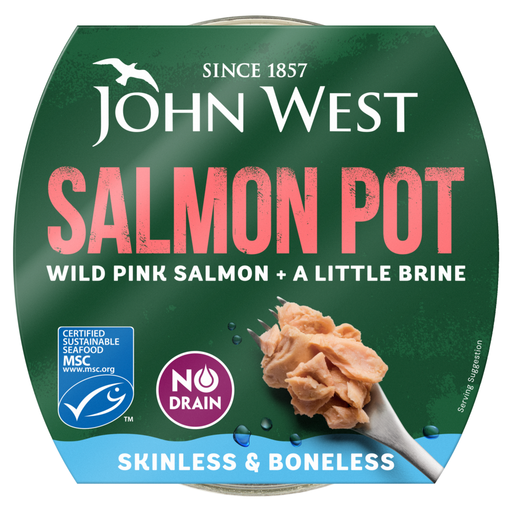
The 80g fridgepot is a small-format option for a meal or snack, but it is not described as a tin. Check the pack's serving statement, sugars per pot and bone information if those details determine your choice.
 No image available
This four-pack suits someone planning to use larger cans across meals. A 213g can may leave a remainder after a smaller meal, so follow its opened-can storage instructions and check the exact pack's bone information.
 No image available
This 213g can is an option if you are content to use part of a larger tin for one meal. Check how much you will use, follow the pack's instructions for any leftovers and read its bone information if that affects your choice.
No. It describes a comparison rather than the tin's actual sugars value. Read “of which sugars” on the nutrition panel and check the ingredients of the particular product.
Compare sugars per 100g when looking across products, then check the figure per can for the amount you intend to use. The NHS describes 5g sugars or less per 100g as low for foods; the cited plain 105g salmon listings include values of 0g or less than 0.5g per can.
A 105g tin can be a one-person meal component, but its serving statement is not the same as the NHS's general reference of around 140g cooked fish per portion. Check the tin's drained weight when deciding how much fish to use.
Follow the storage directions on that exact pack. The cited product instructions call for refrigerating leftovers after transferring them to a covered non-metallic container; the time allowed for using them differs between products.
Tinned salmon contains fish, so plain ingredients do not remove the fish-allergen concern. Read the current on-pack ingredient and allergen information for the exact product.