Parents packing school-holiday lunches
If lunch will be eaten away from home, choose a portion you can prepare and keep cool until it is eaten. Tuna can be the filling in a sandwich or wrap alongside other lunch foods, rather than the whole meal.


For a lower-sugar school-holiday lunch, plain tuna in spring water is a useful starting point, but a “reduced sugar” claim is not necessary: the cited spring-water tins from Marks & Spencer, Tesco Groceries, Asda and Sainsbury's list 0g or less than 0.5g sugars per 100g. Compare the exact tin for sugars, salt and the amount you will pack; an oil-packed or no-drain option may also meet the sugar aim, while storage, fish allergy and bone warnings still matter.
The useful format depends on how the lunch will be prepared, packed and served—not just the sugar figure.
If lunch will be eaten away from home, choose a portion you can prepare and keep cool until it is eaten. Tuna can be the filling in a sandwich or wrap alongside other lunch foods, rather than the whole meal.
Plain spring-water tuna products in the cited retailer examples list little or no total sugar per 100g. Check flavoured tuna separately, then consider the ingredients and labels on sauces, drinks and other lunch items.
A no-drain format may make it simpler to assemble a quick lunch. The cited John West No Drain spring-water product lists 0g sugars per 100g, but convenience does not remove the need to check salt, the fish-allergen declaration and any bone warning.
Start with “of which sugars” per 100g on the product you intend to buy, then compare salt, packing medium and the portion you will actually use. The label-use figure below comes from the Food Standards Agency and Ipsos Northern Ireland's 2024 tracker: 611 quota-sampled adults were interviewed in Northern Ireland between 16 September and 23 November 2024; it describes food shopping generally, not parents buying tuna.
| Priority | What to check | Your needs |
|---|---|---|
| Sugars and ingredients | Read “of which sugars” per 100g and the ingredients list. Check flavoured, sauce-based and mixed tuna separately from plain tuna; compare the amount you will pack as well. | I want the tuna filling to fit a lower-sugar lunch without relying on a claim on the front of the tin. In the Food Standards Agency and Ipsos Northern Ireland's 2024 tracker, 49% of the 611 interviewed adults said they actively used traffic-light labels when shopping for food; that figure is not specific to tuna or school lunches. |
| Packing medium | Compare spring water, oil or brine using each product's nutrition panel; do not assume the liquid determines sugar or salt. Marks & Spencer lists 0.1g sugars, 209kcal and 12.3g fat per 100g for its cited olive-oil tuna, against 0g sugars, 99kcal and 0.6g fat for its cited spring-water tuna. | If I prefer tuna packed in oil, I still need to check its sugar figure and whether its other nutrition values suit this lunch. For a brine-packed tin, I would check the exact label rather than transfer figures from a spring-water product. |
| Salt | Compare salt per 100g on the same drained or prepared basis. The cited Sainsbury's spring-water tin lists 0.12g salt per 100g drained; the cited Tesco and Asda tins each list 0.90g. | Sugar is not my only comparison. I want to see how the tuna's salt figure fits with the other foods packed for lunch. |
| Portion and preparation | Check tin and drained weights, pack count and whether the instructions call for draining. For no-drain products, follow the directions on the actual pack. | A single tin may be simpler for one lunch, while a multipack may suit several planned lunches. If I need to assemble food quickly, preparation matters as well as pack size. |
| Storage and setting | Plan how a ready-to-eat lunch will stay cool. Follow the pack's instructions for opened leftovers and check the holiday club's food policy. | Lunch may sit until it is eaten, so I need a way to keep it cool and a meal the setting allows. London Borough of Tower Hamlets' holiday-childcare guidance advises keeping packed lunches cool. |
| Allergens and bones | Read the fish-allergen declaration, any additional allergen information and the pack's bone warning before serving. | If the child has a fish allergy, tuna is not an option. Otherwise, I still want to check the safety wording on the particular pack, especially for a younger child. |
Salt differs between the cited plain spring-water tins: Sainsbury's lists 0.12g per 100g drained, while Tesco and Asda each list 0.90g. The packing medium alone does not tell you the salt content.
Compare sugars and salt per 100g on the exact product, then consider how much tuna will go into the lunch.
A plain tuna tin with little or no sugar does not describe the sugars in a sauce, drink, snack or dessert served with it. The NHS distinguishes free sugars, including sugars added to foods and drinks, from the total-sugars figure on a label.
Use tuna as one part of lunch and check the ingredients and labels of additions when reducing sugar is the aim.
A prepared tuna lunch may need to remain in a bag until lunchtime. London Borough of Tower Hamlets' holiday-childcare guidance advises keeping packed lunches cool.
Plan a cool bag and ice pack where needed. Refrigerate opened leftovers and follow the use-by instructions on the particular tin.
The cited John West No Drain product contains fish and carries a warning that some bones may remain. Its preparation format does not address those risks.
Read the allergen and safety wording on the pack, and confirm the individual setting's food policy before packing it.
These examples describe particular cited products, not every tuna tin from each brand or what is available on Joybuy.
The cited No Drain Tuna Chunks with a Little Spring Water multipack offers a spring-water format intended to be used without draining.
The cited Tuna Chunks in Spring Water eight-pack is a plain-tuna multipack.
The cited own-label spring-water tuna comes in a 400g tin, a format to consider when preparing more than one portion.
The cited own-label Tuna Chunks in Spring Water is a 145g tin.
The cited own-label Tuna Chunks in Spring Water is a four-pack of 145g tins.
The cited Marks & Spencer products show why packing medium and sugars are separate comparisons.
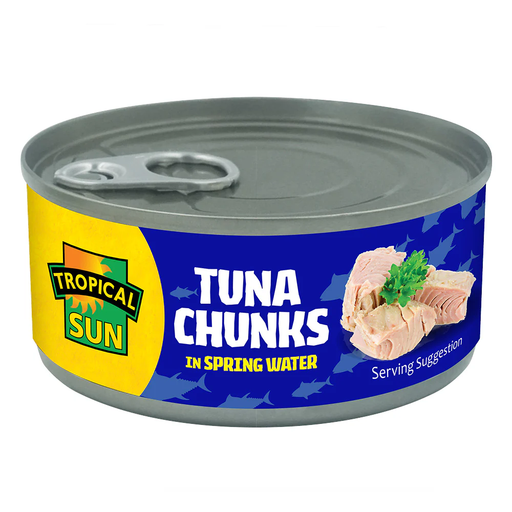
These Joybuy options are spring-water tuna for preparing school-holiday lunches, including a no-drain-labelled multipack. Check each product's pack for its current nutrition, preparation and safety wording.
 No image available
A four-tin option for making tuna sandwiches or salads across several lunches. The listed drained nutrition panel gives 0g sugars, 0.80g salt and 25g protein per 100g. Contains fish; check the pack for any bone warning and refrigerate opened leftovers as directed.
 No image available
This single tin is listed for sandwiches, wraps and salads, with 0g sugars per 100g on its nutrition panel. The listing says to drain it before use and gives approximate values of 0.5g salt and 9.2g protein per 100g. It contains fish and may contain traces of soybeans and wheat; check the pack's allergen and bone information before serving.
 No image available
A three-tin format to consider when preparing smaller tuna portions. The listed panel gives 0g sugars, 0.80g salt and 27g protein per 100g. Although the title identifies it as No Drain, follow the actual pack's preparation directions; also check its fish-allergen and bone warnings.
 No image available
The six-pack format may suit several planned sandwich or salad lunches. Its listed drained panel gives 0g sugars, 1.0g salt and 24.9g protein per 100g; compare the salt figure with other tins rather than choosing on sugar alone. Contains fish; check the pack for a bone warning and follow its directions for opened leftovers.
 No image available
This single tin is listed for sandwiches, salads and pasta. Its drained nutrition panel gives 0g sugars, 1.0g salt and 24.9g protein per 100g. It contains fish; check the pack for bone information and refrigerate any opened leftovers according to its instructions.
No. Compare “of which sugars” per 100g and the ingredients on the exact tin instead. The cited plain spring-water products from Marks & Spencer, Tesco Groceries, Asda and Sainsbury's list 0g or less than 0.5g sugars per 100g; those figures should not be assumed for flavoured or mixed tuna products.
Not necessarily. Marks & Spencer lists 0.1g sugars per 100g for its cited olive-oil tuna and 0g for its cited spring-water tuna. The olive-oil product also lists 209kcal and 12.3g fat per 100g, against 99kcal and 0.6g fat for the spring-water product; compare the exact tins rather than extending that difference to all oil-packed tuna.
Cover and refrigerate unused tuna in a non-metallic container, then follow the particular pack's instructions for how soon to use it. If tuna is packed for later in the day, plan how the prepared lunch will stay cool until it is eaten.
Check that club's food policy and how the lunch will be stored before packing it. London Borough of Tower Hamlets' holiday-childcare guidance advises sending food that is ready to eat and keeping packed lunches cool; an individual setting may have additional rules.
Tuna is fish, so do not choose it for a child with a fish allergy. The cited tuna products identify fish as an allergen; read the particular pack for any further allergen information and bone warning before serving it to other children.