
24/7 Customer Support

Free returns

Same-day & Next-day Delivery

Quality Guaranteed

Unlock Your Welcome Offers: FREE Delivery | Up to 80% OFF | Free 30-day JoyPlus trial
Download the APP
A reliable non-stick frying pan is the cornerstone of any British kitchen, essential for everything from a quick weekday omelette to a perfectly seared steak. Yet, finding one that truly lasts can feel like a gamble. Many of us have been disappointed by a pan that loses its non-stick magic after just a few months, leaving us with stuck-on food and wasted money.
As the Joybuy Product Recommendation Officer, my role is to help you navigate the market's claims and focus on what genuinely matters. Before you invest in a new titanium non-stick frying pan, let's look at the common pitfalls that catch many shoppers out.
To avoid these traps, focus on a few core parameters. These objective details will tell you more about a pan's performance and longevity than any marketing slogan.
The heart of any non-stick pan is its coating. The main types you'll encounter are:
For a healthy cooking pan, always verify that it is, at a minimum, PFOA-free. If you wish to avoid all fluorinated chemicals, look specifically for pans advertised as PFAS-free.
A pan is more than just its surface. The body and handle determine how it heats and how you can use it.
Consider what you cook most often. A 28cm frying pan is a great all-rounder for most households. For individuals or smaller meals, a 20cm or 24cm skillet is more efficient. If you enjoy stir-frying, a non-stick wok with high, sloped sides is ideal. For soups, curries and braising, a deeper stewpot with lid is indispensable. For those with limited storage, a cookware set with detachable handle can be a transformative space-saver.
Based on these practical criteria, here are a few options from our catalogue matched to different cooking styles and household needs.
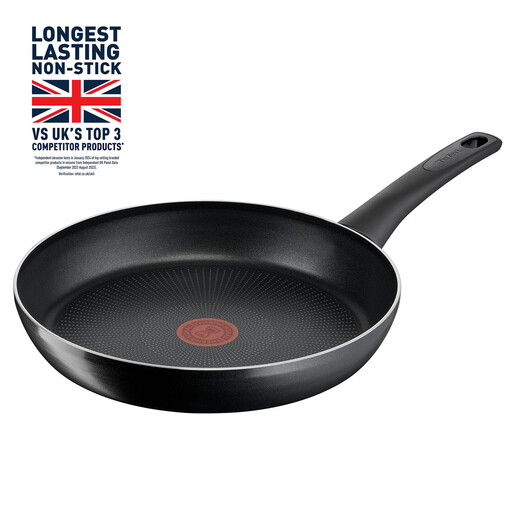
Why This Fits Their Persona: This 28cm pan is the workhorse of a busy UK kitchen. It’s the perfect size for cooking a family breakfast, pan-frying chicken breasts for meal prep or making a quick pasta sauce. It focuses on practicality and reliable daily performance.
Its titanium-reinforced coating is specifically designed for enhanced durability, directly addressing the pitfall of non-stick surfaces that fail prematurely.
The aluminium body ensures even heat distribution for consistent cooking results without hot spots. Its lightweight design makes it easy to handle.
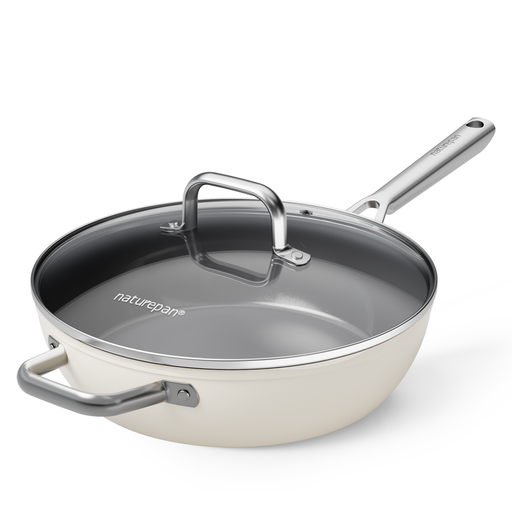
Why This Fits Their Persona: This user prioritises healthy, low-oil cooking and needs cookware that does more. The deep sides and lid make it perfect for one-pot meals, braising or simmering sauces, while its high oven-safe temperature allows for true hob-to-oven cooking.
It directly addresses health and compatibility concerns by being explicitly PTFE/PFOA/PFAS-free, compatible with all hobs including induction and oven-safe to a high 260°C.
The diamond and titanium reinforced ceramic coating offers durability without PFAS. Its high-walled design with a lid makes it far more versatile than a standard skillet.
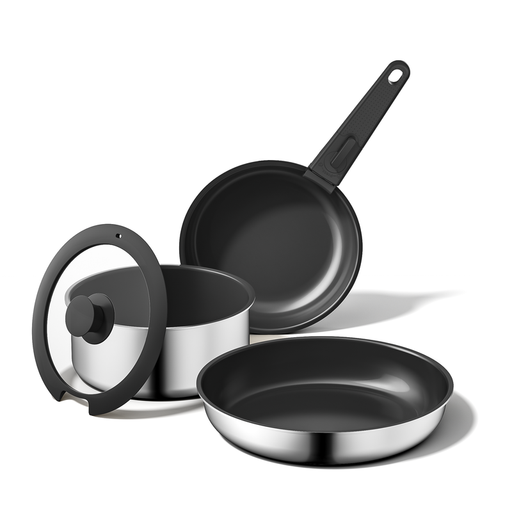
Why This Fits Their Persona: For anyone living in a modern flat, a caravan or simply hating cluttered cupboards, this set is a game-changer. The ability to stack the entire set neatly by removing the handle saves an enormous amount of precious kitchen space.
This set solves the practical problem of storage that many buyers don't consider until it's too late. The secure locking handle ensures it doesn't compromise on safety or stability during use.
The cookware set with detachable handle is its defining feature, saving up to 70% of cabinet space. The 3-layer stainless steel construction also provides excellent durability and heat distribution.
We have compiled a complete, real-time list of products that fully satisfy these strict selection criteria and UK safety regulations.
With proper care, a quality pan should provide good non-stick performance for several years. To maximise its lifespan, avoid using metal utensils, do not expose it to sudden extreme temperature changes (like running a hot pan under cold water) and consider hand-washing even if it is dishwasher-safe. Coatings reinforced with titanium or diamond particles are designed for greater longevity than basic non-stick surfaces.
Reputable cookware sold in the UK is required to be PFOA-free. The "titanium" component refers to particles used to strengthen the coating, not the cooking surface itself, which is typically PTFE-based or ceramic. For those with specific health concerns, many modern ceramic non-stick pan options are also advertised as being completely PFAS-free. Always check the product specifications for these details.
Not all pans are induction-compatible. For a pan to work on an induction hob, its base must be made of a magnetic material, such as stainless steel or cast iron. Always check the product description or look for the induction symbol (which resembles a coil of wire) on the pan's base before purchasing.