What matters when choosing
Decide which keys you want to reach directly, then weigh that against the room you need for your mouse. Keyboard height and connection options matter most when they affect your own desk setup.
Tenkeyless (TKL)
Choose it when: You want to remove the numpad while keeping a more conventional main-key area; consider low-profile models if a shorter body matters too.
Trade-off: It leaves less room than the smaller layouts, and low-profile key feel is a separate preference to check.
75%
Choose it when: You want a smaller footprint but still expect direct arrows and utility keys, as on the CORSAIR K65 Plus Wireless.
Trade-off: It is not as space-saving as 60%, and key positions can differ between models.
60%
Choose it when: Making room for the mouse takes priority and you are happy to learn secondary-key shortcuts.
Trade-off: Razer says its Huntsman Mini omits the dedicated function row, home cluster and numpad.
| Concern | What to check | Who this matters to |
|---|
| Direct controls |
Check whether arrows, function keys and navigation commands have their own keys or require shortcuts. |
If I use arrows and utility keys for maps and menus, I want those commands within direct reach. Around 40% of consumers would put direct controls first. |
| Mouse space |
Compare the stated layout and the keyboard dimensions with the space available on your desk. |
When the mouse feels crowded, I would accept more shortcuts to make room for it. Roughly 30% of consumers would prioritise mouse space. |
| Keyboard height |
Check the stated height and switch options; do not judge key feel from height alone. |
If I also type on this keyboard, I care about its height and how the keys feel. Around 20% of consumers would make a lower-profile setup their main concern. |
| Cable flexibility |
Confirm the chosen model’s connection modes and any receiver or charging requirements. |
If cables get in the way on my small desk, I want more freedom to position the keyboard. Roughly 10% of consumers would put cable flexibility first. |
Compact keyboards on Joybuy
These 75% and 65% keyboards offer compact options for a small desk. Compare each model’s actual key arrangement with the controls you use in puzzle adventures; a layout percentage alone does not tell you which keys are directly accessible.
 No image available
HyperX Alloy Rise 75 Wireless Keyboard UK
Consider this 75% model if you want a compact keyboard and wireless placement options. Confirm the physical key layout of the UK-named variant and the keys you need for navigation before buying.
View on Joybuy
 No image available
AULA F75 75% Wireless Gaming Keyboard, US Layout
Its 75% format is relevant when desk width is limited. The title specifies wired, Bluetooth and 2.4G connection options, but also a QWERTY US layout; check that arrangement and the direct keys you need.
View on Joybuy
 No image available
ASUS ROG Falchion Ace HFX 65 Analogue Gaming Keyboard, UK Layout
Consider this 65 model if a smaller keyboard appeals but you still need to assess access to navigation commands. Its title specifies a UK layout; check the exact key functions you use most often.
View on Joybuy
 No image available
AULA S75 Pro 75% Wireless Mechanical Gaming Keyboard, Star Vektor Switch
The 75% format may suit a small desk if its key arrangement meets your needs. The title specifies tri-mode operation, a TFT display, a knob and hot-swappable Star Vektor switches; check the physical layout and direct navigation keys separately.
View on Joybuy
 No image available
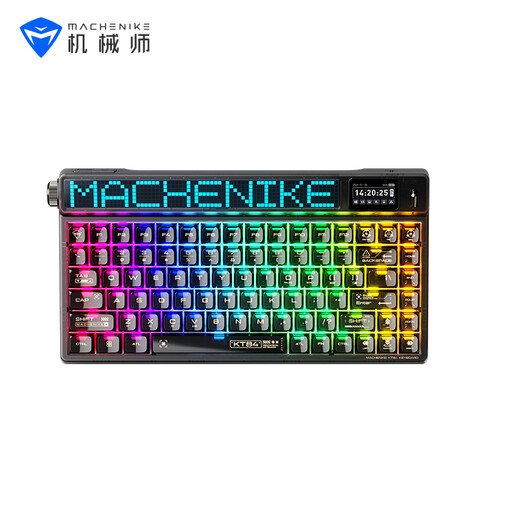
MACHENIKE KT84-B84W 75% Tri-Mode Keyboard, US Layout, Gateron White Switch
This 75% model is another compact option to assess against your desk space. Its title specifies a QWERTY US layout and Gateron White switch; check whether that layout and its direct navigation keys meet your needs.
View on Joybuy
Common questions
Is a 60% keyboard too small for puzzle adventures?
Not if mouse room is your priority and shortcuts suit the way you play. Razer says the Huntsman Mini accesses inputs from its absent function row and home cluster through secondary functions; choose a layout with more direct keys if you use those commands often.
Should I start with TKL or 75% for a small desk?
Start with TKL if removing the numpad gives you enough room and you want a more conventional main-key area. Consider 75% when you need a smaller footprint while retaining direct arrows and utility keys, as CORSAIR specifies for its K65 Plus Wireless.
Does a UK storefront mean the keyboard has a UK layout?
No; check the exact variant’s physical layout before choosing it. Joybuy UK listings include compact keyboards explicitly labelled QWERTY US layout.
Do puzzle adventures call for Rapid Trigger or adjustable actuation?
Those features are not a reason on their own to choose a keyboard for puzzle adventures. Logitech G specifies them for the G515 Rapid TKL, but that does not establish a benefit for this type of game; consider them if you also want configurable key behaviour.
What should I do with an old keyboard in the UK?
Check your local authority’s electrical-recycling options or ask a retailer about available take-back arrangements. GOV.UK explains that the UK’s Waste Electrical and Electronic Equipment Regulations 2013, as amended, support recovery, reuse and recycling, but that guidance does not set out one household disposal route for every area.


