
24/7 Customer Support

Free returns

Same-day & Next-day Delivery

Quality Guaranteed

Unlock Your Welcome Offers: FREE Delivery | Up to 80% OFF | Free 30-day JoyPlus trial
Download the APP
Choosing a toaster can look straightforward until you compare slot sizes, browning controls, cleaning features and worktop dimensions. A low-priced model may seem appealing, but the wrong design can leave you with uneven slices, limited bread compatibility or a worktop covered in crumbs.
This guide from the Joybuy Product Recommendation Officer focuses on practical details rather than inflated marketing language, helping UK households choose between a 2-slice toaster, 4-slice toaster or long-slot design.
A 2-slice toaster is usually suitable for one person, a couple or a student kitchen. However, households preparing several breakfasts at once may find themselves running multiple cycles every morning. A family toaster with four slots can reduce repeated batches, provided you have enough worktop space.
Remember that four slots do not always mean four completely independent controls. Some models operate in pairs, so check whether each pair has its own browning setting.
Standard supermarket bread may fit most toasters, but thick-cut farmhouse slices, crumpets, bagels and artisan loaves require more room. Check the stated slot design rather than relying on phrases such as “versatile” or “multi-purpose”.
A wide-slot toaster is useful for thicker items, while a long-slot toaster can accommodate longer slices or two standard slices in one extended opening. These formats can be more practical for sourdough-style bread, although they may take up more depth or width on the worktop.
Seven browning settings sound useful, but they do not remove crumbs or prevent food debris from collecting inside the appliance. Look for a toaster with a removable crumb tray, ideally with one tray for each operating section on a 4-slice model.
A toaster with cord storage can also make a noticeable difference in smaller UK kitchens, particularly where the appliance is stored in a cupboard between uses.
Measure the available space before ordering. Allow room around the toaster for ventilation and safe handling, and avoid placing it directly beneath low cupboards or beside curtains.
The appliance’s stated dimensions should be compared with your actual worktop, not just the space occupied by the base. Controls and levers may need additional clearance.
An adjustable browning toaster allows you to alter the shade according to bread type and personal preference. Browning numbers are not a universal measurement, so a setting of seven on one toaster may not produce the same result as seven on another.
For households with different preferences, independent controls are more useful than a single control for all slots. On many 4-slice models, the left and right pairs can be adjusted separately. This also means you can use only two slots when preparing a smaller breakfast.
A toaster with defrost and reheat functions can be convenient for frozen bread and slices that have cooled. Defrost is intended for bread taken directly from the freezer, while reheat warms prepared toast without starting a full browning cycle. A cancel button should be easy to reach if you need to stop the cycle.
High-lift levers are useful for retrieving smaller items such as crumpets. Cool-touch sidewalls, non-slip feet and automatic shut-off are also worth checking, although the slots and nearby metal surfaces can still become hot.
Always follow the supplied instructions. Place the toaster on a stable, heat-resistant surface, keep it away from water and flammable materials, unplug it before cleaning, and never use metal utensils to remove trapped food.
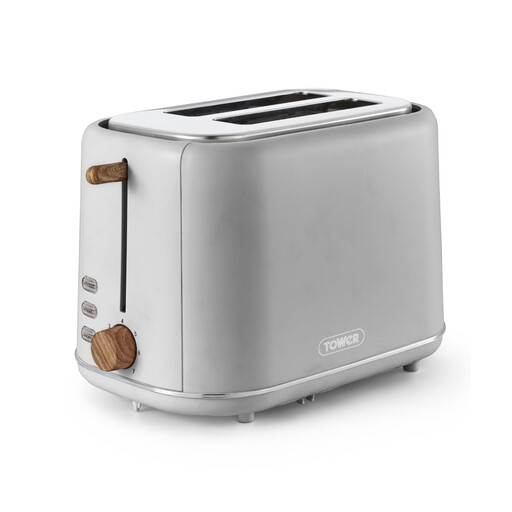
Why This Fits Their Persona: Its 2-slice format suits students, couples and smaller UK kitchens, while the compact design is easier to place on a limited worktop.
It combines seven browning controls with wide self-centring slots, rather than limiting users to a basic narrow-slot design.
Defrost, reheat and cancel functions; removable crumb tray and integrated cord storage.
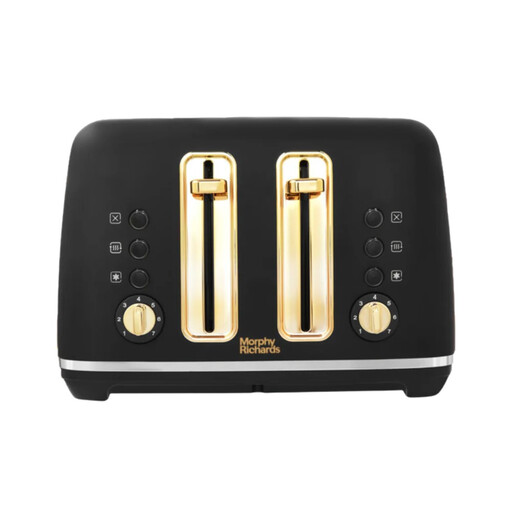
Why This Fits Their Persona: The black and metallic finish suits shoppers looking for a stylish kitchen toaster with four-slot capacity for regular household use.
Its extra-wide 36 mm slots address the limitation of narrow openings, while dual controls allow different settings for each pair.
Seven browning settings, defrost and reheat functions; integrated cord storage and removable crumb tray.
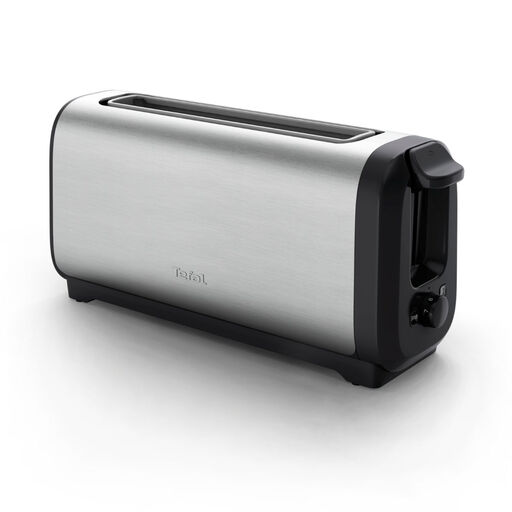
Why This Fits Their Persona: The long-slot format is suited to households using varied bread sizes, while the seven-level control supports different preferences at breakfast.
It is designed for longer bread formats and includes a removable crumb tray, reducing the risk of buying a narrow model that is difficult to clean.
Seven browning levels, defrost and reheat buttons; high-lift eject and cool sidewalls.
We have compiled a complete, real-time list of products that fully satisfy these strict selection criteria and UK safety regulations.
Place it on a stable, heat-resistant surface with clear space around the sides and above it. Do not operate it beneath flammable materials, directly beside a sink or where the cord can touch a hot surface. Check the product instructions for any specific clearance guidance.
Running cost depends mainly on the toaster’s power rating and how long it operates. A higher-wattage model may heat quickly but can use more electricity during each cycle. Using only two slots where independent controls are available can avoid heating unused sections.
Empty the tray regularly, particularly if the toaster is used every day or for crumb-heavy foods such as crumpets. Unplug the appliance and allow it to cool before removing the tray. Do not immerse the toaster in water, and never insert objects into the slots to clear trapped food.