
24/7 Customer Support

Free returns

Same-day & Next-day Delivery

Quality Guaranteed

Unlock Your Welcome Offers: FREE Delivery | Up to 80% OFF | Free 30-day JoyPlus trial
Download the APP
Watching your child prepare for their first bike is a memorable milestone. In recent years, the traditional tricycle or stabiliser-equipped bicycle has made way for a new favourite: the toddler balance bike. These simple, pedal-free bikes are designed to help little ones master the core skills of balance and steering before they need to think about pedalling.
Navigating the market for a first bike for a toddler can be overwhelming, with countless options available. As a Joybuy Product Recommendation Officer, my role is to help you understand the key features to look for, so you can choose a bike that is safe, durable and perfectly suited to your child's development. This guide will walk you through what matters most and present some of our top recommendations for 2026.
Before we look at specific models, let's cover the essential features that make a great kids balance bike. Focusing on these three areas will help you make a confident choice.
A child's safety is the number one priority. Look for a bike with a sturdy frame, often made from steel or a durable metal, which can withstand the bumps and tumbles of learning. The tyres are also a key component. Many modern balance bikes use EVA foam tyres, which have the significant advantage of being puncture-proof and lightweight, offering a smooth ride without the need for maintenance.
Always check that the product conforms to UK safety standards, indicated by the CE marking. This shows the product has been assessed to meet high safety, health and environmental protection requirements.
Toddlers grow quickly, and a bike that can't adapt will have a very short lifespan. An adjustable balance bike is a practical and economical choice. Look for models with an adjustable seat height and, ideally, adjustable handlebars. This allows you to set the bike up perfectly for your child's current size and readjust it as they grow taller, ensuring several years of use. A correctly sized bike allows the child to sit on the saddle with their feet flat on the ground, giving them the confidence and control they need.
Some of the most innovative designs are convertible balance bikes. These multi-functional models can transform to suit different stages of your child's development. A bike might start as a three-wheeled tricycle for extra stability, convert to a two-wheeled balance bike and finally, have pedals attached to become a proper pedal bike. A balance bike with pedals that can be added later offers excellent long-term value, providing a seamless transition as your child's skills progress.
Here are a few standout options that cater to different needs and preferences, based on their features and design.
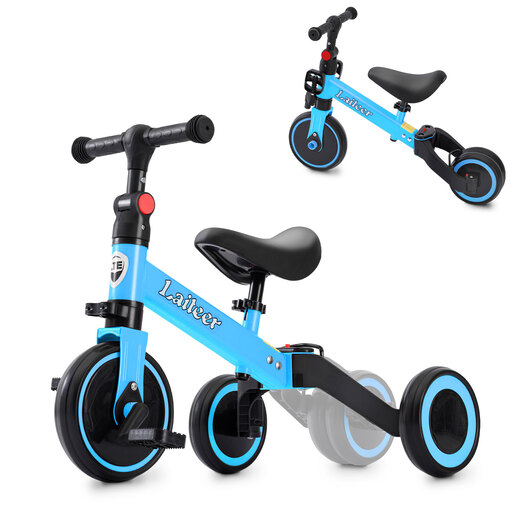
Why It Stands Out: This model is the definition of versatility. Its 3-in-1 design allows it to function as a tricycle, a balance bike and a pedal bike, making it suitable for a very wide age range from 1 to 5 years.
Pros:
Who is it for: Parents looking for a single, all-in-one solution that will grow with their child from their very first ride-on toy to their first pedal bike.
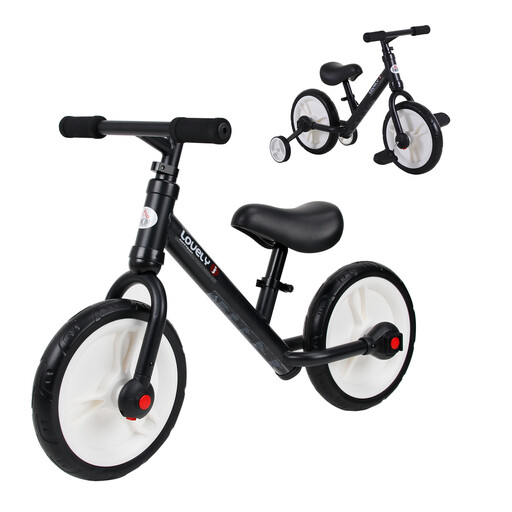
Why It Stands Out: The HOMCOM bike offers a more traditional approach with the inclusion of removable stabilisers and pedals. This allows for a phased learning experience, starting with full support and gradually moving towards independent balancing.
Pros:
Who is it for: Families who appreciate the option of using stabilisers to help a more cautious child build initial confidence before transitioning to balancing.
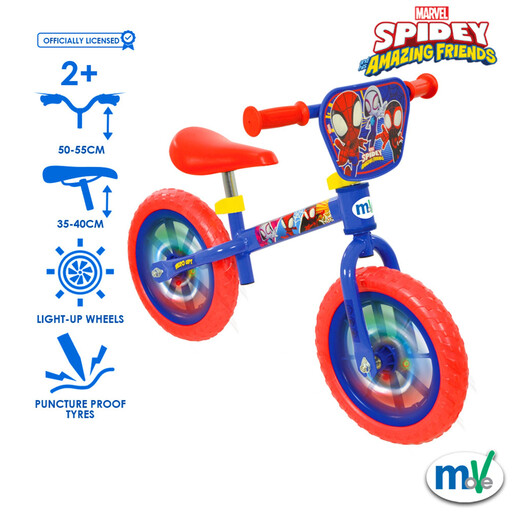
Why It Stands Out: This bike combines the fun of a popular character with an exciting feature: motion-activated light-up wheels. It’s designed to make learning to ride an engaging and thrilling adventure.
Pros:
Who is it for: A perfect balance bike for a 2 year old (or older) who loves Spidey and would be motivated by the fun, light-up features.
The models highlighted here are just a starting point. Every child is different, and you may be looking for a different colour, size or feature set. If you haven't found the perfect fit yet, there are many other excellent choices available.
Explore our full collection of childrens first balance bikes to find the perfect match for your little one.
Most children are ready for a balance bike between 18 months and 2 years old, or as soon as they are walking confidently. However, the key factor is not age but physical development and size. Always choose a bike where the child can sit on the saddle with their feet planted firmly on the ground.
They teach different skills. Balance bikes focus on teaching balance, steering and coordination from the start. Children who master a balance bike often find the transition to a pedal bike without stabilisers much faster. Stabilisers, on the other hand, teach the motion of pedalling but delay the development of balance. Neither is "wrong," but the balance-first approach is widely recognised for building core cycling skills effectively.
The most important measurement is the child's inseam. Measure from the floor to their crotch while they are standing. The bike's minimum seat height should be equal to or slightly less than this measurement. This ensures they can sit comfortably with their feet flat on the ground and a slight bend in their knees, which is crucial for pushing off and stopping safely.