
24/7 Customer Support

Free returns

Same-day & Next-day Delivery

Quality Guaranteed

Unlock Your Welcome Offers: FREE Delivery | Up to 80% OFF | Free 30-day JoyPlus trial
Download the APP
Navigating the world of baby and toddler products can feel overwhelming. When it comes to selecting a toddler cup, the shelves are filled with endless options, each promising to be the perfect solution for your little one. As a Joybuy Product Recommendation Officer, my role is to help you see past the marketing jargon and focus on what truly matters. Many parents find themselves with a cupboard full of cups their child refuses to use, or worse, ones that create more mess than they prevent. Let's look at the common pitfalls to avoid.
Before you make a purchase, be aware of a few common issues that can turn a promising cup into a frustrating waste of money:
To find a cup that is safe, practical and supportive of your child's development, focus on these key parameters.
Seeing BPA-free on the packaging is a good start, but it's the minimum standard you should expect. Bisphenol-A is a chemical that was once common in plastics, and it's now widely avoided in baby products. Look for cups made from durable, food-safe materials like Polypropylene (PP) and food-grade silicone. These materials are not only safe but also robust enough to withstand being dropped, thrown and put through the dishwasher countless times.
The right type of cup depends on your child's age and stage. Understanding the differences is key to making a good choice.
A practical cup is one that both you and your toddler can manage easily. For your child, look for features like lightweight construction and easy-to-hold cup with handles for toddler. For you, consider how easy the cup is to clean. The fewer parts, the better. Cups that are top-rack dishwasher safe and have wide openings for easy scrubbing will make your life significantly easier.
Based on these practical criteria, here are a few options from our catalogue that are well-suited to different needs and stages.
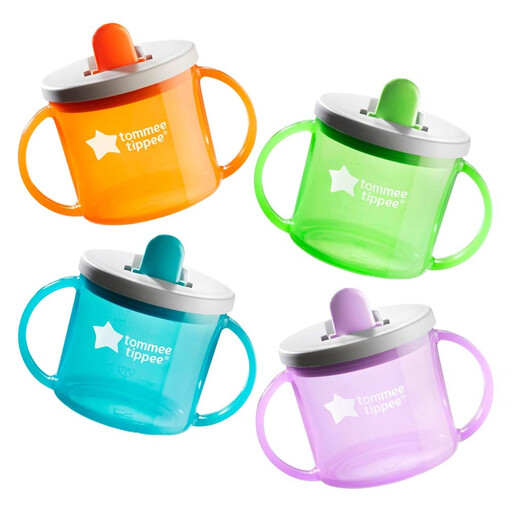
Why This Fits Their Persona: This cup is ideal for the very beginning of the weaning journey. Its simple design and easy-grip handles are perfect for tiny hands just learning to hold a cup, helping to build confidence and motor skills in your baby.
It avoids the cleaning nightmare with a simple two-part design. Its free-flow spout also helps with healthy oral development by teaching sipping rather than hard sucking.
The spout flips down for spill-proof travel, and the cup disassembles into just two parts for exceptionally easy cleaning and sterilisation.

Why This Fits Their Persona: For parents who dread cleaning up puddles, this cup is a game-changer. It provides the freedom of an open cup without the mess, making it perfect for use at home, in the car or at the grandparents' house.
It sidesteps the "leak-proof illusion" with a reliable valve that seals when the child isn't drinking. Its spoutless design is also recommended by dentists, avoiding the oral development pitfall.
The 360° drinking edge allows sipping from any side, and the cup automatically seals to prevent spills. It has minimal parts for easy cleaning.

Why This Fits Their Persona: For parents of busy toddlers, a cup that is durable, spill-proof and genuinely easy to clean is essential. This cup's design is focused on hygiene and convenience, making it a reliable choice for days out at the park or trips to nursery.
It directly solves the "cleaning nightmare" with a unique straw that opens fully for scrubbing, eliminating the need for special brushes and worries about hidden grime.
The straw zips open for a thorough clean, and the integrated spill-proof valve prevents leaks. It's made from durable, impact-resistant materials.
We have compiled a complete, real-time list of products that fully satisfy these strict selection criteria and UK safety regulations.
Most health visitors in the UK suggest introducing a baby first cup around 6 months of age, at the same time you begin introducing solid foods. Starting with a small amount of water in an open cup (with your help) or a free-flow trainer cup can help your baby learn the skills needed for independent drinking.
Both are generally considered better options than hard-spouted sippy cups. Dentists often prefer open cups as the ideal, but for a practical, spill-resistant alternative, both 360 cups and soft straw cups promote a more natural sipping motion that supports healthy oral muscle development. The key is to avoid cups that require a prolonged, unnatural sucking pattern similar to a bottle.
There is no fixed timeline, but it's crucial to inspect cups before each use. Check for cracks in the cup body, bite marks on the spout or straw and signs of wear on the valves. Many manufacturers recommend replacing soft spouts or straws every 2-3 months, or immediately if you see any damage. A worn-out valve is a common cause of leaks.