Usually not for an everyday snack: a mini piece does not remove the concerns that NHS guidance raises about sugary snacks or hard, gooey and sticky sweets for young children. If considering fudge as an occasional sweet food, check the exact pack for texture and allergens; for nursery or school occasions, check the setting’s food and allergy policy too.
Who needs to consider these checks?
Parents choosing everyday toddler snacks
A small sweet may look convenient, but size does not establish that its texture is suitable. The NHS advises avoiding sugary snacks and identifies hard, gooey or sticky sweets as choking hazards for babies and young children.
Families checking allergens
Fudge recipes and precautionary statements vary. Check the ingredients and allergen information on the exact pack, particularly when a child has a food allergy or the food is going into a nut-aware setting.
Parents packing food for a nursery or school occasion
A home decision does not establish what a setting permits. Check its food and allergy policy; for food provided in England state-funded schools, the Department for Education’s school-food requirements are distinct from England’s retail promotion rules.
What matters when choosing?
Start with texture and the eating occasion, then check the exact product label and any rules for the setting where the food will be offered.
| Priority | What to check | Your needs |
|---|
| Texture |
Check the actual sweet’s texture, not just its piece size. The NHS identifies hard, gooey and sticky sweets as choking hazards for babies and young children. |
I need to know whether the sweet has a texture my toddler should avoid; a “mini” label cannot answer that. |
| Eating occasion and sugar |
Read the sugar value and its basis, such as per 100g or per serving. The NHS advises avoiding sugary snacks and offering sugary foods with meals rather than between them. |
For an ordinary between-meal snack, I would choose something other than confectionery. A smaller piece does not change when it is being offered. |
| Allergens |
Read the current pack’s ingredients, emphasised allergens and any “may contain” statement. Do not apply another product’s allergen details to this one. |
If an allergy or nut-aware policy matters, I need information for the exact product I plan to offer or pack. |
| Setting rules |
Check the nursery or school’s food and allergy policy. In England, retail HFSS promotion and placement rules are separate from requirements for food provided in state-funded schools. |
I need to know what this particular setting permits, rather than treating a retail classification as permission to serve the food. |
Assumptions to avoid
-
Assuming “mini” means safe to eat
Piece size does not reveal whether a sweet is hard, gooey or sticky. The NHS identifies those textures as choking hazards for babies and young children.
Do not choose a toddler’s sweet by size alone; avoid those textures and choose a non-sugary option for routine snack time.
-
Using one fudge label for every product
Recipes differ: the reviewed products declare different allergens, and the Thorntons mini cake bites carry a “May also contain: Nuts” statement.
Read the ingredients, highlighted allergens and precautionary statements on the exact pack each time.
-
Making a portioned sweet a routine snack
Individual pieces do not change the eating occasion. The NHS advises avoiding sugary snacks and offering sugary foods with meals rather than between them.
Treat a mini sweet as confectionery, not as an everyday between-meal toddler snack.
-
Using retail HFSS rules to decide what a school permits
England’s food promotion and placement regulations address retail activity, while the Department for Education describes separate requirements for food provided in state-funded schools in England.
For food going into a nursery or school, check the setting’s policy and the requirements that apply to its food provision.
Relevant brand examples
These products illustrate why the exact label and product type matter; a baking ingredient or mini cake bite is not automatically a toddler snack.
Waitrose
Waitrose sells own-label fudge, including Cooks’ Ingredients Fudge Chunks, a 70g product described for baking.
- Waitrose & Partners lists 66.6g sugars per 100g for these chunks and declares milk ingredients.
- Waitrose advises checking the pack because recipes can change. Baking chunks are not, by their format, established as suitable for toddlers.
M&S
M&S presents its 100g All Butter Fudge Cubes as a baking and decorating ingredient.
- M&S lists 72.9g sugars per 100g and ingredients including milk and soya.
- M&S advises reading the current label. A cube shape alone does not establish toddler suitability.
Thorntons
The Thorntons mini product reviewed at Sainsbury’s is a chocolate-dipped brownie bite with fudge pieces, not plain fudge.
- Sainsbury’s lists ten servings of about 12g each and 5.5g sugars per serving for this product.
- Its listed allergens include milk, wheat, egg and soya, and it states “May also contain: Nuts.” Its mini format does not settle the toddler snack decision.
Mini fudge on Joybuy
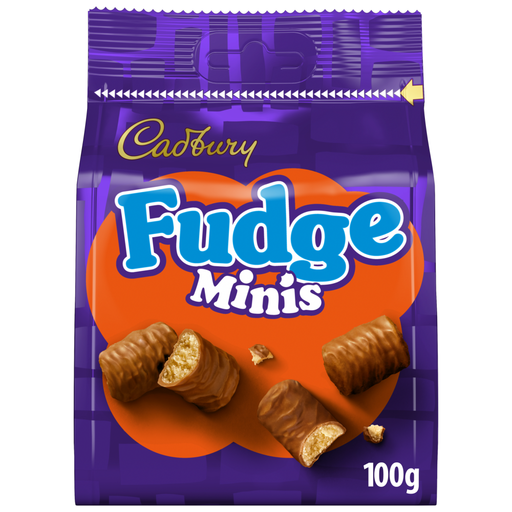
For anyone considering an occasional sweet item rather than a routine toddler snack, this mini fudge option still calls for checks of the exact pack and texture.
 No image available
Cadbury Fudge Minis 100G
This mini-format fudge is an occasional sweet to assess, not a substitute for an everyday toddler snack.
Before considering it for a young child, check the exact pack’s ingredients, allergen statements and piece size, and assess whether the texture is hard, gooey or sticky.
View on Joybuy
Questions about mini fudge for toddlers
Does mini fudge make a suitable everyday toddler snack?
No: the mini format does not change the NHS advice to avoid sugary snacks. The NHS also identifies hard, gooey and sticky sweets as choking hazards for babies and young children, so check the texture rather than relying on size.
Can I tell from the name whether fudge contains nuts?
No. Recipes and precautionary statements vary: Sainsbury’s lists “May also contain: Nuts” for the reviewed Thorntons brownie bites. Check the ingredients and allergen statements on the exact pack; neither “fudge” nor “mini” establishes nut-free status.
Which allergens should I check on a fudge product?
Check the full current label rather than assuming every fudge has the same ingredients. The reviewed Waitrose and M&S fudge products list milk ingredients, the M&S product also lists soya, and the reviewed Thorntons brownie bites list milk, wheat, egg and soya alongside a nut precautionary statement.
Do England’s HFSS retail rules decide whether mini fudge can be served at school?
No. England’s Food (Promotion and Placement) Regulations concern specified retail and online promotions and placement; they are not a school-meal permission rule. The Department for Education describes separate requirements for food provided in state-funded schools in England. Check the applicable current requirements and the individual setting’s food and allergy policy.


