Parents planning an occasional toddler pizza dinner
Compare margherita pizzas by fat, saturates and salt per 100g, then choose the child’s portion separately from any adult serving shown on the pack.


For a toddler dinner, compare the exact pizza’s fat, saturates and salt per 100g rather than using an adult serving as a portion guide. Among three margheritas compared using Tesco, Sainsbury’s and Asda label figures, the Tesco and Sainsbury’s pizzas each list 7.4g fat per 100g; Sainsbury’s lists less salt at 0.71g versus Tesco’s 0.83g. If you need a freezer option, note that the Sainsbury’s pizza is sold chilled and must be frozen before its use-by date; check the current pack’s allergens and cooking directions, and decide the child’s portion separately.
The useful comparison depends on how you will serve the pizza, as well as what its label says.
Compare margherita pizzas by fat, saturates and salt per 100g, then choose the child’s portion separately from any adult serving shown on the pack.
A relatively lower-fat pizza is not necessarily labelled low fat. If a child has a medically prescribed fat restriction, follow advice from their clinician or paediatric dietitian instead of using a general pizza comparison.
Check the current ingredient declaration and the setting’s own food and allergen policy. The Tesco, Sainsbury’s and Asda margheritas compared here declare wheat and milk.
Start with the nutrition values per 100g for the exact product, then check whether its storage, ingredients and preparation work for the meal you are planning.
| Priority | What to check | Why it matters to me |
|---|---|---|
| Fat and saturates | Compare both figures per 100g on the same cooked basis. NHS food-label guidance defines low fat as no more than 3g per 100g and low saturated fat as no more than 1.5g per 100g; none of the three retailer-labelled margheritas meets those thresholds. | I’m looking for less fat among comparable pizzas, not assuming that a relatively lower figure makes a pizza a low-fat food for a toddler. |
| Salt | Read salt per 100g alongside fat. Sainsbury’s lists 0.71g, Tesco 0.83g and Asda Saporito 1.5g per 100g for their compared margheritas, cooked as instructed. | If two pizzas have similar fat figures, I also want to see how their salt figures differ. The NHS advises that young children should not have much salt. |
| Portion | Use per-100g figures to compare packs; decide the amount served to the child separately from an adult portion or reference intake. Department for Education guidance applies the Eatwell Guide from age 2. | An adult half-pizza serving does not tell me how much to put on a toddler’s plate. I need to consider the child’s age and the rest of the meal. |
| Ingredients and serving | Read the current allergen declaration and follow that pack’s storage and cooking directions. Cook thoroughly, let the pizza cool before serving and cut it appropriately for the child; Department for Education guidance says food for children under 5 should be prepared to minimise choking risk. | Before serving or packing pizza, I need to check that its ingredients suit the child and, for food going to an early-years setting, that it meets the setting’s policy. |
Crust wording does not establish the nutrition values. The Asda Saporito stonebaked margherita lists 8.2g fat and 4.8g saturates per 100g, while the compared Tesco and Sainsbury’s stonebaked margheritas each list 7.4g fat and 3.4g saturates.
Compare the exact pizzas’ per-100g nutrition tables on the same cooked basis rather than choosing by format alone.
Adult reference-intake percentages and a manufacturer’s suggested serving are not instructions for how much to serve a toddler.
Use per-100g values for the product comparison, then decide the child’s amount separately. Follow professional advice if the child has a medically prescribed diet.
Similar fat figures can come with different salt figures: the compared Sainsbury’s and Tesco pizzas both list 7.4g fat per 100g, but list 0.71g and 0.83g salt respectively.
Read both values on the current pack, and consider what else you plan to serve with the pizza.
The compared Tesco, Sainsbury’s and Asda margheritas declare wheat and milk. The ingredient declaration matters even when the flavour sounds familiar.
Check the exact current pack against the child’s needs, and ask an early-years setting about its own food and allergen policy before packing pizza.
These examples refer to specific pizza lines, not to every pizza made by each brand.
Tesco Stonebaked Margherita is one retailer-labelled margherita for a per-100g comparison.
Sainsbury’s Stonebaked Margherita is sold chilled and can be frozen before its use-by date.
Asda Saporito Stonebaked Margherita provides another frozen margherita label for comparison.
Goodfella’s Stonebaked Thin Margherita offers a thin-base margherita format.
Chicago Town Ultimate Chicago Thin Loaded Cheese is a frozen, thin-base cheese pizza.
Dr Oetker Professional’s Gastronorm Margherita is a bulk catering product rather than the same product as a consumer Ristorante pizza.
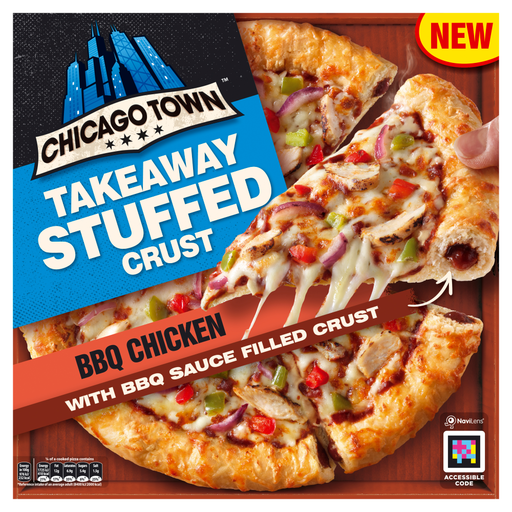
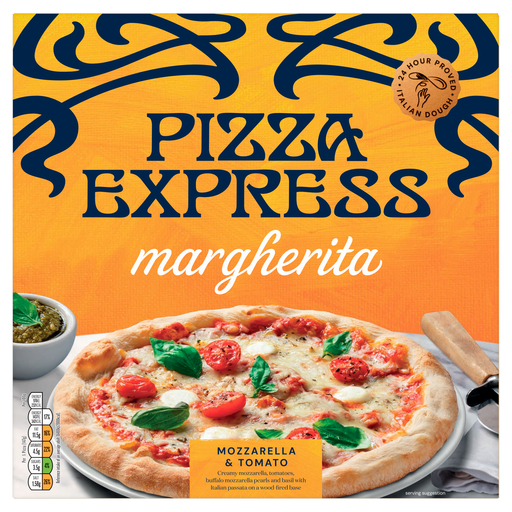
These options are a BBQ chicken stuffed-crust pizza and a margherita. For a toddler dinner, compare each current pack’s nutrition, ingredients and preparation directions rather than treating them as interchangeable frozen margheritas.
 No image available
For a toddler dinner, compare this BBQ chicken pizza’s current per-100g fat, saturates and salt figures with the other pizzas you are considering. Check its wheat and cheese ingredients against the child’s needs, follow the pack’s oven directions and choose the child’s portion separately.
 No image available
This margherita is an option to assess by its current per-100g fat, saturates and salt figures. Check the pack for wheat and milk, and confirm its refrigeration, freezing and cooking directions before planning it as a freezer meal. Decide the toddler’s portion separately.
No. NHS food-label guidance defines low fat as no more than 3g per 100g and low saturated fat as no more than 1.5g per 100g. The Tesco, Sainsbury’s and Asda margheritas compared here exceed both thresholds, even though their figures differ from one another. Read the values on the exact pack you plan to use.
Do not use an adult half-pizza serving or adult reference-intake percentage as a toddler portion guide. Compare products using their per-100g labels, then decide how much to serve in light of the child’s age and the rest of the meal.
Consider pizza as part of a varied pattern of meals rather than relying on it as the same daily dinner. The NHS advises that young children should not have much salt or too many foods high in saturated fat; Department for Education guidance applies the Eatwell Guide from age 2.
Check the current ingredient and allergen declaration for the exact pizza. The Tesco, Sainsbury’s and Asda margheritas compared here declare wheat and milk. If pizza is going to an early-years setting, check that setting’s own food and allergen policy before packing it.
Follow the exact pack’s storage and cooking instructions, make sure the pizza is thoroughly cooked, then let it cool before serving. Cut it into pieces appropriate for the child; Department for Education guidance says food for children under 5 should be prepared to minimise choking risk.