What to check before buying
Start with the ingredient list, then compare preparation format and any allergen requirements for the child or setting.
| Priority |
What to check |
Your needs |
| Control of free sugars |
Look for an ingredient list containing only oats. Compare sugars on the same basis, preferably per 100g as sold, and separate milk or fruit added at home from the dry product. |
I want to decide whether sweetness comes from fruit rather than from syrup, honey, dried fruit or a flavoured cereal base. NHS guidance distinguishes free sugars from sugars naturally present in milk, fruit and vegetables. |
| Allergen and gluten checks |
Read the current allergen declaration and any “may contain” statement. Choose an explicitly labelled gluten-free product only where that requirement applies, and confirm the setting’s policy before packing food. |
I need to know whether the specific pack fits my child’s allergy needs or the nursery or school plan. A gluten-free claim does not mean oats themselves are no longer an allergen. |
| Texture and preparation |
Decide between regular rolled oats, thicker jumbo oats and pre-portioned sachets. Check cooking directions, adjust liquid for the child’s preferred consistency and allow prepared porridge to cool before serving. |
Some mornings call for a quick sachet, while at home I may prefer to control the consistency of plain oats. For under-2s, NHS guidance advises against making wholegrain starchy foods the only starchy-food choice. |
Joybuy product options
Joybuy options for plain-oat toddler breakfasts, including an explicitly gluten-free route and a quick original sachet format.
 Image unavailable
Morrisons Free From Gluten Free Oats 1kg
A plain-oat base for households that need an explicitly gluten-free and wheat-free option.
Listed as 100% gluten-free oat flakes in a 1kg bag. Oats remain an allergen, so check the current pack and any setting-specific requirements before packing.
Joybuy
 Image unavailable
Quaker Oat So Simple Big Bowl Original 6 Pack 231g
A pre-portioned original plain-oat sachet option for rushed weekday breakfasts.
The listing states wholegrain rolled oats and 0.4g sugars per dry sachet, with 2½-minute microwave preparation. The sugars shown after preparation with semi-skimmed milk are not a dry-oat figure; cool before serving.
Joybuy
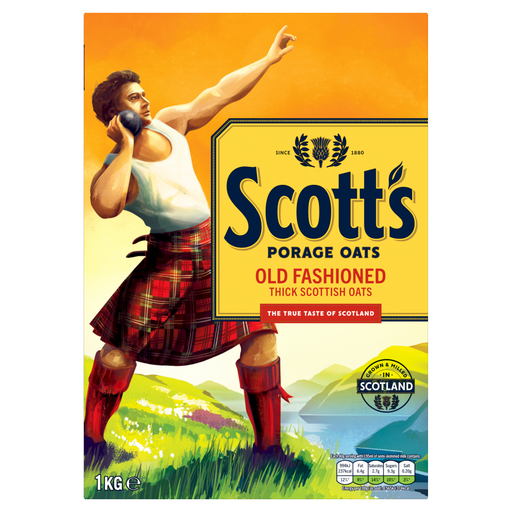 Image unavailable
Scotts Porage Oats Old Fashioned Porridge Oats 1kg
A plain rolled-oat option for home preparation with water or milk.
The listing states 100% rolled oats, 1.1g sugars per 100g as sold, and both stovetop and microwave methods. It may contain wheat and barley, and its thicker texture may need adjusting for the child.
Joybuy
 Image unavailable
Flahavan's Organic Porridge Oats 2kg, 2 x 1kg
A larger plain-oat supply for parent-prepared porridge at home.
The bundle contains two 1kg packs of 100% organic wholegrain oat flakes and lists 0.4g sugars per 40g serving. Check the pack directions for preparation, and keep wholegrain starchy foods varied across the day for under-2s.
Joybuy
 Image unavailable
Flahavan's Organic Porridge Oats 1kg
A single-pack plain-oat choice where you want to add fruit or other toppings yourself.
The listing states 100% organic wholegrain oat flakes and 0.4g sugars per 40g serving. It contains oats and should not replace an explicitly gluten-free product where that claim is required.
Joybuy
Frequently asked questions
Does a low “sugars” figure on porridge mean there is no added sugar?
Not necessarily. The total-sugars line includes naturally occurring sugars from milk, fruit and vegetables as well as free sugars. Check the ingredient list for syrup, honey, sweetened fruit ingredients or other sweeteners; plain oats containing only oats give the clearest starting point. NHS guidance states that sugars naturally present in milk, fruit and vegetables are not free sugars.
Can I make toddler porridge with milk?
For a child aged 1 or over, pasteurised whole or semi-skimmed cows’ milk can be used as a main drink and in breakfast preparation. For babies under 12 months, first infant formula is the suitable alternative to breast milk as a main drink; seek individual advice for weaning and feeding questions.
Are ordinary porridge oats gluten-free?
Do not assume so. In the UK, a product labelled gluten-free must contain no more than 20mg/kg gluten, but oats still need allergen emphasis because oat itself can trigger allergy. Choose an explicitly labelled gluten-free product only where that requirement applies and check the current pack.
Can porridge oats be packed for nursery or school?
It depends on the setting’s published allergy safety policy and the child’s own requirements. The Department for Education says schools must publish an allergy safety policy. Check the exact oat product’s allergen and “may contain” statements before packing it.
Should a toddler eat only wholegrain oats and other wholegrain starches?
No. NHS guidance says wholegrain foods can be offered, but it is not a good idea to give under-2s only wholegrain starchy foods because the fibre can fill them before they take in enough energy and nutrients. Keep foods varied across the day and adapt texture and portion to the child.


