Parents choosing everyday toddler snacks
If the snack will be offered regularly, the NHS suggests options including fruit, vegetable sticks and plain unsweetened yoghurt, and advises avoiding salty foods such as crisps for babies and young children.


For routine toddler snacks, choose options such as fruit, vegetable sticks, plain unsweetened yoghurt or unsalted rice cakes instead of a sharing bag of crisps: the NHS advises avoiding salty foods, including crisps, for babies and young children. If you are buying crisps for an occasional family occasion, check the exact pack’s salt, saturated fat and allergens, and put any amount offered to the toddler in a separate bowl rather than treating the bag’s stated servings as child portions.
If the snack will be offered regularly, the NHS suggests options including fruit, vegetable sticks and plain unsweetened yoghurt, and advises avoiding salty foods such as crisps for babies and young children.
A sharing bag may be intended for the family, but its pack size and stated servings do not define an amount for a toddler. Check the exact flavour’s label and separate any amount offered to the child before the bag goes on the table.
For food supplied by an early-years setting, the Department for Education says meals, snacks and drinks must be healthy, balanced and nutritious. Since September 2025, providers have also had to take its Early Years Foundation Stage nutrition guidance into account unless there is good reason not to.
Decide whether this is a routine toddler snack or food for an occasional family occasion before comparing crisp packs.
| Priority | What to check | Your needs |
|---|---|---|
| Routine snacks | For everyday snacks, consider the NHS examples of fruit, vegetable sticks, plain unsweetened yoghurt, toast or unsalted rice cakes. The NHS advises avoiding salty foods such as crisps for babies and young children. | I’m choosing something to offer regularly between meals, rather than buying crisps because they come in a sharing bag. |
| Nutrition label | If buying crisps for an occasional family occasion, compare salt and saturated fat on the exact packs using the same basis, such as per 100g. Check what a reduced-salt or reduced-fat claim is being compared with. | A front-of-pack claim catches my eye, but I want to know what the crisps actually contain before deciding whether to buy them for the family. |
| Sharing-bag portions | Check the bag weight and what its stated serving represents. Tyrrells labels its 150g Sea Salt & Cider Vinegar bag as five 30g servings; that is pack information, not a toddler portion. | If the family opens a large bag, I’d rather put any amount offered to the toddler in a separate bowl than leave the bag within reach. |
| Flavour and allergens | Read the ingredients and allergen statement on the exact flavour and current pack, including any may-contain wording. Check the nursery’s food policy before sending snacks there. | One flavour’s ingredients may differ from another’s, so I need to check the pack that will actually be served. |
Tyrrells describes its 150g Sea Salt & Cider Vinegar bag as five 30g servings, but that label does not specify an amount for a toddler.
For an occasional family occasion, put any amount offered to the child in a separate bowl before serving and put the rest away.
Walkers says its Lightly Salted crisps have 45% less salt than the average salt value of regular potato crisps; its label still lists 0.67g salt per 100g. The comparison does not change NHS advice to avoid salty foods such as crisps for young children.
Compare the exact pack’s salt and saturated fat if buying crisps for the family, and use NHS-listed alternatives for routine toddler snacks.
A vegan or gluten-free declaration addresses a specific dietary question, not every possible allergen or the nutritional values of every flavour. For example, McCoy’s says its Salted flavour may contain milk, soya, gluten and mustard.
Read the current label for the exact pack, and check the setting’s policy if the food will be taken to nursery.
Department of Health and Social Care guidance describes England’s restrictions on promotions and placement of certain foods in qualifying retail settings. Early-years providers have separate food requirements and nutrition guidance from the Department for Education.
If buying for an early-years setting in England, check its food policy and the applicable early-years guidance rather than relying on an HFSS description of a retail product.
Compare the stated values for the particular flavour and pack, rather than assuming every crisp from one brand has the same ingredients or nutrition.
Its Lightly Salted and Baked variants illustrate why reduced-nutrient claims need a look at the full label.
Its Sea Salt & Cider Vinegar crisps provide an example of how a sharing bag presents serving information.
The Lightly Salted variant has a stated salt value that can be compared with other packs on a per-100g basis.
Sea Salted has both per-bag and per-100g salt information.
Its Salted flavour shows why the allergen statement matters even when the flavour name sounds straightforward.
REAL lists its Sea Salt crisps in 35g and 150g formats.
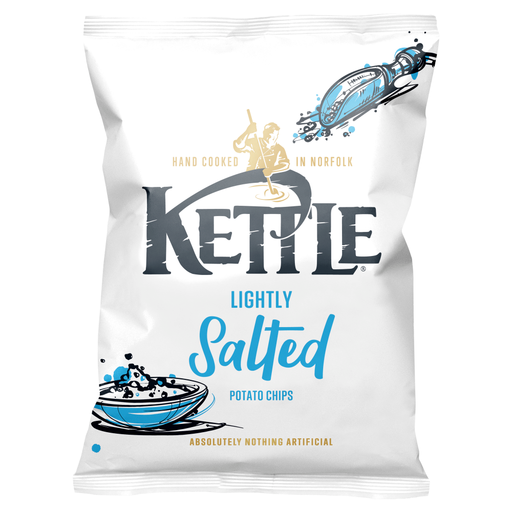
This lightly salted sharing bag is an option to compare if you are buying crisps for an occasional family occasion, not a replacement for routine toddler snacks.
 No image available
For an occasional family crisp purchase, compare the label and put any amount offered to a toddler in a separate bowl. This is a 130g Lightly Salted bag; KETTLE Chips lists 0.7g salt per 100g for the Lightly Salted variant. Check the current pack’s ingredients and allergen statement before serving.
Choose another option for routine toddler snack time. The NHS advises avoiding salty foods, including crisps, for babies and young children, and suggests snacks such as fruit, vegetable sticks, plain unsweetened yoghurt, toast and unsalted rice cakes.
No: it describes a comparison, not a toddler-feeding recommendation. Walkers says its Lightly Salted crisps have 45% less salt than the average salt value of regular potato crisps, while listing 0.67g salt per 100g; check the exact pack rather than relying on the front-of-pack wording.
If any crisps are offered to a toddler, put that amount in a separate bowl before the family starts eating and put the rest away. A sharing bag’s stated servings are pack information, not instructions for a toddler: Tyrrells lists five 30g servings for its 150g Sea Salt & Cider Vinegar bag.
Read the current ingredients and allergen statement for the exact flavour, including may-contain warnings. Tyrrells identifies barley in Sea Salt & Cider Vinegar, while McCoy's says its Salted flavour may contain milk, soya, gluten and mustard.
Check the setting’s food policy rather than assuming a retail sharing bag is acceptable. The Department for Education says food supplied by early-years providers must be healthy, balanced and nutritious; since September 2025, providers have also had to take its Early Years Foundation Stage nutrition guidance into account unless there is good reason not to. England’s retail HFSS promotion rules are separate from these early-years requirements.