
24/7 Customer Support

Free returns

Same-day & Next-day Delivery

Quality Guaranteed

Unlock Your Welcome Offers: FREE Delivery | Up to 80% OFF | Free 30-day JoyPlus trial
Download the APP
A toddler soft play set can turn part of a living room, playroom, nursery or childminding space into an active play area. However, colourful foam blocks are not automatically suitable for every child or room. Parents and settings should compare the construction, age guidance, floor space, cleaning method and safety information before buying.
The right set should support climbing, crawling and imaginative building without becoming difficult to store or maintain. Below are the main pitfalls to avoid, followed by practical product recommendations for different household and professional-use needs.
A set with ten pieces is not necessarily more useful than one with six or seven. The shape mix matters more than the number printed on the box. A toddler climb and crawl set with ramps, steps, arches, waves and mats may offer more varied routes than a larger collection of similar cubes.
Check the dimensions of each module and the maximum footprint when assembled. A configuration measuring over 150cm in length may be unsuitable for a smaller flat or shared playroom, even if the individual pieces are easy to move.
Foam can cushion ordinary tumbles, but it does not remove the need for active supervision. A toddler could still fall from a raised block, trap fingers between pieces or move equipment towards furniture. Avoid placing soft play equipment near radiators, windows, stairs or hard-edged furniture.
Look for practical stability features such as anti-slip bases, touch fasteners or hook-and-loop connectors. Also check the stated weight capacity, particularly if older children may use the set.
Unsealed fabric covers can absorb spills and are more difficult to wipe down after messy play. PU-covered children's foam play blocks are generally more convenient for everyday cleaning because the surface can be wiped with a damp cloth.
Do not assume every cover is machine washable. Check whether the product uses PU, EPE foam, polyester or a removable fabric cover, and follow the supplied care instructions. Strong chemicals and soaking may damage foam, stitching or coatings.
Most products in this guide are specified for children aged approximately 1–3 years or 12–36 months. This guidance should be treated as a starting point rather than a substitute for assessing a child’s coordination and confidence.
Use the equipment indoors, on a suitable clear surface and under adult supervision. Remove shoes where the instructions recommend it, as this can reduce wear on seams and covers. Inspect the set regularly and stop using any piece with a tear, broken fastening or significant deformation.
Common materials include EPE foam, PU or polyester covers. EPE provides a lightweight, cushioned structure, while a wipeable outer layer can make routine maintenance simpler. High-density foam may retain its shape more effectively, but buyers should still check the product’s stated capacity rather than relying on material descriptions.
Some sets specify a maximum load of 60kg, while the AIYAPLAY 10-piece model lists a 90kg capacity. These figures describe the product specification; they do not mean children should use the equipment without supervision or that every configuration has identical stability.
EN71-1-2-3 refers to parts of the European toy safety standard covering mechanical and physical properties, flammability and migration of certain elements. Product listings may describe a set as meeting or being tested to these parts of EN71.
Check that the listing provides clear safety information, age guidance, warnings and manufacturer details. EN71 information is useful, but it does not replace sensible setup, regular inspection or supervision. For nurseries, playgroups and therapy settings, also consider your own risk assessment and insurance requirements.
The following products suit different room sizes, budgets and patterns of use. Always check the current product page for availability, delivery details and the latest instructions before ordering.
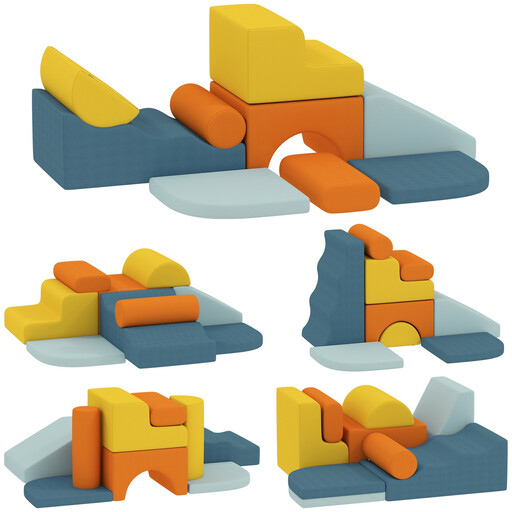
Why This Fits Their Persona: A practical starting point for families wanting indoor soft play without a larger ten-piece layout. Its six-piece format can suit a modest playroom or living-room corner.
The listing gives individual block dimensions, a 60kg maximum load and EN71-1-2-3 information, making it easier to compare than a listing based only on colourful images.
Six stackable components include square, stairs, ramp and incline pieces. The PU-covered surface is designed to be wiped with a damp cloth.
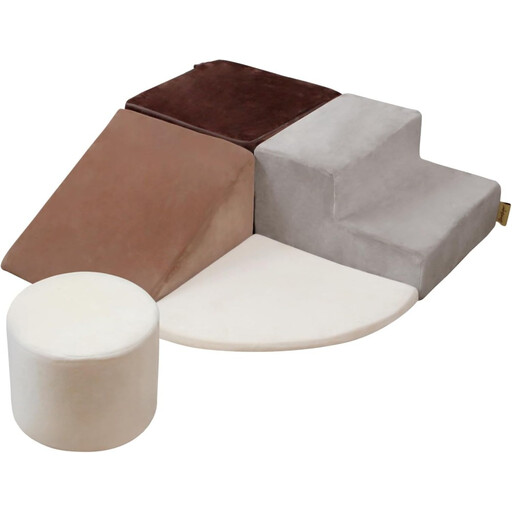
Why This Fits Their Persona: Suitable for households or settings that prioritise removable covers and a more neutral colour scheme for a carefully organised indoor play area.
The five-piece set lists textured non-slip sections, hook-and-loop connectors and hidden zippers. It is supplied vacuum-packed, so the foam should be allowed 24–48 hours to expand before use.
Removable fabric covers are described as machine washable. The listing states compliance with EN71-1, EN71-2, EN71-3 and the Toy Safety Directive 2009/48/EC.
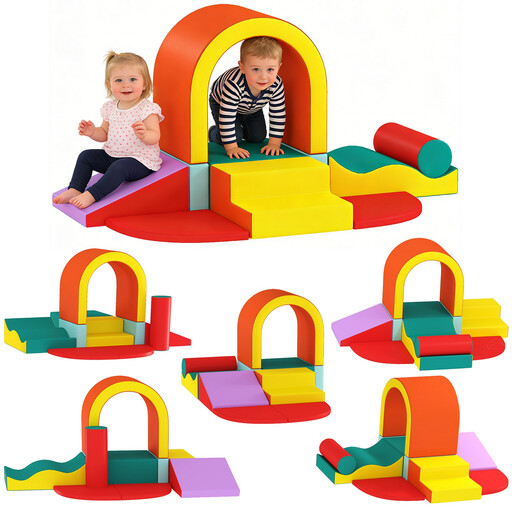
Why This Fits Their Persona: A flexible option for nurseries, childminders, playgroups or larger homes where toddlers need several routes and regular layout changes.
The product combines anti-slip hook-and-loop pads with a stated 90kg capacity and gives an overall assembled dimension of 152 x 82 x 70cm. Measure the intended area first.
Ten pieces include an arch, cube, wave, cylinder, ramp, stairs, mats and blocks. The PU surface is described as water- and stain-resistant for wipe cleaning.
We have compiled a complete, real-time list of products that fully satisfy these strict selection criteria and UK safety regulations.
Before use, clear a generous area and place the blocks away from hard furniture and trip hazards. Check whether connectors are attached correctly and allow vacuum-packed foam to expand fully where required. A non-slip play mat may provide an additional floor layer, but it should not replace supervision or the manufacturer’s instructions.
Wipe PU surfaces with a damp cloth and use only the cleaning products recommended by the supplier. For fabric-covered foam climbing blocks, remove and wash covers according to the care label. Store the set somewhere dry and away from direct sunlight, heat and fire sources.
There is no fixed lifespan for a toddler activity set. Longevity depends on frequency of use, storage, cleaning and whether children climb in shoes. Inspect seams, fasteners, covers and foam shape regularly. Replace any damaged component rather than continuing to use an incomplete or unstable arrangement.
Yes, provided the individual dimensions and assembled footprint fit the available space. A six-piece set may be easier to arrange in a flat, while a ten-piece toddler climb and crawl set may need a dedicated playroom or nursery area. Store unused modules safely so they do not become trip hazards.
Climbing, crawling, stepping over and rearranging blocks can provide opportunities to practise balance, coordination, spatial awareness and problem-solving through play. These are play-based benefits, not medical or therapeutic outcomes. Children should use educational soft play toys at a level appropriate to their age and ability.
Adult supervision is required, particularly for children aged 1–3 years. Keep the set on a clear indoor surface, follow the stated weight and age limits and check it before each session for loose fasteners, torn covers or damaged foam.