
24/7 Customer Support

Free returns

Same-day & Next-day Delivery

Quality Guaranteed

Unlock Your Welcome Offers: FREE Delivery | Up to 80% OFF | Free 30-day JoyPlus trial
Download the APP
A toddler step stool can make hand washing, tooth brushing and toilet routines easier, but choosing the wrong one may create more problems than it solves. A stool that slides on a tiled bathroom floor, feels too narrow or takes too long to assemble can quickly become unused furniture.
Before buying, look beyond cheerful colours and phrases such as “extra safe” or “heavy duty”. The useful questions are practical: does it provide enough standing space, stay in contact with the floor and suit the child’s intended routine?
An “anti-slip” description may refer only to the top surface. A child’s children's bathroom step stool also needs a base that resists movement. Rubber grips can help, but they cannot compensate for a wet floor, an uneven surface or a stool being placed too far from the sink.
Always position the stool on a flat, stable, dry surface, check that the base is fully in contact with the floor and supervise use. A non-slip step stool for toddlers is an aid to access, not a replacement for adult oversight.
A taller stool is not automatically more useful. Extra height may help at a kitchen worktop but could place a toddler too close to a sink or toilet cistern. For many hand-washing routines, a lower platform such as 17cm can provide a practical lift without making the child stand unnecessarily high.
Check the stool’s dimensions against the sink, toilet and storage space. Also consider whether your child can step on and off without reaching for unstable furniture.
A wooden kitchen helper stool for children may look substantial, but poorly fitted joints, loose screws or chipped paint can affect everyday use. If assembly is required, inspect all connections before allowing a child to use it. Smooth surfaces are easier to wipe after toothpaste, soap or food spills.
For plastic models, look for a clearly defined standing surface and a base designed to reduce movement. Whichever material you choose, check the stool regularly for cracks, worn grips and other damage.
A wider platform can give a child more room to place both feet. This is particularly relevant for a wide step stool with handles, where side supports may also help the child steady themselves while stepping up. Handles should be treated as hand supports, not as permission for climbing or carrying the stool.
Look for:
A child standing stool should remain steady during ordinary stepping and standing, but no design eliminates the need for supervision.
Measure the gap between the floor and the surface your toddler needs to reach. A kids' sink step stool may need a different height from a toddler toilet step stool. A portable model is useful if the stool moves between the bathroom, kitchen and study, while a larger handled design may be more suitable when it stays in one location.
The OKBABY Herbie, for example, has a stated height of 17cm and is described for children aged 18 months and over. This can suit lower-access tasks such as reaching a sink or toilet, subject to the child’s development and the manufacturer’s instructions.
Plastic is generally straightforward to wipe down and move around the home. A board-built model may provide a broader platform and integrated handles but usually requires assembly. Check the listed materials, finish and care instructions rather than assuming that a heavier-looking product has a published load rating.
For a painted model, inspect the finish after assembly. For any independent washing stool, clean it with a suitable damp cloth and mild detergent, then allow it to dry fully.

Why This Fits Their Persona: A compact, lightweight option for families starting hand-washing or toilet routines and needing to move one stool between rooms.
Its specification states a large slip-proof grip surface and an anti-slip, anti-scratch rubber base, addressing both foot placement and floor contact.
17cm height; lightweight plastic construction; suitable from 18 months according to the product description.
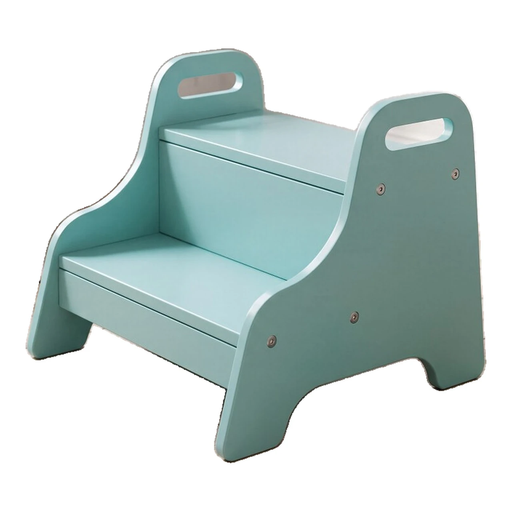
Why This Fits Their Persona: Suitable for households wanting a handled, furniture-style stool for repeated bathroom, kitchen and study use.
The wide pedal and integrated side handles are specified to provide support, while the mortise-and-tenon structure is reinforced with screws.
High-density board construction; water-based painted finish; wide step with handles.
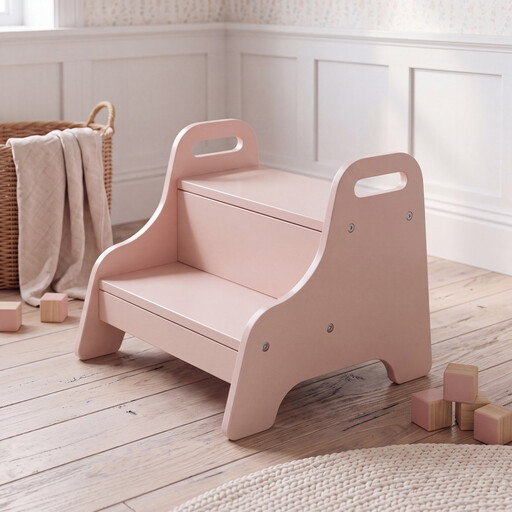
Why This Fits Their Persona: A practical choice for families using one stool frequently at a bathroom sink, kitchen worktop or children’s study area.
Its broad pedal and side handles address the narrow-platform problem; assembly can also be checked before regular use.
High-density boards; smooth, burr-free surface; integrated handles and reinforced construction.
We have compiled a complete, real-time list of products that fully satisfy these strict selection criteria and UK safety regulations.
Use this checklist before each new installation:
A toddler may use a stool confidently in the bathroom but still need help in the kitchen, where hot surfaces, knives and appliances create additional hazards.
Age guidance varies by product and should be followed alongside your child’s ability to stand and step steadily. The OKBABY Herbie description states suitability from 18 months and over. Children should always be supervised, even when they appear confident.
Lifespan depends on frequency of use, flooring, cleaning and construction. Inspect it regularly rather than relying on a fixed number of years. A plastic stool may be convenient for frequent wiping, while a board-built model needs particular attention to joints, screws and the painted surface.
It can be useful if the dimensions suit the available floor area. Measure the space in front of the sink and check where the stool will be stored when not in use. A lightweight model is easier to move, while a handled design may be easier for a child to steady themselves beside, provided it remains on a stable surface.