
24/7 Customer Support

Free returns

Same-day & Next-day Delivery

Quality Guaranteed

Unlock Your Welcome Offers: FREE Delivery | Up to 80% OFF | Free 30-day JoyPlus trial
Download the APP
Choosing toddler toys can feel straightforward until you compare age labels, safety information, batteries, dimensions and the amount of space each toy needs. A colourful product may attract attention online, but it may not suit your child’s stage, your home or your preferred style of play.
This guide from the Joybuy Product Recommendation Officer focuses on practical selection rather than marketing language. It covers common buying traps, important specifications and a selection of products for different UK households.
A toy marked “1–3 years” may still require close supervision, floor space or a certain level of balance and coordination. Conversely, some baby toys are suitable from six months but may become less engaging once a child is confidently walking.
Always consider:
Lights, songs and sounds can make musical toys for toddlers appealing, but loud or repetitive audio may become tiring in a small home. Check whether the product has an adjustable volume, mute mode or replaceable batteries.
For example, some activity tables and children’s drum sets include volume controls, while other toys may have no sound adjustment. Batteries can also become an ongoing cost, particularly with frequently used electronic toys.
Large toddler activity toys, rocking horses and soft play equipment can be useful for active play, but they require a clear, suitable area. Measure doorways, storage spaces and the intended play zone before ordering.
For younger children, easy cleaning matters too. Wipeable foam surfaces or compact activity cubes may be more manageable than toys with many fabric sections or loose accessories.
For babies aged around 6–12 months, look for simple cause-and-effect features, graspable surfaces, visual tracking and tummy-time interaction. Suitable options may include sensory toys for babies, activity cubes and rolling toys.
For children aged 12–18 months, toys that support standing, pushing, sorting, stacking and early imaginative play can be considered. From 18 months onwards, children may show more interest in educational toys for toddlers, pretend play and larger construction pieces.
Products labelled for toys for 1 to 3 year olds should still be checked for specific warnings. A three-year age limit may relate to small parts, rather than the toy’s overall complexity.
Look for clearly stated information about:
A safety standard is not a substitute for supervision. Inspect toys regularly for loose parts, damaged seams, cracked plastic or worn surfaces. Batteries, particularly button batteries, should be kept away from children and replaced or disposed of carefully.
Rocking toys need enough clearance for movement and should be used according to the stated age and weight limit. The HOMCOM rocking lion, for instance, is listed for 18–36 months with a 40 kg maximum load, while the Le Toy Van wooden rocking products list a 50 kg maximum capacity.
Soft play sets should be used indoors on a suitable surface and checked regularly. The six-piece HOMCOM set has wipeable surfaces, a 60 kg maximum load and separate warnings about adult supervision and damage checks.
The following options are matched to different households and use cases. Product suitability should always be confirmed against your child’s age, abilities and the latest listing information.
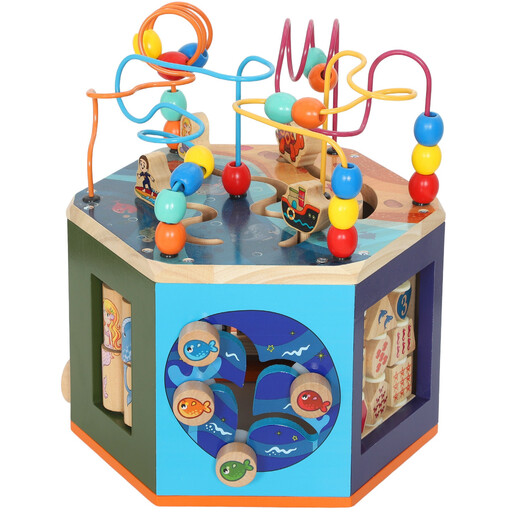
Why This Fits Their Persona: A compact choice for flats, nurseries or grandparents’ homes, with several activities in one unit for children aged 18 months and over.
It avoids relying on electronic effects alone, offering bead movement, number learning, pattern matching and sorting activities.
Measures 28 x 26.2 x 32 cm; listed with smooth edges, EN71-1-2-3 information and an 18-month-plus recommendation.
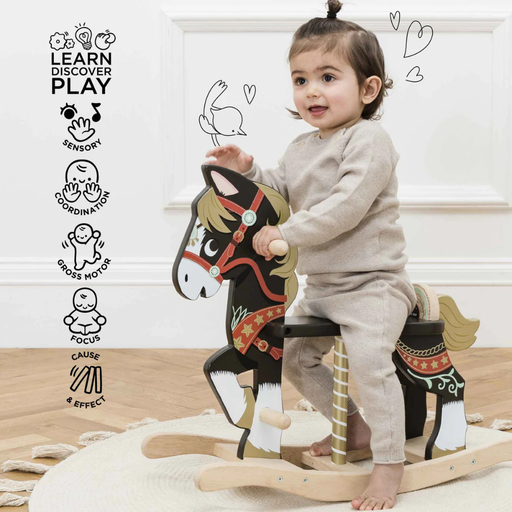
Why This Fits Their Persona: A traditional nursery or playroom option for families seeking a non-battery toy with a decorative wooden finish.
It has no battery requirement, so there are no recurring battery purchases or electronic controls to manage.
Made from rubberwood and plywood; suitable from 12 months and listed with a 50 kg maximum capacity.
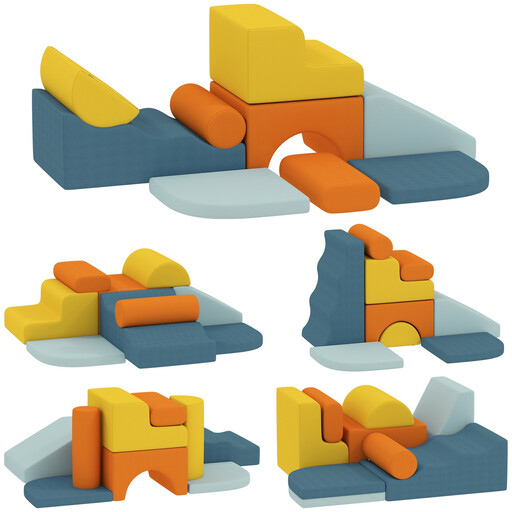
Why This Fits Their Persona: Designed for active indoor play in a playroom, nursery or spacious living area, especially for toddlers who enjoy climbing and crawling.
Its dimensions and 60 kg maximum load are stated clearly, while wipeable surfaces address the cleaning problem common with active play equipment.
Six stackable foam blocks support climbing, crawling and rearranging; listed for ages 1–3 with EN71-1-2-3 information.
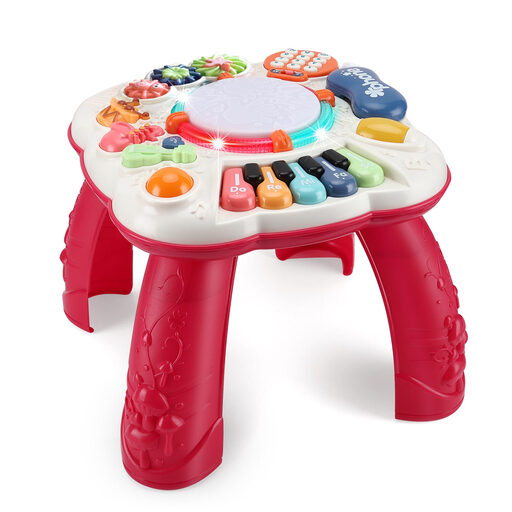
Why This Fits Their Persona: A multifunction option for families wanting piano keys, a drum, gears and pretend-play controls in one compact table.
The listing specifies adjustable volume and removable legs, making it easier to adapt between floor play and standing play.
Six play zones, a stated 6–36-month age range and BPA-free ABS material information; batteries are not included.
We have compiled a complete, real-time list of products that fully satisfy these strict selection criteria and UK safety regulations.
For birthday gifts for toddlers, choose an item that fits the child’s current abilities rather than selecting solely by appearance. A compact activity cube may be more useful in a smaller home, while a rocking horse or soft play set may suit families with dedicated indoor space.
The main ongoing cost is usually batteries. Check whether batteries are included, the type required and whether the toy has an adjustable volume or mute setting. Non-electronic wooden toys and foam play sets avoid battery costs but may require more floor space or occasional surface care.
Lifespan depends on construction, frequency of use, storage and whether the toy matches the child’s age. Toys with open-ended functions, such as stacking blocks, activity cubes and wooden play products, may remain useful across several stages. Always stop using a product if it becomes damaged or develops loose parts.