Carers of toddlers under 2
Fat content matters at this age: the NHS recommends full-fat yoghurt and fromage frais up to age 2. Check the particular pot or tub rather than relying on its child-focused branding.


For a toddler under 2, check that the yoghurt meets NHS advice on full-fat dairy before choosing between individual pots and a larger family tub. Pots offer ready-made portions, while a shared tub lets you serve the amount needed; with either format, compare the exact pack’s ingredients, sugars and milk declaration.
Fat content matters at this age: the NHS recommends full-fat yoghurt and fromage frais up to age 2. Check the particular pot or tub rather than relying on its child-focused branding.
A fruit-flavoured child pot may contain added sugar. Compare its ingredients and nutrition panel with a plain or no-added-sugar option before choosing a breakfast yoghurt.
Individual pots avoid portioning from a shared tub each morning. A larger tub may suit a household serving yoghurt to several people, provided it can be stored and used as directed on its label.
Check age and ingredients before choosing a pack format: a child-sized pot is not, by itself, a guarantee that its fat content or sweetness suits your breakfast plans.
| Priority | What to check | Your needs |
|---|---|---|
| Fat content | Read the fat declaration on the exact pack. The NHS recommends full-fat yoghurt and fromage frais up to age 2; names such as “plain” or “Greek style” do not state the fat level. | For a child under 2, I want a yoghurt that fits the NHS full-fat recommendation. |
| Sugars and ingredients | Check whether “no added sugar” appears on that product and flavour. Compare sugars per 100g and per pot, alongside ingredients such as added sugar or sweetened fruit preparations. | I would rather compare what is in a flavoured pot with a plain or no-added-sugar option than decide from the fruit pictured on the pack. |
| Milk allergen | Read the allergen and ingredient declarations every time. The NHS identifies cow’s milk as a possible allergen for babies and young children. | If my child has a known or suspected cow’s-milk allergy, I need to check suitability with their healthcare professional rather than substitute an ordinary dairy yoghurt. |
| Portions and storage | Compare the number and size of pots with the servings your household will use. For a shared tub, follow its refrigeration and after-opening instructions. | Ready-portioned pots suit a rushed morning; if several of us eat yoghurt, I may prefer to serve it from one tub. |
The NHS recommends full-fat yoghurt up to age 2, so a lighter-sounding name is not a useful substitute for checking fat content.
Use the child’s age and the exact pack’s nutrition information to make the choice.
Tesco Groceries lists sugar among the ingredients of Onken Kids Raspberry & Banana Yoghurt, despite its fruit content.
Compare the ingredients and sugars per 100g and per serving. Check any no-added-sugar wording on the particular flavour you intend to buy.
The NHS identifies cow’s milk as a food that can trigger allergic reactions in young children.
For a child with a known or suspected cow’s-milk allergy, check every product label and follow their healthcare professional’s advice.
A shared tub still needs to be stored and used according to its own label after opening.
Choose a size your household can serve within those instructions, or consider individual pots for separate breakfasts.
An unfinished tub may lead to food waste if it cannot be used within the labelled period.
These ranges illustrate different pack formats; a brand name alone does not establish the fat content, ingredients or suitability of a particular yoghurt.
Its Little Yeos range includes child-sized multipacks. Yeo Valley describes a no-added-sugar range made with 100% organic ingredients.
Tesco Groceries lists Onken Kids Raspberry & Banana Yoghurt as four 90g pots.
Its grocery listings provide examples of children’s yoghurt pots and standard multipack formats.
Tesco Groceries lists Müller Corner products among its standard yoghurt multipacks.
Tesco Groceries lists an Activia Strawberry Gut Health Yoghurt four-pack of 115g pots.
Tesco Groceries lists a 450g low-fat fig-and-honey yoghurt, illustrating a larger-pot format rather than a child-sized multipack.
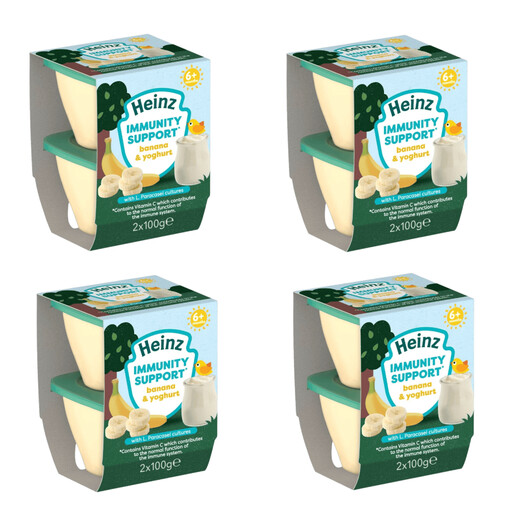
This eight-pot Heinz bundle offers individual portions. Its 6+ months age label does not replace checking fat content against NHS guidance for a toddler under 2.
 No image available
Four twin-packs provide eight individual 100g pots for portioned use. Before choosing them for a toddler’s breakfast, check the pack’s fat content, sugars, ingredients and milk declaration; the 6+ months label alone does not answer those questions.
Yes: the NHS recommends full-fat yoghurt and fromage frais up to age 2. Check the fat content of the exact product, including yoghurt sold in child-sized pots.
No. Tesco Groceries lists added sugar in Onken Kids Raspberry & Banana Yoghurt, alongside fruit. Read the ingredients and nutrition panel on the particular flavour you are considering.
Do not assume an ordinary dairy yoghurt is suitable. The NHS identifies cow’s milk as an allergen; check the product label and follow advice from the child’s healthcare professional for their circumstances.
Yes. NHS toddler meal ideas include plain, unsweetened yoghurt alongside other foods. Check the yoghurt against the child’s age and dietary needs rather than relying on its pack format.
Follow the refrigeration and after-opening instructions on that tub. Choose a size your household can use within the period stated on its label.