For a toddler under 2, start by comparing small pots of full-fat plain or unsweetened yoghurt: NHS guidance recommends full-fat yoghurt for this age group and identifies plain or unsweetened yoghurt as a good choice. For a nursery lunchbox, also check the pack’s storage directions, whether the nursery refrigerates food, and its allergy policy; dairy yoghurt is not suitable for a child with a milk allergy.
Who is this choice for?
Carers of toddlers under 2
NHS guidance recommends full-fat yoghurt and fromage frais up to age 2. If you are choosing an everyday snack, compare plain or unsweetened pots with flavoured and fat-free recipes rather than relying on a child-focused pack design.
Parents packing nursery lunchboxes
Individual pots are straightforward to portion, but they need a spoon and a plan for keeping them cool. The NHS advises an insulated lunchbox with an ice pack if lunchboxes are not refrigerated at nursery.
Carers checking allergies and nursery rules
The Food Standards Agency identifies milk as an allergen commonly present in yoghurt. Check the current label and the nursery’s food policy before packing a pot, and tell nursery staff about a child’s food allergy.
What should you check?
Start with the child’s age and the recipe, then check whether the portion can be stored and served under the nursery’s arrangements.
| Priority | What to check | Your needs |
|---|
| Age and fat level |
Read the fat description on the exact pack. For a child under 2, compare it with the NHS recommendation for full-fat yoghurt rather than assuming an adult fat-free product is an equivalent choice. |
For my toddler under 2, I want a pot that fits the NHS full-fat guidance, not one chosen simply because it is labelled low-calorie. |
| Ingredients and sugars |
Compare plain or unsweetened recipes with flavoured ones. Read both the ingredients and sugars per 100g: total sugars alone do not tell you whether sugar was added. |
If avoiding added sugar matters to me, a children’s label or fruit flavour is not enough; I want to know what is in this recipe. |
| Pot and storage |
Check the pot size, pack storage directions and whether a spoon is needed. Ask whether the nursery refrigerates lunchboxes; the NHS advises an insulated box with an ice pack if it does not. |
I need a portion that is practical to pack and can stay cool until my child’s snack time. |
| Milk and nursery rules |
Check the current allergen statement and ask about the nursery’s food policy. For a child with a milk allergy, do not substitute another dairy yoghurt; check any proposed alternative against the child’s allergy plan. |
Before sending a new pot, I need to know that its ingredients and the nursery’s rules allow it. |
Common buying mistakes
-
Choosing fat-free adult yoghurt for a toddler under 2
A no-added-sugar claim does not address fat level. The NHS recommends full-fat yoghurt and fromage frais up to age 2, so an adult fat-free multipack is not the default match for that age group.
Check the exact pack’s fat description and start your comparison with full-fat plain or unsweetened pots.
-
Assuming every children’s yoghurt has no added sugar
Recipes differ: Onken lists sugar in its Kids Raspberry & Banana yoghurt, while Yeo Valley Organic describes its Little Yeos Greek Style Natural recipe as having no added sugar. Total sugars and added sugar are not the same measure.
Read the ingredients alongside the nutrition information per 100g when comparing pots of different sizes.
-
Packing a chilled pot without checking storage
If nursery lunchboxes are not kept in a fridge, the NHS advises using an insulated box with an ice pack to keep food cool.
Ask the nursery about refrigeration, follow the pot’s storage directions and pack a spoon if needed.
An insulated lunchbox and ice pack may be needed when the nursery does not refrigerate lunchboxes.
-
Overlooking milk allergy or nursery food rules
Yoghurt commonly contains milk, which the Food Standards Agency identifies as an allergen. A suitable-looking portion or recipe does not override a child’s allergy plan or a nursery rule.
Do not send dairy yoghurt for a child with a milk allergy. Check the nursery’s policy and the current allergen label of any alternative.
Brand ranges to compare
These ranges illustrate different recipes and pot formats; compare the particular pack you intend to buy rather than treating a brand name as an age or allergy indication.
Yeo Valley Organic
Little Yeos includes small pots aimed at babies and toddlers, including Greek Style Natural yoghurt.
- Yeo Valley Organic describes its Greek Style Natural recipe as made with organic whole milk and no added sugar.
- It is a milk-containing yoghurt; check the current pack and nursery rules before sending it in a lunchbox.
Onken
Tesco lists Onken Kids Raspberry & Banana as a 4 x 90g multipack.
- The individual pots offer a fruit-flavoured format.
- Onken lists sugar and cow’s milk in this recipe, so check it against your ingredient and allergen requirements.
Tesco
Tesco’s children’s yoghurt listings provide examples of multipacks with different pot counts and sizes.
- Its listings include Onken Kids 4 x 90g and Little Yeos 6 x 42g formats.
- Use the current product label for the final ingredient, nutrition and allergen checks.
Rachel’s Organic
Luscious Fruits Bio-Live Yogurt comes in a 4 x 110g fruit-yoghurt multipack rather than a specifically toddler-labelled format.
- The 110g pots offer a different portion size from smaller children’s pots.
- Rachel’s Organic lists sugar as an ingredient and 12.5g sugars per 100g for this product; it is not equivalent to a plain, unsweetened pot.
Müller
Müller Light Greek Style Strawberry is an adult-oriented, fat-free four-pack.
- Müller describes this recipe as having 0% added sugar.
- The recipe contains aspartame, and its fat-free formulation is not the default match for the NHS full-fat guidance for children under 2.
Activia
Assess an Activia multipack as an individual recipe, not as a toddler-specific range.
- Check its pot size and ingredient list against the snack portion you need.
- Check fat level, allergens and the current label before considering it for a young child.
Joybuy fruit-and-yoghurt pots
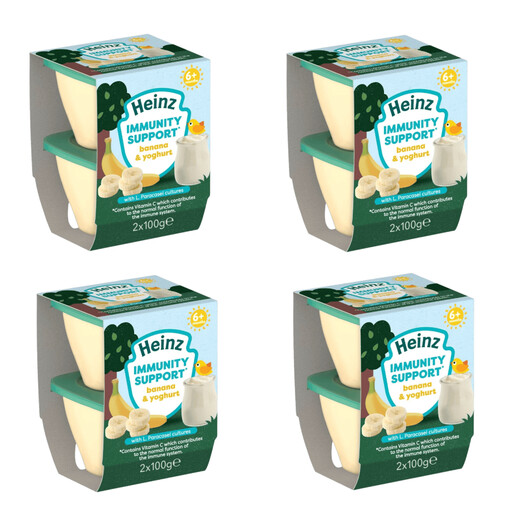
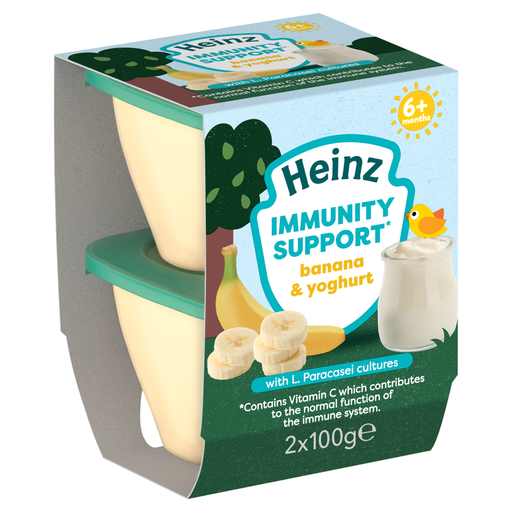
These Heinz banana-and-yoghurt pots offer two pack quantities for a spoon-served fruit snack. Their 6+ months labelling does not by itself establish that the recipe meets the NHS full-fat guidance for a toddler under 2; check the current pack before choosing either format.
 No image available
Heinz Banana & Yoghurt 6+ Months, 8 x 100g pots
Four twin-packs provide eight individual fruit-and-yoghurt pots for spoon-served snacks. The listed fat value is 1.0g per 100g, which does not establish that this is a full-fat yoghurt for an under-2 toddler. It contains milk; check the current label, storage directions and nursery arrangements before packing a pot.
View on Joybuy
 No image available
Heinz Banana & Yoghurt 6+ Months, 2 x 100g pots
This twin-pack provides individual fruit-and-yoghurt pots for spoon-served snacks. The listed fat value is 1.0g per 100g, which does not establish that this is a full-fat yoghurt for an under-2 toddler. It contains milk; check the current label, storage directions and nursery arrangements before packing a pot.
View on Joybuy
Questions about toddler yoghurt
Can I pack a yoghurt pot in a nursery lunchbox?
Yes, if it suits the child and the nursery’s food rules. Pack a spoon and follow the pot’s storage directions; the NHS advises an insulated lunchbox with an ice pack when lunchboxes are not refrigerated at nursery.
Is fat-free yoghurt a suitable default for a toddler under 2?
No. The NHS recommends full-fat yoghurt and fromage frais up to age 2, so check the fat description rather than choosing an adult fat-free multipack on its no-added-sugar claim alone.
Does ‘no added sugar’ mean a yoghurt has no sugars?
No. Yoghurt can contain sugars from milk, and fruit can contribute sugars too. Compare the ingredients with the nutrition information per 100g; a no-added-sugar adult product may also contain sweeteners.
Can a child with a milk allergy take dairy yoghurt to nursery?
No. The Food Standards Agency identifies milk as an allergen commonly found in yoghurt. Tell nursery staff about the allergy, follow the child’s allergy plan and check both the nursery policy and the allergen label of any alternative.
Should I recheck the label when buying a familiar yoghurt?
Yes, particularly when managing a milk allergy or choosing by ingredients, sweeteners or fat level. Check the current pack rather than relying on a previous purchase; Müller also advises checking its product labelling before consumption.


