What should you check before buying?
Decide whether you are buying an occasional sweet or a regular snack, then check the format and the exact product label.
| Priority | What to check | Your needs |
|---|
| Snack role |
Decide whether this is an occasional treat or the regular after-school snack. When comparing packaged snacks, read their nutrition labels. |
I’m choosing a deliberate sweet treat, not replacing the usual snack. For regular after-school snacks, the NHS suggests swapping sweets for options including fruit and vegetables. |
| Pack format |
Check the declared unit count, whether units are separately sealed and their individual weights. A total bag weight or the word “assortment” does not answer those questions. |
Separate portions would make it easier to allocate a treat; a single sharing bag would serve a different purpose. |
| Allergens |
Read the ingredients and any “may contain” statement on the exact current pack. If it will be taken to school, check the school’s allergy policy too. |
I need to check this particular recipe and where the food will be eaten, rather than assume every product in a brand’s range has the same allergen warning. |
| Age warning |
Follow the warning on the specific product. M&S says its Toffee Assortment is unsuitable for children under 36 months because of a potential choking hazard. |
For a younger child, I would check the chosen product’s age warning before offering a chewy or hard sweet. |
Brand and retailer references
These examples show why the exact product and pack format matter; a brand or retailer name alone does not establish individual portions.
Werther’s Original
Its range includes Butter Candies and mixed assortments, which need separate label checks.
- Werther’s Original gives values per 5.2g Butter Candy: 22 kcal and 3.7g sugars per piece.
- Butter Candies list milk and soya; Golden Mix has a precautionary warning for hazelnut, almond, peanut and other nuts. Per-piece values do not establish an individually sealed multipack.
M&S
M&S describes its Toffee Assortment as a 200g pack with several flavours.
- The M&S product information lists ingredients and nutrition, including 46.9g sugars per 100g.
- The 200g assortment is not established as individually portioned. M&S says it is unsuitable for children under 36 months because of a potential choking hazard.
Sainsbury’s
Sainsbury’s sweets listing includes its Assorted Toffees 200g and Werther’s Original Butter Sweets 135g.
- The listed weights help distinguish the two products.
- Check the exact product label for ingredients, allergens and any individual portion count before choosing either pack.
Tesco
Tesco’s traditional-sweets listing includes Tesco Toffee 175g.
- The listing identifies the product as a 175g toffee bag.
- That total weight does not establish separately sealed portions; check the pack if individual units are important.
Joybuy options for occasional treats
These Toffee Crisp options are chocolate-coated caramel bars and biscuit bars, rather than plain toffee sweets. Check the format of each pack if you want to allocate separate after-school treats.
 No image available
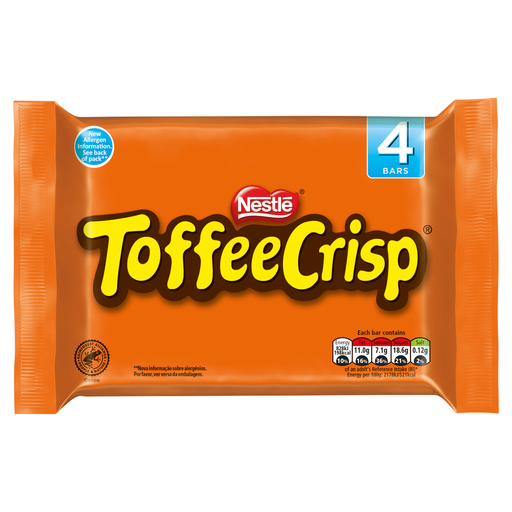
Nestlé Toffee Crisp 4x38g
The 4x38g pack provides four stated units for an occasional treat. These are Toffee Crisp bars rather than plain toffee; check the current allergen and age information, and any school policy, before packing one for a child.
View on Joybuy
 No image available
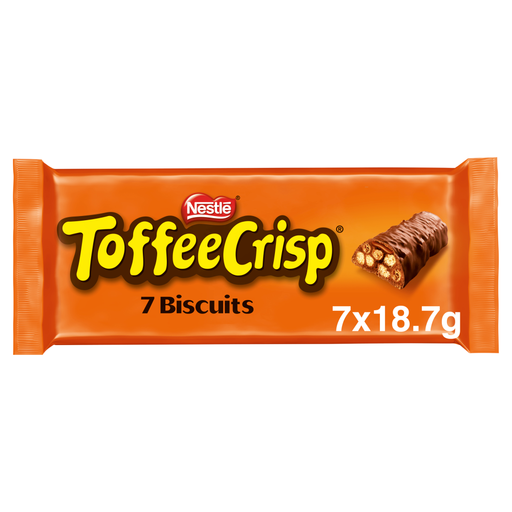
Nestlé Toffee Crisp Biscuits 7Pack
This seven-count biscuit-bar pack is an option when you want countable occasional treats, not traditional plain toffee. If separate sealed portions matter, confirm the wrapping on the pack; also check its current allergen and age information before giving it to a child.
View on Joybuy
Frequently asked questions
Does an England school-food rule prohibit toffee at home after school?
The Department for Education’s school-food guidance concerns food provided in state-funded schools in England, not a parent serving an after-school treat at home. England’s separate less-healthy-food promotion rules concern qualifying retail promotions and placement. If food will be taken into school, check the school’s own arrangements and the rules applicable there.
Can I assume a school is nut-free if a pupil has an allergy?
No. Department for Education guidance for England says schools must publish an allergy safety policy setting out how they reduce contact with known allergens; it does not establish the same food restrictions at every school. Check the relevant school or club policy before sending food in.
Are all Werther’s Original products nut-free?
Do not apply one product’s statement to the whole range. Werther’s Original lists milk and soya in Butter Candies, while Golden Mix says it may contain hazelnut, almond, peanut and other nuts. Read the current label on the exact pack.
How can I tell a multipack from a sharing bag?
Look for a declared unit count, whether each portion is separately sealed and the net weight per unit. A total weight alone does not confirm those details: the M&S, Sainsbury’s and Tesco toffee examples are described by bag or assortment weight.
Is chewy toffee suitable for a toddler?
Follow the warning for the exact product. M&S says its Toffee Assortment is unsuitable for children under 36 months because of a potential choking hazard; that warning should not be silently transferred to every other toffee product.


